
Home
Latin to the Rescue! - How to make sense of English Spelling by learning a bit of Latin
Barnes and Noble
Loading Inventory...
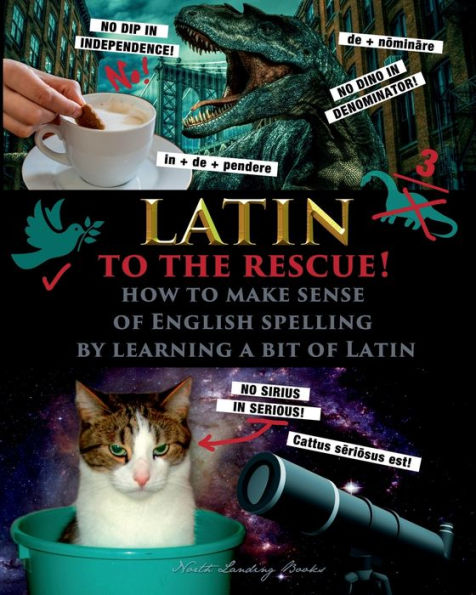
Latin to the Rescue! - How to make sense of English Spelling by learning a bit of Latin in Chattanooga, TN
Current price: $19.99
Barnes and Noble
Latin to the Rescue! - How to make sense of English Spelling by learning a bit of Latin in Chattanooga, TN
Current price: $19.99
Loading Inventory...
Size: OS
This book is a middle schooler's secret weapon designed to grow our kids' spelling skills by engaging their curiosity about word origins and language history. I am a big fan of word study books. They have improved my son's spelling for sure, but as he plowed through the piles of Greek and Latin roots, prefixes and suffixes, I knew something was missing. The missing link was the 'why' - the curiosity factor.
Why is there a silent S in 'island'?
Why 'possess' possesses more S's than 'obsess'?
Why 'derive' has one R, while 'arrive' has two? And are 'derive' and 'arrive', by any chance, related to 'river'?
Why 'prefix' has one F, while 'suffix' has two?
Is there any logic behind all those Ls in 'delusion, ' 'illusion, ' and 'collusion'?
What is the 'scent' in 'crescent, ' 'fluorescent, ' and 'incandescent'?
English is a layered language, its spelling reflecting the history of conquests (Roman, Saxon, Norman) and cultural changes (Christianization, Renaissance, etc.) However, up to 90% of multi-syllable words in English are of Latin origin. Even the most basic knowledge of Latin helps breathe meaning into boring spelling rules.
In this book I introduce the absolute beginner basics of Latin grammar and morphology that explain many features of English spelling. I also offer bits of conversational Latin (just for fun and bragging rights!) and some thematic study of Latin words whose roots produced lots of derivatives in English (body parts, food, house, nature, and personal qualities). All grammar sections are illustrated with classical Latin expressions, sayings and proverbs that are good to know as part of our Western heritage.
This book is easy to use for independent study, as a basis for ELA school projects, or as part of a structured curriculum. I hope that this book will educate and entertain our kids, as well as nurture interest in learning beyond school programs.
Why is there a silent S in 'island'?
Why 'possess' possesses more S's than 'obsess'?
Why 'derive' has one R, while 'arrive' has two? And are 'derive' and 'arrive', by any chance, related to 'river'?
Why 'prefix' has one F, while 'suffix' has two?
Is there any logic behind all those Ls in 'delusion, ' 'illusion, ' and 'collusion'?
What is the 'scent' in 'crescent, ' 'fluorescent, ' and 'incandescent'?
English is a layered language, its spelling reflecting the history of conquests (Roman, Saxon, Norman) and cultural changes (Christianization, Renaissance, etc.) However, up to 90% of multi-syllable words in English are of Latin origin. Even the most basic knowledge of Latin helps breathe meaning into boring spelling rules.
In this book I introduce the absolute beginner basics of Latin grammar and morphology that explain many features of English spelling. I also offer bits of conversational Latin (just for fun and bragging rights!) and some thematic study of Latin words whose roots produced lots of derivatives in English (body parts, food, house, nature, and personal qualities). All grammar sections are illustrated with classical Latin expressions, sayings and proverbs that are good to know as part of our Western heritage.
This book is easy to use for independent study, as a basis for ELA school projects, or as part of a structured curriculum. I hope that this book will educate and entertain our kids, as well as nurture interest in learning beyond school programs.
This book is a middle schooler's secret weapon designed to grow our kids' spelling skills by engaging their curiosity about word origins and language history. I am a big fan of word study books. They have improved my son's spelling for sure, but as he plowed through the piles of Greek and Latin roots, prefixes and suffixes, I knew something was missing. The missing link was the 'why' - the curiosity factor.
Why is there a silent S in 'island'?
Why 'possess' possesses more S's than 'obsess'?
Why 'derive' has one R, while 'arrive' has two? And are 'derive' and 'arrive', by any chance, related to 'river'?
Why 'prefix' has one F, while 'suffix' has two?
Is there any logic behind all those Ls in 'delusion, ' 'illusion, ' and 'collusion'?
What is the 'scent' in 'crescent, ' 'fluorescent, ' and 'incandescent'?
English is a layered language, its spelling reflecting the history of conquests (Roman, Saxon, Norman) and cultural changes (Christianization, Renaissance, etc.) However, up to 90% of multi-syllable words in English are of Latin origin. Even the most basic knowledge of Latin helps breathe meaning into boring spelling rules.
In this book I introduce the absolute beginner basics of Latin grammar and morphology that explain many features of English spelling. I also offer bits of conversational Latin (just for fun and bragging rights!) and some thematic study of Latin words whose roots produced lots of derivatives in English (body parts, food, house, nature, and personal qualities). All grammar sections are illustrated with classical Latin expressions, sayings and proverbs that are good to know as part of our Western heritage.
This book is easy to use for independent study, as a basis for ELA school projects, or as part of a structured curriculum. I hope that this book will educate and entertain our kids, as well as nurture interest in learning beyond school programs.
Why is there a silent S in 'island'?
Why 'possess' possesses more S's than 'obsess'?
Why 'derive' has one R, while 'arrive' has two? And are 'derive' and 'arrive', by any chance, related to 'river'?
Why 'prefix' has one F, while 'suffix' has two?
Is there any logic behind all those Ls in 'delusion, ' 'illusion, ' and 'collusion'?
What is the 'scent' in 'crescent, ' 'fluorescent, ' and 'incandescent'?
English is a layered language, its spelling reflecting the history of conquests (Roman, Saxon, Norman) and cultural changes (Christianization, Renaissance, etc.) However, up to 90% of multi-syllable words in English are of Latin origin. Even the most basic knowledge of Latin helps breathe meaning into boring spelling rules.
In this book I introduce the absolute beginner basics of Latin grammar and morphology that explain many features of English spelling. I also offer bits of conversational Latin (just for fun and bragging rights!) and some thematic study of Latin words whose roots produced lots of derivatives in English (body parts, food, house, nature, and personal qualities). All grammar sections are illustrated with classical Latin expressions, sayings and proverbs that are good to know as part of our Western heritage.
This book is easy to use for independent study, as a basis for ELA school projects, or as part of a structured curriculum. I hope that this book will educate and entertain our kids, as well as nurture interest in learning beyond school programs.
You May Also Like














More About Barnes and Noble at Hamilton Place
Barnes & Noble is the world’s largest retail bookseller and a leading retailer of content, digital media and educational products. Our Nook Digital business offers a lineup of NOOK® tablets and e-Readers and an expansive collection of digital reading content through the NOOK Store®. Barnes & Noble’s mission is to operate the best omni-channel specialty retail business in America, helping both our customers and booksellers reach their aspirations, while being a credit to the communities we serve.
2100 Hamilton Pl Blvd, Chattanooga, TN 37421, United States
Find Barnes and Noble at Hamilton Place in Chattanooga, TN
Visit Barnes and Noble at Hamilton Place in Chattanooga, TN
