
Home
Language and Community in Early England: Imagining Distance in Medieval Literature
Barnes and Noble
Loading Inventory...
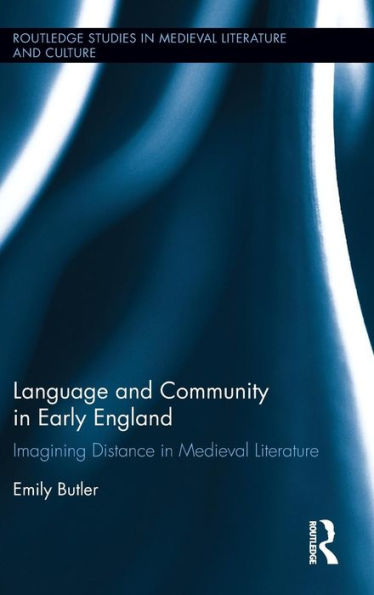
Language and Community in Early England: Imagining Distance in Medieval Literature in Chattanooga, TN
Current price: $190.00
Barnes and Noble
Language and Community in Early England: Imagining Distance in Medieval Literature in Chattanooga, TN
Current price: $190.00
Loading Inventory...
Size: OS
This book examines the development of English as a written vernacular and identifies that development as a process of community building that occurred in a multilingual context. Moving through the eighth century to the thirteenth century, and finally to the sixteenth-century antiquarians who collected medieval manuscripts, it suggests that this important period in the history of English can only be understood if we loosen our insistence on a sharp divide between Old and Middle English and place the textuality of this period in the framework of a multilingual matrix. The book examines a wide range of materials, including the works of Bede, the Alfredian circle, and Wulfstan, as well as the mid-eleventh-century
Encomium Emmae Reginae
, the Tremulous Hand of Worcester, the
Ancrene Wisse
, and Matthew Parker’s study of Old English manuscripts. Engaging foundational theories of textual community and intellectual community, this book provides a crucial link with linguistic distance. Perceptions of distance, whether between English and other languages or between different forms of English, are fundamental to the formation of textual community, since the awareness of shared language that can shape or reinforce a sense of communal identity only has meaning by contrast with other languages or varieties. The book argues that the precocious rise of English as a written vernacular has its basis in precisely these communal negotiations of linguistic distance, the effects of which were still playing out in the religious and political upheavals of the sixteenth century. Ultimately, the book argues that the tension of linguistic distance provides the necessary energy for the community-building activities of annotation and glossing, translation, compilation, and other uses of texts and manuscripts. This will be an important volume for literary scholars of the medieval period, and those working on the early modern period, both on literary topics and on historical studies of English nationalism. It will also appeal to those with interests in sociolinguistics, history of the English language, and medieval religious history.
Encomium Emmae Reginae
, the Tremulous Hand of Worcester, the
Ancrene Wisse
, and Matthew Parker’s study of Old English manuscripts. Engaging foundational theories of textual community and intellectual community, this book provides a crucial link with linguistic distance. Perceptions of distance, whether between English and other languages or between different forms of English, are fundamental to the formation of textual community, since the awareness of shared language that can shape or reinforce a sense of communal identity only has meaning by contrast with other languages or varieties. The book argues that the precocious rise of English as a written vernacular has its basis in precisely these communal negotiations of linguistic distance, the effects of which were still playing out in the religious and political upheavals of the sixteenth century. Ultimately, the book argues that the tension of linguistic distance provides the necessary energy for the community-building activities of annotation and glossing, translation, compilation, and other uses of texts and manuscripts. This will be an important volume for literary scholars of the medieval period, and those working on the early modern period, both on literary topics and on historical studies of English nationalism. It will also appeal to those with interests in sociolinguistics, history of the English language, and medieval religious history.
This book examines the development of English as a written vernacular and identifies that development as a process of community building that occurred in a multilingual context. Moving through the eighth century to the thirteenth century, and finally to the sixteenth-century antiquarians who collected medieval manuscripts, it suggests that this important period in the history of English can only be understood if we loosen our insistence on a sharp divide between Old and Middle English and place the textuality of this period in the framework of a multilingual matrix. The book examines a wide range of materials, including the works of Bede, the Alfredian circle, and Wulfstan, as well as the mid-eleventh-century
Encomium Emmae Reginae
, the Tremulous Hand of Worcester, the
Ancrene Wisse
, and Matthew Parker’s study of Old English manuscripts. Engaging foundational theories of textual community and intellectual community, this book provides a crucial link with linguistic distance. Perceptions of distance, whether between English and other languages or between different forms of English, are fundamental to the formation of textual community, since the awareness of shared language that can shape or reinforce a sense of communal identity only has meaning by contrast with other languages or varieties. The book argues that the precocious rise of English as a written vernacular has its basis in precisely these communal negotiations of linguistic distance, the effects of which were still playing out in the religious and political upheavals of the sixteenth century. Ultimately, the book argues that the tension of linguistic distance provides the necessary energy for the community-building activities of annotation and glossing, translation, compilation, and other uses of texts and manuscripts. This will be an important volume for literary scholars of the medieval period, and those working on the early modern period, both on literary topics and on historical studies of English nationalism. It will also appeal to those with interests in sociolinguistics, history of the English language, and medieval religious history.
Encomium Emmae Reginae
, the Tremulous Hand of Worcester, the
Ancrene Wisse
, and Matthew Parker’s study of Old English manuscripts. Engaging foundational theories of textual community and intellectual community, this book provides a crucial link with linguistic distance. Perceptions of distance, whether between English and other languages or between different forms of English, are fundamental to the formation of textual community, since the awareness of shared language that can shape or reinforce a sense of communal identity only has meaning by contrast with other languages or varieties. The book argues that the precocious rise of English as a written vernacular has its basis in precisely these communal negotiations of linguistic distance, the effects of which were still playing out in the religious and political upheavals of the sixteenth century. Ultimately, the book argues that the tension of linguistic distance provides the necessary energy for the community-building activities of annotation and glossing, translation, compilation, and other uses of texts and manuscripts. This will be an important volume for literary scholars of the medieval period, and those working on the early modern period, both on literary topics and on historical studies of English nationalism. It will also appeal to those with interests in sociolinguistics, history of the English language, and medieval religious history.
You May Also Like







More About Barnes and Noble at Hamilton Place
Barnes & Noble is the world’s largest retail bookseller and a leading retailer of content, digital media and educational products. Our Nook Digital business offers a lineup of NOOK® tablets and e-Readers and an expansive collection of digital reading content through the NOOK Store®. Barnes & Noble’s mission is to operate the best omni-channel specialty retail business in America, helping both our customers and booksellers reach their aspirations, while being a credit to the communities we serve.
2100 Hamilton Pl Blvd, Chattanooga, TN 37421, United States
Find Barnes and Noble at Hamilton Place in Chattanooga, TN
Visit Barnes and Noble at Hamilton Place in Chattanooga, TN
