
Home
Landmarks the History of Science: Great Scientific Discoveries from a Global-Historical Perspective
Barnes and Noble
Loading Inventory...
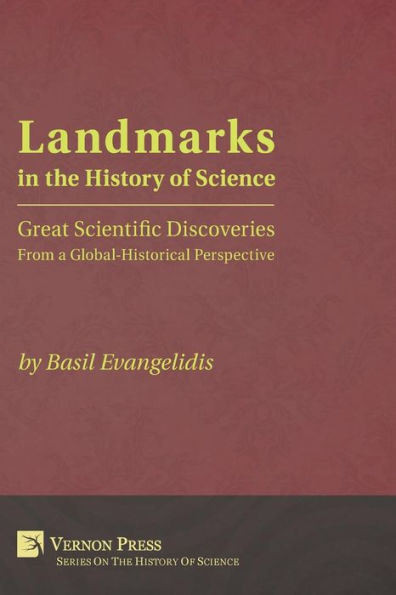
Landmarks the History of Science: Great Scientific Discoveries from a Global-Historical Perspective in Chattanooga, TN
Current price: $61.00
Barnes and Noble
Landmarks the History of Science: Great Scientific Discoveries from a Global-Historical Perspective in Chattanooga, TN
Current price: $61.00
Loading Inventory...
Size: Hardcover
Landmarks in the History of Science is a concise history of science from a global and macro-historical standpoint. It is an account of grand theoretical revolutions, such as heliocentrism, atomism, and relativity. But, more importantly, it is also a story of the methodological transitions to the experimental, mathematical, constructivist and instrumental practices of science. It begins with Ancient Greek science, as one of the first self-conscious, comprehensive and well-documented scientific endeavors at the global level. The numerous contributions of the Greeks, in philosophy, mathematics, geometry, geography and astronomy, momentous as they were, were fruits of leisure rather than industry. It then examines the history of science in China and China's exchanges with India and Islam. A systematic and collaborative scientific effort is the hallmark of Chinese science. The contributions of the Chinese in medicine, printing, manufacturing and navigation invariably predate and outshine those of western contemporaries. Attention then shifts to the age of oceanic discoveries, which created the inexorable presuppositions for the genesis of global trade and a world system. From the inner organs of the organisms to the outer regions of Earth, Renaissance science was ubiquitous. The importance of inter-cultural scientific syncretism is highlighted, with the Iberian Peninsula as meeting point and crossroad of mutual affection between Arab, Jewish and European culture. Discoveries and inventions in metallurgy, electromagnetism and the science of petroleum set the scientific basis for the industrial revolution. The logic of the industrial revolution dictates developments in information technologies that culminate with the invention of modern computers. A dedicated chapter on the history of modern scientific conceptions of the universe showcases the subtle links in the fabric of seminal ideas in physics and astronomy. The book concludes with some reflections on the relationship between philosophy and the history of science. Following Kuhn and Latour, this discussion centers on the characteristics of continuities, ruptures and paradigmatic transitions in science.
Landmarks in the History of Science is a concise history of science from a global and macro-historical standpoint. It is an account of grand theoretical revolutions, such as heliocentrism, atomism, and relativity. But, more importantly, it is also a story of the methodological transitions to the experimental, mathematical, constructivist and instrumental practices of science. It begins with Ancient Greek science, as one of the first self-conscious, comprehensive and well-documented scientific endeavors at the global level. The numerous contributions of the Greeks, in philosophy, mathematics, geometry, geography and astronomy, momentous as they were, were fruits of leisure rather than industry. It then examines the history of science in China and China's exchanges with India and Islam. A systematic and collaborative scientific effort is the hallmark of Chinese science. The contributions of the Chinese in medicine, printing, manufacturing and navigation invariably predate and outshine those of western contemporaries. Attention then shifts to the age of oceanic discoveries, which created the inexorable presuppositions for the genesis of global trade and a world system. From the inner organs of the organisms to the outer regions of Earth, Renaissance science was ubiquitous. The importance of inter-cultural scientific syncretism is highlighted, with the Iberian Peninsula as meeting point and crossroad of mutual affection between Arab, Jewish and European culture. Discoveries and inventions in metallurgy, electromagnetism and the science of petroleum set the scientific basis for the industrial revolution. The logic of the industrial revolution dictates developments in information technologies that culminate with the invention of modern computers. A dedicated chapter on the history of modern scientific conceptions of the universe showcases the subtle links in the fabric of seminal ideas in physics and astronomy. The book concludes with some reflections on the relationship between philosophy and the history of science. Following Kuhn and Latour, this discussion centers on the characteristics of continuities, ruptures and paradigmatic transitions in science.
You May Also Like

















More About Barnes and Noble at Hamilton Place
Barnes & Noble is the world’s largest retail bookseller and a leading retailer of content, digital media and educational products. Our Nook Digital business offers a lineup of NOOK® tablets and e-Readers and an expansive collection of digital reading content through the NOOK Store®. Barnes & Noble’s mission is to operate the best omni-channel specialty retail business in America, helping both our customers and booksellers reach their aspirations, while being a credit to the communities we serve.
2100 Hamilton Pl Blvd, Chattanooga, TN 37421, United States
Find Barnes and Noble at Hamilton Place in Chattanooga, TN
Visit Barnes and Noble at Hamilton Place in Chattanooga, TN
