
Home
Labyrinth of Ruins: Francis Bacon's Encrypted Sonnet Sequence
Barnes and Noble
Loading Inventory...
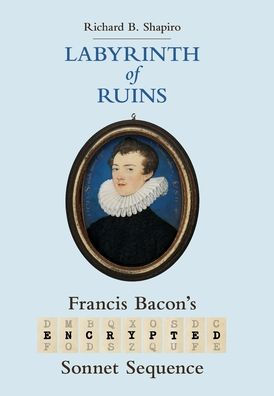
Labyrinth of Ruins: Francis Bacon's Encrypted Sonnet Sequence in Chattanooga, TN
Current price: $53.40
Barnes and Noble
Labyrinth of Ruins: Francis Bacon's Encrypted Sonnet Sequence in Chattanooga, TN
Current price: $53.40
Loading Inventory...
Size: OS
The Hekatompathia (1582), the first English sonnet sequence, surprises its readers with a cryptographic puzzle at a critical juncture in the text. The puzzle's instructions, enumerated in five points, promise that a message can be deciphered using a specific set of published cryptographic tables. This odd, indeed unique, interruption of a poetic text has long baffled critics. Some have dismissed the puzzle as esoterica; one critic argued that the puzzle is unsolvable because its construction is flawed; what no one has previously done is to solve the puzzle. And so, until now, the mystery has remained. However, by applying both cryptographic and literary skills, Labyrinth of Ruins uncovers the solution to this extraordinarily elaborate 7-stage puzzle, in which each stage produces a cryptographic message. Even more surprising, in its grand finale, the seventh stage's cryptographic message reveals that the work's author is not actually he whose name appears on the title page, Thomas Watson, but rather the philosopher, statesman, and harbinger of scientific progress, Francis Bacon. This study's arguments are quantifiable, unlike any matters of literary interpretation or authorship attribution based on the historical record. Indeed, false claims based on a true cryptographic system are difficult to concoct because such systems impose significant constraints. Mathematical techniques are applied to validate the deciphered messages. Solving the Hekatompathia's puzzle not only produces seven messages, but also reorders the sonnet sequence, producing what is, in effect, a new sequence with a different ending. Labyrinth of Ruins, in addition to solving the puzzle, is a critical study of the reordered sequence. The Hekatompathia, in its new order, provides valuable insights into the intellectual history of its day. It reveals much about early modern rhetorical practices, the role of natural philosophy (especially Lucretian cosmology) in Elizabethan poetry, and the structural organization of sonnet sequences. The Hekatompathia's poet, with the decipherer's assistance, has accomplished the unprecedented feat of publishing, what is effectively a new literary work four centuries after his death. Book's website: Hekatompathia.com
The Hekatompathia (1582), the first English sonnet sequence, surprises its readers with a cryptographic puzzle at a critical juncture in the text. The puzzle's instructions, enumerated in five points, promise that a message can be deciphered using a specific set of published cryptographic tables. This odd, indeed unique, interruption of a poetic text has long baffled critics. Some have dismissed the puzzle as esoterica; one critic argued that the puzzle is unsolvable because its construction is flawed; what no one has previously done is to solve the puzzle. And so, until now, the mystery has remained. However, by applying both cryptographic and literary skills, Labyrinth of Ruins uncovers the solution to this extraordinarily elaborate 7-stage puzzle, in which each stage produces a cryptographic message. Even more surprising, in its grand finale, the seventh stage's cryptographic message reveals that the work's author is not actually he whose name appears on the title page, Thomas Watson, but rather the philosopher, statesman, and harbinger of scientific progress, Francis Bacon. This study's arguments are quantifiable, unlike any matters of literary interpretation or authorship attribution based on the historical record. Indeed, false claims based on a true cryptographic system are difficult to concoct because such systems impose significant constraints. Mathematical techniques are applied to validate the deciphered messages. Solving the Hekatompathia's puzzle not only produces seven messages, but also reorders the sonnet sequence, producing what is, in effect, a new sequence with a different ending. Labyrinth of Ruins, in addition to solving the puzzle, is a critical study of the reordered sequence. The Hekatompathia, in its new order, provides valuable insights into the intellectual history of its day. It reveals much about early modern rhetorical practices, the role of natural philosophy (especially Lucretian cosmology) in Elizabethan poetry, and the structural organization of sonnet sequences. The Hekatompathia's poet, with the decipherer's assistance, has accomplished the unprecedented feat of publishing, what is effectively a new literary work four centuries after his death. Book's website: Hekatompathia.com
You May Also Like












More About Barnes and Noble at Hamilton Place
Barnes & Noble is the world’s largest retail bookseller and a leading retailer of content, digital media and educational products. Our Nook Digital business offers a lineup of NOOK® tablets and e-Readers and an expansive collection of digital reading content through the NOOK Store®. Barnes & Noble’s mission is to operate the best omni-channel specialty retail business in America, helping both our customers and booksellers reach their aspirations, while being a credit to the communities we serve.
2100 Hamilton Pl Blvd, Chattanooga, TN 37421, United States
Find Barnes and Noble at Hamilton Place in Chattanooga, TN
Visit Barnes and Noble at Hamilton Place in Chattanooga, TN
