
Home
Jatropha, Challenges for A New Energy Crop: Volume 3: Sustainable Multipurpose Crop
Barnes and Noble
Loading Inventory...
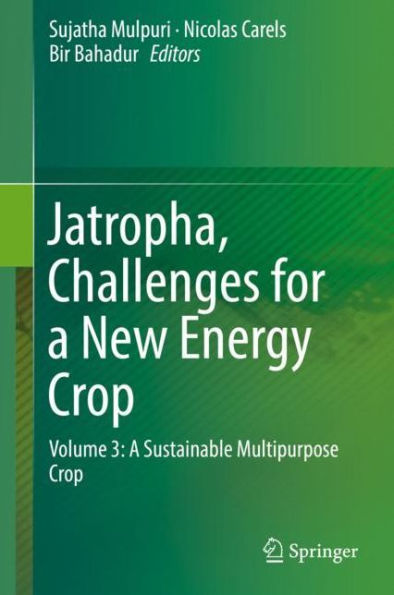
Jatropha, Challenges for A New Energy Crop: Volume 3: Sustainable Multipurpose Crop in Chattanooga, TN
Current price: $169.99
Barnes and Noble
Jatropha, Challenges for A New Energy Crop: Volume 3: Sustainable Multipurpose Crop in Chattanooga, TN
Current price: $169.99
Loading Inventory...
Size: Hardcover
Jatropha curcas
, or physic nut, is a small tree that, in tropical climates, produces fruits with seeds containing ~38% oil. The physic nut has the potential to be highly productive and is amenable to subculture
in vitro
and to genetic modification. It also displays remarkable diversity and is relatively easy to cross hybridize within the genus. Thanks to these promising features,
J. curcas
is emerging as a promising oil crop and is gaining commercial interest among the biofuel research communities. However, as a crop, physic nut has been an economic flop since 2012, because the species was not fully domesticated and the average productivity was less than 2 t/ha, which is below the threshold of profitability.sub7 t/ha could be reached and it is contributing to new markets in some countries. As such, it is important fro research to focus on the physiology and selective breeding of
Jatropha
.
This book provides a positive global update on
, a crop that has suffered despite its promising agronomic and economic potential. The editors have used their collective expertise in agronomy, botany, selective breeding, biotechnology, genomics and bioinformatics to seek out high-quality contributions that address the bottleneck features in order to improve the economic trajectory of physic nut breeding.
, or physic nut, is a small tree that, in tropical climates, produces fruits with seeds containing ~38% oil. The physic nut has the potential to be highly productive and is amenable to subculture
in vitro
and to genetic modification. It also displays remarkable diversity and is relatively easy to cross hybridize within the genus. Thanks to these promising features,
J. curcas
is emerging as a promising oil crop and is gaining commercial interest among the biofuel research communities. However, as a crop, physic nut has been an economic flop since 2012, because the species was not fully domesticated and the average productivity was less than 2 t/ha, which is below the threshold of profitability.sub7 t/ha could be reached and it is contributing to new markets in some countries. As such, it is important fro research to focus on the physiology and selective breeding of
Jatropha
.
This book provides a positive global update on
, a crop that has suffered despite its promising agronomic and economic potential. The editors have used their collective expertise in agronomy, botany, selective breeding, biotechnology, genomics and bioinformatics to seek out high-quality contributions that address the bottleneck features in order to improve the economic trajectory of physic nut breeding.
Jatropha curcas
, or physic nut, is a small tree that, in tropical climates, produces fruits with seeds containing ~38% oil. The physic nut has the potential to be highly productive and is amenable to subculture
in vitro
and to genetic modification. It also displays remarkable diversity and is relatively easy to cross hybridize within the genus. Thanks to these promising features,
J. curcas
is emerging as a promising oil crop and is gaining commercial interest among the biofuel research communities. However, as a crop, physic nut has been an economic flop since 2012, because the species was not fully domesticated and the average productivity was less than 2 t/ha, which is below the threshold of profitability.sub7 t/ha could be reached and it is contributing to new markets in some countries. As such, it is important fro research to focus on the physiology and selective breeding of
Jatropha
.
This book provides a positive global update on
, a crop that has suffered despite its promising agronomic and economic potential. The editors have used their collective expertise in agronomy, botany, selective breeding, biotechnology, genomics and bioinformatics to seek out high-quality contributions that address the bottleneck features in order to improve the economic trajectory of physic nut breeding.
, or physic nut, is a small tree that, in tropical climates, produces fruits with seeds containing ~38% oil. The physic nut has the potential to be highly productive and is amenable to subculture
in vitro
and to genetic modification. It also displays remarkable diversity and is relatively easy to cross hybridize within the genus. Thanks to these promising features,
J. curcas
is emerging as a promising oil crop and is gaining commercial interest among the biofuel research communities. However, as a crop, physic nut has been an economic flop since 2012, because the species was not fully domesticated and the average productivity was less than 2 t/ha, which is below the threshold of profitability.sub7 t/ha could be reached and it is contributing to new markets in some countries. As such, it is important fro research to focus on the physiology and selective breeding of
Jatropha
.
This book provides a positive global update on
, a crop that has suffered despite its promising agronomic and economic potential. The editors have used their collective expertise in agronomy, botany, selective breeding, biotechnology, genomics and bioinformatics to seek out high-quality contributions that address the bottleneck features in order to improve the economic trajectory of physic nut breeding.
You May Also Like
















More About Barnes and Noble at Hamilton Place
Barnes & Noble is the world’s largest retail bookseller and a leading retailer of content, digital media and educational products. Our Nook Digital business offers a lineup of NOOK® tablets and e-Readers and an expansive collection of digital reading content through the NOOK Store®. Barnes & Noble’s mission is to operate the best omni-channel specialty retail business in America, helping both our customers and booksellers reach their aspirations, while being a credit to the communities we serve.
2100 Hamilton Pl Blvd, Chattanooga, TN 37421, United States
Find Barnes and Noble at Hamilton Place in Chattanooga, TN
Visit Barnes and Noble at Hamilton Place in Chattanooga, TN
