
Home
It Will Yet Be Heard: A Polish Rabbi's Witness of the Shoah and Survival
Barnes and Noble
Loading Inventory...
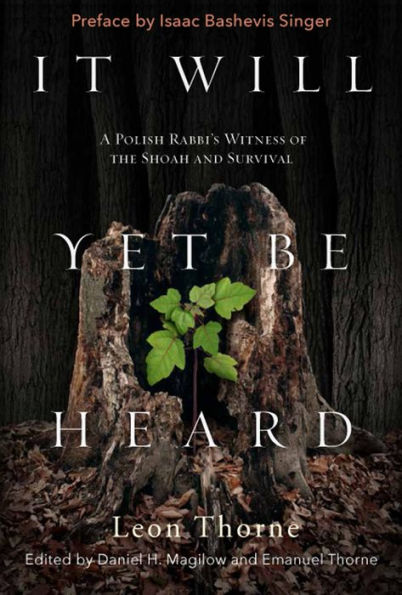
It Will Yet Be Heard: A Polish Rabbi's Witness of the Shoah and Survival in Chattanooga, TN
Current price: $36.95
Barnes and Noble
It Will Yet Be Heard: A Polish Rabbi's Witness of the Shoah and Survival in Chattanooga, TN
Current price: $36.95
Loading Inventory...
Size: Hardcover
Nobel laureate Isaac Bashevis Singer once described Dr. Leon Thorne’s memoir as a work of “bitter truth” that he compared favorably to the works of Tolstoy, Dostoevsky, and Proust. Out of print for over forty years, this lost classic of Holocaust literature now reappears in a revised, annotated edition, including both Thorne’s original 1961 memoir
Out of the Ashes: The Story of a Survivor
and his previously unpublished accounts of his arduous postwar experiences in Germany and Poland.
Rabbi Thorne composed his memoir under extraordinary conditions, confined to a small underground bunker below a Polish peasant’s pigsty. But,
It Will Yet Be Heard
is remarkable not only for the story of its composition, but also for its moral clarity and complexity. A deeply religious man, Rabbi Thorne bore witness to forced labor camps, human degradation, and the murders of entire communities. And once he emerged from hiding, he grappled not only with survivor’s guilt, but also with the lingering antisemitism and anti-Jewish violence in Poland even after the war ended. Harrowing, moving, and deeply insightful, Rabbi Thorne’s firsthand account offers a rediscovered perspective on the twentieth century’s greatest tragedy.
Out of the Ashes: The Story of a Survivor
and his previously unpublished accounts of his arduous postwar experiences in Germany and Poland.
Rabbi Thorne composed his memoir under extraordinary conditions, confined to a small underground bunker below a Polish peasant’s pigsty. But,
It Will Yet Be Heard
is remarkable not only for the story of its composition, but also for its moral clarity and complexity. A deeply religious man, Rabbi Thorne bore witness to forced labor camps, human degradation, and the murders of entire communities. And once he emerged from hiding, he grappled not only with survivor’s guilt, but also with the lingering antisemitism and anti-Jewish violence in Poland even after the war ended. Harrowing, moving, and deeply insightful, Rabbi Thorne’s firsthand account offers a rediscovered perspective on the twentieth century’s greatest tragedy.
Nobel laureate Isaac Bashevis Singer once described Dr. Leon Thorne’s memoir as a work of “bitter truth” that he compared favorably to the works of Tolstoy, Dostoevsky, and Proust. Out of print for over forty years, this lost classic of Holocaust literature now reappears in a revised, annotated edition, including both Thorne’s original 1961 memoir
Out of the Ashes: The Story of a Survivor
and his previously unpublished accounts of his arduous postwar experiences in Germany and Poland.
Rabbi Thorne composed his memoir under extraordinary conditions, confined to a small underground bunker below a Polish peasant’s pigsty. But,
It Will Yet Be Heard
is remarkable not only for the story of its composition, but also for its moral clarity and complexity. A deeply religious man, Rabbi Thorne bore witness to forced labor camps, human degradation, and the murders of entire communities. And once he emerged from hiding, he grappled not only with survivor’s guilt, but also with the lingering antisemitism and anti-Jewish violence in Poland even after the war ended. Harrowing, moving, and deeply insightful, Rabbi Thorne’s firsthand account offers a rediscovered perspective on the twentieth century’s greatest tragedy.
Out of the Ashes: The Story of a Survivor
and his previously unpublished accounts of his arduous postwar experiences in Germany and Poland.
Rabbi Thorne composed his memoir under extraordinary conditions, confined to a small underground bunker below a Polish peasant’s pigsty. But,
It Will Yet Be Heard
is remarkable not only for the story of its composition, but also for its moral clarity and complexity. A deeply religious man, Rabbi Thorne bore witness to forced labor camps, human degradation, and the murders of entire communities. And once he emerged from hiding, he grappled not only with survivor’s guilt, but also with the lingering antisemitism and anti-Jewish violence in Poland even after the war ended. Harrowing, moving, and deeply insightful, Rabbi Thorne’s firsthand account offers a rediscovered perspective on the twentieth century’s greatest tragedy.
You May Also Like














More About Barnes and Noble at Hamilton Place
Barnes & Noble is the world’s largest retail bookseller and a leading retailer of content, digital media and educational products. Our Nook Digital business offers a lineup of NOOK® tablets and e-Readers and an expansive collection of digital reading content through the NOOK Store®. Barnes & Noble’s mission is to operate the best omni-channel specialty retail business in America, helping both our customers and booksellers reach their aspirations, while being a credit to the communities we serve.
2100 Hamilton Pl Blvd, Chattanooga, TN 37421, United States
Find Barnes and Noble at Hamilton Place in Chattanooga, TN
Visit Barnes and Noble at Hamilton Place in Chattanooga, TN
