
Home
Isosurfaces: Geometry, Topology, and Algorithms
Barnes and Noble
Loading Inventory...
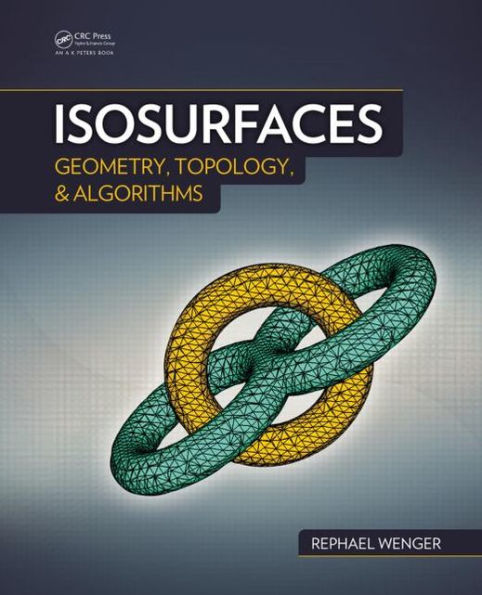
Isosurfaces: Geometry, Topology, and Algorithms in Chattanooga, TN
Current price: $140.00
Barnes and Noble
Isosurfaces: Geometry, Topology, and Algorithms in Chattanooga, TN
Current price: $140.00
Loading Inventory...
Size: Hardcover
Ever since Lorensen and Cline published their paper on the Marching Cubes algorithm, isosurfaces have been a standard technique for the visualization of 3D volumetric data. Yet there is no book exclusively devoted to isosurfaces.
Isosurfaces: Geometry, Topology, and Algorithms
represents the first book to focus on basic algorithms for isosurface construction. It also gives a rigorous mathematical perspective on some of the algorithms and results.
In color throughout, the book covers the Marching Cubes algorithm and variants, dual contouring algorithms, multilinear interpolation, multiresolution isosurface extraction, isosurfaces in four dimensions, interval volumes, and contour trees. It also describes data structures for faster isosurface extraction as well as methods for selecting significant isovalues.
For designers of visualization software, the book presents an organized overview of the various algorithms associated with isosurfaces. For graduate students, it provides a solid introduction to research in this area. For visualization researchers, the book serves as a reference to the vast literature on isosurfaces.
Isosurfaces: Geometry, Topology, and Algorithms
represents the first book to focus on basic algorithms for isosurface construction. It also gives a rigorous mathematical perspective on some of the algorithms and results.
In color throughout, the book covers the Marching Cubes algorithm and variants, dual contouring algorithms, multilinear interpolation, multiresolution isosurface extraction, isosurfaces in four dimensions, interval volumes, and contour trees. It also describes data structures for faster isosurface extraction as well as methods for selecting significant isovalues.
For designers of visualization software, the book presents an organized overview of the various algorithms associated with isosurfaces. For graduate students, it provides a solid introduction to research in this area. For visualization researchers, the book serves as a reference to the vast literature on isosurfaces.
Ever since Lorensen and Cline published their paper on the Marching Cubes algorithm, isosurfaces have been a standard technique for the visualization of 3D volumetric data. Yet there is no book exclusively devoted to isosurfaces.
Isosurfaces: Geometry, Topology, and Algorithms
represents the first book to focus on basic algorithms for isosurface construction. It also gives a rigorous mathematical perspective on some of the algorithms and results.
In color throughout, the book covers the Marching Cubes algorithm and variants, dual contouring algorithms, multilinear interpolation, multiresolution isosurface extraction, isosurfaces in four dimensions, interval volumes, and contour trees. It also describes data structures for faster isosurface extraction as well as methods for selecting significant isovalues.
For designers of visualization software, the book presents an organized overview of the various algorithms associated with isosurfaces. For graduate students, it provides a solid introduction to research in this area. For visualization researchers, the book serves as a reference to the vast literature on isosurfaces.
Isosurfaces: Geometry, Topology, and Algorithms
represents the first book to focus on basic algorithms for isosurface construction. It also gives a rigorous mathematical perspective on some of the algorithms and results.
In color throughout, the book covers the Marching Cubes algorithm and variants, dual contouring algorithms, multilinear interpolation, multiresolution isosurface extraction, isosurfaces in four dimensions, interval volumes, and contour trees. It also describes data structures for faster isosurface extraction as well as methods for selecting significant isovalues.
For designers of visualization software, the book presents an organized overview of the various algorithms associated with isosurfaces. For graduate students, it provides a solid introduction to research in this area. For visualization researchers, the book serves as a reference to the vast literature on isosurfaces.
You May Also Like












More About Barnes and Noble at Hamilton Place
Barnes & Noble is the world’s largest retail bookseller and a leading retailer of content, digital media and educational products. Our Nook Digital business offers a lineup of NOOK® tablets and e-Readers and an expansive collection of digital reading content through the NOOK Store®. Barnes & Noble’s mission is to operate the best omni-channel specialty retail business in America, helping both our customers and booksellers reach their aspirations, while being a credit to the communities we serve.
2100 Hamilton Pl Blvd, Chattanooga, TN 37421, United States
Find Barnes and Noble at Hamilton Place in Chattanooga, TN
Visit Barnes and Noble at Hamilton Place in Chattanooga, TN
