
Home
Impacts of Climate and Human Activities on Water Resources Quality: Integrated Regional Assessment
Barnes and Noble
Loading Inventory...
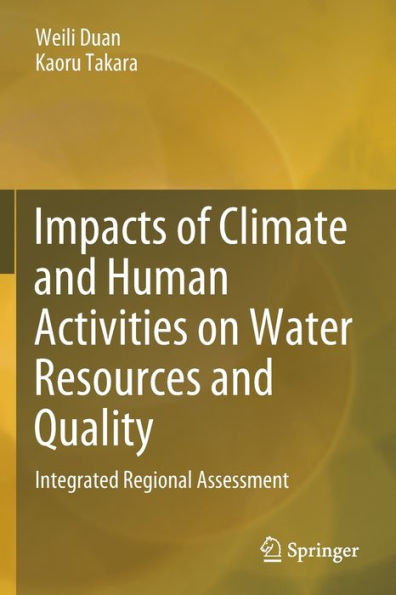
Impacts of Climate and Human Activities on Water Resources Quality: Integrated Regional Assessment in Chattanooga, TN
Current price: $159.99
Barnes and Noble
Impacts of Climate and Human Activities on Water Resources Quality: Integrated Regional Assessment in Chattanooga, TN
Current price: $159.99
Loading Inventory...
Size: Hardcover
With the rapid increase of world population, the global water shortage is set to be the major crises of the twenty-first century; that is, population dynamics (growth, age distribution, urbanization and migration) create pressures on freshwater resources due to the increased water demands and pollution. Moreover, water resources management faces a new uncertainty- i.e. the potential for longer-term and more persistent climate change nowadays, which, in coming years, may significantly affect the availability of supply and patterns of water demand. This book mainly focuses on the impact of climate change and human activities on water quality and water resources in Asia Countries. It begins by describing the characteristics of water related disasters in the world. Then, the book analyzes the changes of floods and associated socio-economic damages for whole China over the last century, and assesses water quality and pollution source for the Yangtze River Basin, suggesting water-related disasters would become more intense, longer lasting, and/or more frequent in a future warmer climate. Then, after investigating spatiotemporal trends and causes of water quality and water quality incidents (Chapter 4) and precipitation extreme events (Chapter 5) in Japan, subsequent two chapters mainly evaluate the climate and human impacts on precipitation variations, water quality and water resources in the Hokkaido area. The final chapter comprehensively analyzes climate change impacts on water resources in the Aral Sea Basin, and then estimate the water requirements and water deficits for irrigation, future agricultural yields of seven major crops, and land and water productivity in four provinces of Turkmenistan considering climate change, population growth, and three socio-economic development scenarios. All results obtained from this book may provide a means to reduce water quality incidents and mitigate future negative impacts by adapting water management. Furthermore, the improved methods for water quality modeling in data scarce regions are transferable to other study areas and applicable in future research.
With the rapid increase of world population, the global water shortage is set to be the major crises of the twenty-first century; that is, population dynamics (growth, age distribution, urbanization and migration) create pressures on freshwater resources due to the increased water demands and pollution. Moreover, water resources management faces a new uncertainty- i.e. the potential for longer-term and more persistent climate change nowadays, which, in coming years, may significantly affect the availability of supply and patterns of water demand. This book mainly focuses on the impact of climate change and human activities on water quality and water resources in Asia Countries. It begins by describing the characteristics of water related disasters in the world. Then, the book analyzes the changes of floods and associated socio-economic damages for whole China over the last century, and assesses water quality and pollution source for the Yangtze River Basin, suggesting water-related disasters would become more intense, longer lasting, and/or more frequent in a future warmer climate. Then, after investigating spatiotemporal trends and causes of water quality and water quality incidents (Chapter 4) and precipitation extreme events (Chapter 5) in Japan, subsequent two chapters mainly evaluate the climate and human impacts on precipitation variations, water quality and water resources in the Hokkaido area. The final chapter comprehensively analyzes climate change impacts on water resources in the Aral Sea Basin, and then estimate the water requirements and water deficits for irrigation, future agricultural yields of seven major crops, and land and water productivity in four provinces of Turkmenistan considering climate change, population growth, and three socio-economic development scenarios. All results obtained from this book may provide a means to reduce water quality incidents and mitigate future negative impacts by adapting water management. Furthermore, the improved methods for water quality modeling in data scarce regions are transferable to other study areas and applicable in future research.
You May Also Like







More About Barnes and Noble at Hamilton Place
Barnes & Noble is the world’s largest retail bookseller and a leading retailer of content, digital media and educational products. Our Nook Digital business offers a lineup of NOOK® tablets and e-Readers and an expansive collection of digital reading content through the NOOK Store®. Barnes & Noble’s mission is to operate the best omni-channel specialty retail business in America, helping both our customers and booksellers reach their aspirations, while being a credit to the communities we serve.
2100 Hamilton Pl Blvd, Chattanooga, TN 37421, United States
Find Barnes and Noble at Hamilton Place in Chattanooga, TN
Visit Barnes and Noble at Hamilton Place in Chattanooga, TN
