
Home
Hemp as an Agricultural Commodity
Barnes and Noble
Loading Inventory...
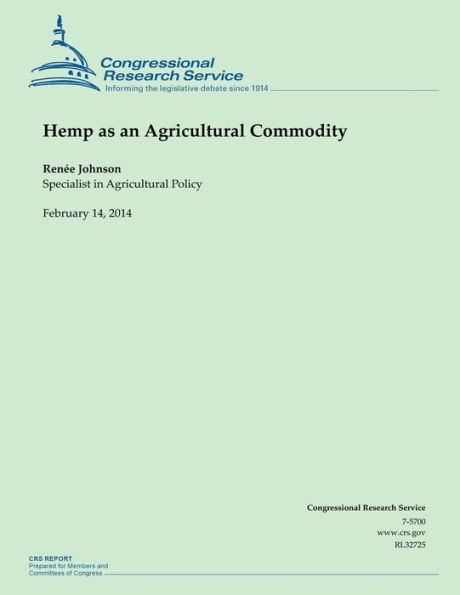
Hemp as an Agricultural Commodity in Chattanooga, TN
Current price: $15.99
Barnes and Noble
Hemp as an Agricultural Commodity in Chattanooga, TN
Current price: $15.99
Loading Inventory...
Size: OS
Industrial hemp is an agricultural commodity that is cultivated for use in the production of a wide range of products, including foods and beverages, cosmetics and personal care products, and nutritional supplements, as well as fabrics and textiles, yarns and spun fibers, paper, construction and insulation materials, and other manufactured goods. Hemp can be grown as a fiber, seed, or other dual-purpose crop. Some estimate that the global market for hemp consists of more than 25,000 products. Precise data are not available on the size of the U.S. market for hemp-based products, but current industry estimates report annual sales at more than $580 million annually. Hemp is a variety of Cannabis sativa and is of the same plant species as marijuana. Although industrial hemp is genetically different and distinguished by its use and chemical makeup, and has long been cultivated for non-drug use in the production of industrial and other goods, in the United States, hemp is subject to U.S. drug laws and growing industrial hemp is restricted. Under current U.S. drug policy all cannabis varieties, including industrial hemp, are considered Schedule I controlled substances under the Controlled Substances Act (CSA, 21 U.S.C. §§801 et seq.; Title 21 CFR Part 1308.11). Despite these legitimate industrial uses, hemp production and usage are controlled and regulated by the U.S. Drug Enforcement Administration (DEA). Strictly speaking, the CSA does not make growing hemp illegal; rather, it places strict controls on its production and enforces standards governing the security conditions under which the crop must be grown, making it illegal to grow without a DEA permit. In other words, a grower needs to get permission from the DEA to grow hemp or faces the possibility of federal charges or property confiscation, regardless of whether the grower has a state-issued permit. Currently, cannabis varieties may be legitimately grown for research purposes only. No known active federal licenses allow for hemp cultivation at this time. There is no large-scale commercial hemp production in the United States, and the U.S. market is largely dependent on imports, both as finished hemp-containing products and as ingredients for use in further processing. More than 30 nations grow industrial hemp as an agricultural commodity, which is sold on the world market. In the early 1990s a sustained resurgence of interest in allowing commercial cultivation of industrial hemp began in the United States. Several states have conducted economic or market studies, and have initiated or passed legislation to expand state-level resources and production. The 113th Congress made significant changes to U.S. policies regarding industrial hemp during the omnibus farm bill debate. The Agricultural Act of 2014 ("farm bill," P.L. 113-79) provided that certain research institutions and state departments of agriculture may grow industrial hemp, as part of an agricultural pilot program, if allowed under state laws where the institution or state department of agriculture is located. The farm bill also established a statutory definition of "industrial hemp" as the plant Cannabis sativa L. and any part of such plant with a delta-9 tetrahydrocannabinol (THC) concentration of not more than 0.3% on a dry weight basis. The enacted FY2015 appropriations (P.L. 113-235) further blocked federal law enforcement authorities from interfering with state agencies, hemp growers, and agricultural research.
Industrial hemp is an agricultural commodity that is cultivated for use in the production of a wide range of products, including foods and beverages, cosmetics and personal care products, and nutritional supplements, as well as fabrics and textiles, yarns and spun fibers, paper, construction and insulation materials, and other manufactured goods. Hemp can be grown as a fiber, seed, or other dual-purpose crop. Some estimate that the global market for hemp consists of more than 25,000 products. Precise data are not available on the size of the U.S. market for hemp-based products, but current industry estimates report annual sales at more than $580 million annually. Hemp is a variety of Cannabis sativa and is of the same plant species as marijuana. Although industrial hemp is genetically different and distinguished by its use and chemical makeup, and has long been cultivated for non-drug use in the production of industrial and other goods, in the United States, hemp is subject to U.S. drug laws and growing industrial hemp is restricted. Under current U.S. drug policy all cannabis varieties, including industrial hemp, are considered Schedule I controlled substances under the Controlled Substances Act (CSA, 21 U.S.C. §§801 et seq.; Title 21 CFR Part 1308.11). Despite these legitimate industrial uses, hemp production and usage are controlled and regulated by the U.S. Drug Enforcement Administration (DEA). Strictly speaking, the CSA does not make growing hemp illegal; rather, it places strict controls on its production and enforces standards governing the security conditions under which the crop must be grown, making it illegal to grow without a DEA permit. In other words, a grower needs to get permission from the DEA to grow hemp or faces the possibility of federal charges or property confiscation, regardless of whether the grower has a state-issued permit. Currently, cannabis varieties may be legitimately grown for research purposes only. No known active federal licenses allow for hemp cultivation at this time. There is no large-scale commercial hemp production in the United States, and the U.S. market is largely dependent on imports, both as finished hemp-containing products and as ingredients for use in further processing. More than 30 nations grow industrial hemp as an agricultural commodity, which is sold on the world market. In the early 1990s a sustained resurgence of interest in allowing commercial cultivation of industrial hemp began in the United States. Several states have conducted economic or market studies, and have initiated or passed legislation to expand state-level resources and production. The 113th Congress made significant changes to U.S. policies regarding industrial hemp during the omnibus farm bill debate. The Agricultural Act of 2014 ("farm bill," P.L. 113-79) provided that certain research institutions and state departments of agriculture may grow industrial hemp, as part of an agricultural pilot program, if allowed under state laws where the institution or state department of agriculture is located. The farm bill also established a statutory definition of "industrial hemp" as the plant Cannabis sativa L. and any part of such plant with a delta-9 tetrahydrocannabinol (THC) concentration of not more than 0.3% on a dry weight basis. The enacted FY2015 appropriations (P.L. 113-235) further blocked federal law enforcement authorities from interfering with state agencies, hemp growers, and agricultural research.
You May Also Like










More About Barnes and Noble at Hamilton Place
Barnes & Noble is the world’s largest retail bookseller and a leading retailer of content, digital media and educational products. Our Nook Digital business offers a lineup of NOOK® tablets and e-Readers and an expansive collection of digital reading content through the NOOK Store®. Barnes & Noble’s mission is to operate the best omni-channel specialty retail business in America, helping both our customers and booksellers reach their aspirations, while being a credit to the communities we serve.
2100 Hamilton Pl Blvd, Chattanooga, TN 37421, United States
Find Barnes and Noble at Hamilton Place in Chattanooga, TN
Visit Barnes and Noble at Hamilton Place in Chattanooga, TN
