
Home
Handbook on Teaching Empirical Software Engineering
Barnes and Noble
Loading Inventory...
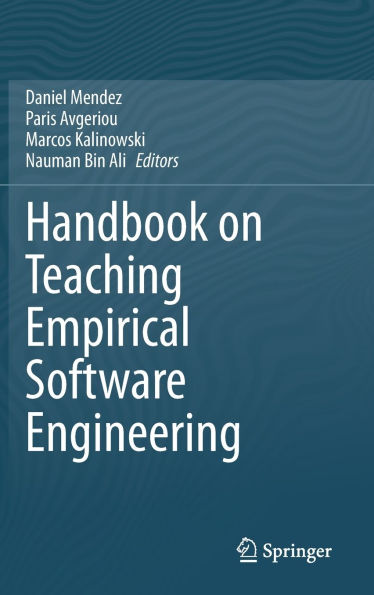
Handbook on Teaching Empirical Software Engineering in Chattanooga, TN
Current price: $249.99
Barnes and Noble
Handbook on Teaching Empirical Software Engineering in Chattanooga, TN
Current price: $249.99
Loading Inventory...
Size: Hardcover
This handbook exploits the profound experience and expertise of well-established scholars in the empirical software engineering community to provide guidance and support in teaching various research methods and fundamental concepts. A particular focus is thus on combining research methods and their epistemological settings and terminology with didactics and pedagogy for the subject. The book covers the most essential contemporary research methods and philosophical and cross-cutting concerns in software engineering research, considering both academic and industrial settings, at the same time providing insights into the effective teaching of concepts and strategies.
To this end, the book is organized into four major parts. In the first part, the editors set the foundation with two chapters; one laying out the larger context of the discipline for a positioning of the remainder of this book, and one guiding the creation of a syllabus for courses in empirical software engineering. The second part of the book lays the fundamentals for teaching empirical software engineering, addressing more cross-cutting aspects from theorizing and teaching research designs to measurement and quantitative data analysis. In the third part, general experiences and personal reflections from teaching empirical software engineering in different settings are shared. Finally, the fourth part contains a number of carefully selected research methods, presented through an educational lens. Next to the chapter contributions themselves that provide a more theoretical perspective and practical advice, readers will find additional material in the form of, for example, slide sets and tools, in an online material section.
The book mainly targets three different audiences: (1) educators teaching empirical software engineering to undergraduate, postgraduate or doctoral students, (2) professional trainers teaching the basic concepts of empirical software engineering to software professionals, and (3) students and trainees attending such courses.
To this end, the book is organized into four major parts. In the first part, the editors set the foundation with two chapters; one laying out the larger context of the discipline for a positioning of the remainder of this book, and one guiding the creation of a syllabus for courses in empirical software engineering. The second part of the book lays the fundamentals for teaching empirical software engineering, addressing more cross-cutting aspects from theorizing and teaching research designs to measurement and quantitative data analysis. In the third part, general experiences and personal reflections from teaching empirical software engineering in different settings are shared. Finally, the fourth part contains a number of carefully selected research methods, presented through an educational lens. Next to the chapter contributions themselves that provide a more theoretical perspective and practical advice, readers will find additional material in the form of, for example, slide sets and tools, in an online material section.
The book mainly targets three different audiences: (1) educators teaching empirical software engineering to undergraduate, postgraduate or doctoral students, (2) professional trainers teaching the basic concepts of empirical software engineering to software professionals, and (3) students and trainees attending such courses.
This handbook exploits the profound experience and expertise of well-established scholars in the empirical software engineering community to provide guidance and support in teaching various research methods and fundamental concepts. A particular focus is thus on combining research methods and their epistemological settings and terminology with didactics and pedagogy for the subject. The book covers the most essential contemporary research methods and philosophical and cross-cutting concerns in software engineering research, considering both academic and industrial settings, at the same time providing insights into the effective teaching of concepts and strategies.
To this end, the book is organized into four major parts. In the first part, the editors set the foundation with two chapters; one laying out the larger context of the discipline for a positioning of the remainder of this book, and one guiding the creation of a syllabus for courses in empirical software engineering. The second part of the book lays the fundamentals for teaching empirical software engineering, addressing more cross-cutting aspects from theorizing and teaching research designs to measurement and quantitative data analysis. In the third part, general experiences and personal reflections from teaching empirical software engineering in different settings are shared. Finally, the fourth part contains a number of carefully selected research methods, presented through an educational lens. Next to the chapter contributions themselves that provide a more theoretical perspective and practical advice, readers will find additional material in the form of, for example, slide sets and tools, in an online material section.
The book mainly targets three different audiences: (1) educators teaching empirical software engineering to undergraduate, postgraduate or doctoral students, (2) professional trainers teaching the basic concepts of empirical software engineering to software professionals, and (3) students and trainees attending such courses.
To this end, the book is organized into four major parts. In the first part, the editors set the foundation with two chapters; one laying out the larger context of the discipline for a positioning of the remainder of this book, and one guiding the creation of a syllabus for courses in empirical software engineering. The second part of the book lays the fundamentals for teaching empirical software engineering, addressing more cross-cutting aspects from theorizing and teaching research designs to measurement and quantitative data analysis. In the third part, general experiences and personal reflections from teaching empirical software engineering in different settings are shared. Finally, the fourth part contains a number of carefully selected research methods, presented through an educational lens. Next to the chapter contributions themselves that provide a more theoretical perspective and practical advice, readers will find additional material in the form of, for example, slide sets and tools, in an online material section.
The book mainly targets three different audiences: (1) educators teaching empirical software engineering to undergraduate, postgraduate or doctoral students, (2) professional trainers teaching the basic concepts of empirical software engineering to software professionals, and (3) students and trainees attending such courses.
You May Also Like










More About Barnes and Noble at Hamilton Place
Barnes & Noble is the world’s largest retail bookseller and a leading retailer of content, digital media and educational products. Our Nook Digital business offers a lineup of NOOK® tablets and e-Readers and an expansive collection of digital reading content through the NOOK Store®. Barnes & Noble’s mission is to operate the best omni-channel specialty retail business in America, helping both our customers and booksellers reach their aspirations, while being a credit to the communities we serve.
2100 Hamilton Pl Blvd, Chattanooga, TN 37421, United States
Find Barnes and Noble at Hamilton Place in Chattanooga, TN
Visit Barnes and Noble at Hamilton Place in Chattanooga, TN
