
Home
Fundamentals of Neuromechanics
Barnes and Noble
Loading Inventory...
Fundamentals of Neuromechanics in Chattanooga, TN
Current price: $99.99
Barnes and Noble
Fundamentals of Neuromechanics in Chattanooga, TN
Current price: $99.99
Loading Inventory...
Size: Hardcover
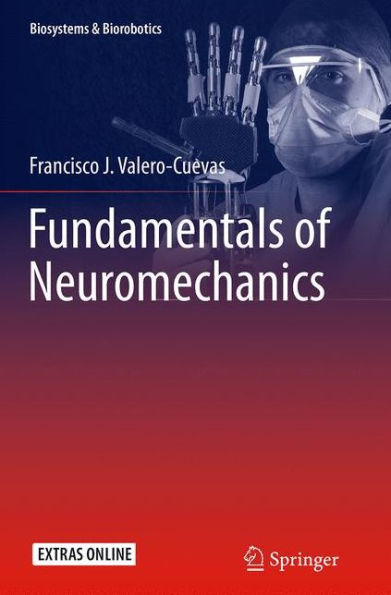
This book provides a conceptual and computational framework to study how the nervous system exploits the anatomical properties of limbs to produce mechanical function. The study of the neural control of limbs has historically emphasized the use of optimization to find solutions to the muscle redundancy problem. That is, how does the nervous system select a specific muscle coordination pattern when the many muscles of a limb allow for multiple solutions?
I revisit this problem from the emerging perspective of neuromechanics that emphasizes finding and implementing families of feasible solutions, instead of a single and unique optimal solution. Those families of feasible solutions emerge naturally from the interactions among the feasible neural commands, anatomy of the limb, and constraints of the task. Such alternative perspective to the neural control of limb function is not only biologically plausible, but sheds light on the most central tenets and debates in the fields of neural control, robotics, rehabilitation, and brain-body co-evolutionary adaptations. This perspective developed from courses I taught to engineers and life scientists at Cornell University and the University of Southern California, and is made possible by combining fundamental concepts from mechanics, anatomy, mathematics, robotics and neuroscience with advances in the field of computational geometry.
Fundamentals of Neuromechanics
is intended for neuroscientists, roboticists, engineers, physicians, evolutionary biologists, athletes, and physical and occupational therapists seeking to advance their understanding of neuromechanics. Therefore, the tone is decidedly pedagogical, engaging, integrative, and practical to make it accessible to people coming from a broad spectrum of disciplines. I attempt to tread the line between making the mathematical exposition accessible to life scientists, and convey the wonder and complexity of neuroscience to engineers and computational scientists. While no one approach can hope to definitively resolve the important questions in these related fields, I hope to provide you with the fundamental background and tools to allow you to contribute to the emerging field of neuromechanics.
I revisit this problem from the emerging perspective of neuromechanics that emphasizes finding and implementing families of feasible solutions, instead of a single and unique optimal solution. Those families of feasible solutions emerge naturally from the interactions among the feasible neural commands, anatomy of the limb, and constraints of the task. Such alternative perspective to the neural control of limb function is not only biologically plausible, but sheds light on the most central tenets and debates in the fields of neural control, robotics, rehabilitation, and brain-body co-evolutionary adaptations. This perspective developed from courses I taught to engineers and life scientists at Cornell University and the University of Southern California, and is made possible by combining fundamental concepts from mechanics, anatomy, mathematics, robotics and neuroscience with advances in the field of computational geometry.
Fundamentals of Neuromechanics
is intended for neuroscientists, roboticists, engineers, physicians, evolutionary biologists, athletes, and physical and occupational therapists seeking to advance their understanding of neuromechanics. Therefore, the tone is decidedly pedagogical, engaging, integrative, and practical to make it accessible to people coming from a broad spectrum of disciplines. I attempt to tread the line between making the mathematical exposition accessible to life scientists, and convey the wonder and complexity of neuroscience to engineers and computational scientists. While no one approach can hope to definitively resolve the important questions in these related fields, I hope to provide you with the fundamental background and tools to allow you to contribute to the emerging field of neuromechanics.
This book provides a conceptual and computational framework to study how the nervous system exploits the anatomical properties of limbs to produce mechanical function. The study of the neural control of limbs has historically emphasized the use of optimization to find solutions to the muscle redundancy problem. That is, how does the nervous system select a specific muscle coordination pattern when the many muscles of a limb allow for multiple solutions?
I revisit this problem from the emerging perspective of neuromechanics that emphasizes finding and implementing families of feasible solutions, instead of a single and unique optimal solution. Those families of feasible solutions emerge naturally from the interactions among the feasible neural commands, anatomy of the limb, and constraints of the task. Such alternative perspective to the neural control of limb function is not only biologically plausible, but sheds light on the most central tenets and debates in the fields of neural control, robotics, rehabilitation, and brain-body co-evolutionary adaptations. This perspective developed from courses I taught to engineers and life scientists at Cornell University and the University of Southern California, and is made possible by combining fundamental concepts from mechanics, anatomy, mathematics, robotics and neuroscience with advances in the field of computational geometry.
Fundamentals of Neuromechanics
is intended for neuroscientists, roboticists, engineers, physicians, evolutionary biologists, athletes, and physical and occupational therapists seeking to advance their understanding of neuromechanics. Therefore, the tone is decidedly pedagogical, engaging, integrative, and practical to make it accessible to people coming from a broad spectrum of disciplines. I attempt to tread the line between making the mathematical exposition accessible to life scientists, and convey the wonder and complexity of neuroscience to engineers and computational scientists. While no one approach can hope to definitively resolve the important questions in these related fields, I hope to provide you with the fundamental background and tools to allow you to contribute to the emerging field of neuromechanics.
I revisit this problem from the emerging perspective of neuromechanics that emphasizes finding and implementing families of feasible solutions, instead of a single and unique optimal solution. Those families of feasible solutions emerge naturally from the interactions among the feasible neural commands, anatomy of the limb, and constraints of the task. Such alternative perspective to the neural control of limb function is not only biologically plausible, but sheds light on the most central tenets and debates in the fields of neural control, robotics, rehabilitation, and brain-body co-evolutionary adaptations. This perspective developed from courses I taught to engineers and life scientists at Cornell University and the University of Southern California, and is made possible by combining fundamental concepts from mechanics, anatomy, mathematics, robotics and neuroscience with advances in the field of computational geometry.
Fundamentals of Neuromechanics
is intended for neuroscientists, roboticists, engineers, physicians, evolutionary biologists, athletes, and physical and occupational therapists seeking to advance their understanding of neuromechanics. Therefore, the tone is decidedly pedagogical, engaging, integrative, and practical to make it accessible to people coming from a broad spectrum of disciplines. I attempt to tread the line between making the mathematical exposition accessible to life scientists, and convey the wonder and complexity of neuroscience to engineers and computational scientists. While no one approach can hope to definitively resolve the important questions in these related fields, I hope to provide you with the fundamental background and tools to allow you to contribute to the emerging field of neuromechanics.
You May Also Like

















More About Barnes and Noble at Hamilton Place
Barnes & Noble is the world’s largest retail bookseller and a leading retailer of content, digital media and educational products. Our Nook Digital business offers a lineup of NOOK® tablets and e-Readers and an expansive collection of digital reading content through the NOOK Store®. Barnes & Noble’s mission is to operate the best omni-channel specialty retail business in America, helping both our customers and booksellers reach their aspirations, while being a credit to the communities we serve.
2100 Hamilton Pl Blvd, Chattanooga, TN 37421, United States
Find Barnes and Noble at Hamilton Place in Chattanooga, TN
Visit Barnes and Noble at Hamilton Place in Chattanooga, TN