
Home
Forty Years of the International Journal Lifelong Education, Volume II: Insights on Published Research
Barnes and Noble
Loading Inventory...
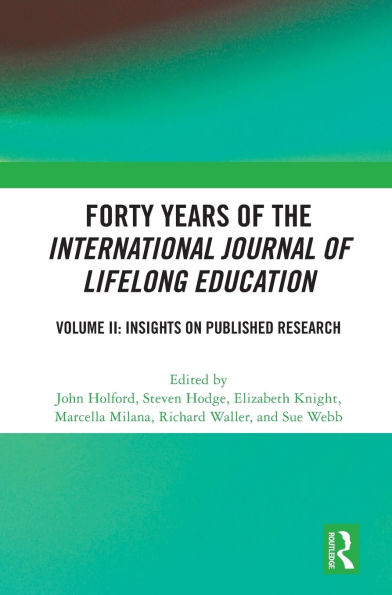
Forty Years of the International Journal Lifelong Education, Volume II: Insights on Published Research in Chattanooga, TN
Current price: $180.00
Barnes and Noble
Forty Years of the International Journal Lifelong Education, Volume II: Insights on Published Research in Chattanooga, TN
Current price: $180.00
Loading Inventory...
Size: Hardcover
Over the last forty years, the
International Journal of Lifelong Education
has become a global leader in the field of research on adult education and lifelong learning. Drawing extensively on articles published in the journal, scholars from Africa, Asia, North and South America, Australasia and Europe reflect in two volumes on how the field has evolved over four decades, and on the strengths and weaknesses of its contributions to knowledge.
The second of two volumes, this book is based on a collective research project, carried out largely by members of the journal’s editorial advisory board, on what it has published over four decades. The introduction explains the origins development of the journal, the sometimes-passionate debates in the wider field, and the approach and concerns of those who conducted this research. Other chapters explore critical areas of debate (citizenship and its learning, learning and work, and widening participation and higher education); ‘political’ and ‘scientific’ dimensions in intergovernmental organisations’ policy work; inequality and lifelong education; opportunities and tensions created in universities by lifelong learning; and the development of studies of learning in later life since the 1980s. Two concluding chapters examine the influence of Paolo Freire and Jack Mezirow.
The two volumes will appeal to researchers, teachers and professionals in lifelong learning and adult education, as well as to those interested in the development of knowledge in fields of science and practice.
International Journal of Lifelong Education
has become a global leader in the field of research on adult education and lifelong learning. Drawing extensively on articles published in the journal, scholars from Africa, Asia, North and South America, Australasia and Europe reflect in two volumes on how the field has evolved over four decades, and on the strengths and weaknesses of its contributions to knowledge.
The second of two volumes, this book is based on a collective research project, carried out largely by members of the journal’s editorial advisory board, on what it has published over four decades. The introduction explains the origins development of the journal, the sometimes-passionate debates in the wider field, and the approach and concerns of those who conducted this research. Other chapters explore critical areas of debate (citizenship and its learning, learning and work, and widening participation and higher education); ‘political’ and ‘scientific’ dimensions in intergovernmental organisations’ policy work; inequality and lifelong education; opportunities and tensions created in universities by lifelong learning; and the development of studies of learning in later life since the 1980s. Two concluding chapters examine the influence of Paolo Freire and Jack Mezirow.
The two volumes will appeal to researchers, teachers and professionals in lifelong learning and adult education, as well as to those interested in the development of knowledge in fields of science and practice.
Over the last forty years, the
International Journal of Lifelong Education
has become a global leader in the field of research on adult education and lifelong learning. Drawing extensively on articles published in the journal, scholars from Africa, Asia, North and South America, Australasia and Europe reflect in two volumes on how the field has evolved over four decades, and on the strengths and weaknesses of its contributions to knowledge.
The second of two volumes, this book is based on a collective research project, carried out largely by members of the journal’s editorial advisory board, on what it has published over four decades. The introduction explains the origins development of the journal, the sometimes-passionate debates in the wider field, and the approach and concerns of those who conducted this research. Other chapters explore critical areas of debate (citizenship and its learning, learning and work, and widening participation and higher education); ‘political’ and ‘scientific’ dimensions in intergovernmental organisations’ policy work; inequality and lifelong education; opportunities and tensions created in universities by lifelong learning; and the development of studies of learning in later life since the 1980s. Two concluding chapters examine the influence of Paolo Freire and Jack Mezirow.
The two volumes will appeal to researchers, teachers and professionals in lifelong learning and adult education, as well as to those interested in the development of knowledge in fields of science and practice.
International Journal of Lifelong Education
has become a global leader in the field of research on adult education and lifelong learning. Drawing extensively on articles published in the journal, scholars from Africa, Asia, North and South America, Australasia and Europe reflect in two volumes on how the field has evolved over four decades, and on the strengths and weaknesses of its contributions to knowledge.
The second of two volumes, this book is based on a collective research project, carried out largely by members of the journal’s editorial advisory board, on what it has published over four decades. The introduction explains the origins development of the journal, the sometimes-passionate debates in the wider field, and the approach and concerns of those who conducted this research. Other chapters explore critical areas of debate (citizenship and its learning, learning and work, and widening participation and higher education); ‘political’ and ‘scientific’ dimensions in intergovernmental organisations’ policy work; inequality and lifelong education; opportunities and tensions created in universities by lifelong learning; and the development of studies of learning in later life since the 1980s. Two concluding chapters examine the influence of Paolo Freire and Jack Mezirow.
The two volumes will appeal to researchers, teachers and professionals in lifelong learning and adult education, as well as to those interested in the development of knowledge in fields of science and practice.
You May Also Like









More About Barnes and Noble at Hamilton Place
Barnes & Noble is the world’s largest retail bookseller and a leading retailer of content, digital media and educational products. Our Nook Digital business offers a lineup of NOOK® tablets and e-Readers and an expansive collection of digital reading content through the NOOK Store®. Barnes & Noble’s mission is to operate the best omni-channel specialty retail business in America, helping both our customers and booksellers reach their aspirations, while being a credit to the communities we serve.
2100 Hamilton Pl Blvd, Chattanooga, TN 37421, United States
Find Barnes and Noble at Hamilton Place in Chattanooga, TN
Visit Barnes and Noble at Hamilton Place in Chattanooga, TN