
Home
Forces and Fields
Barnes and Noble
Loading Inventory...
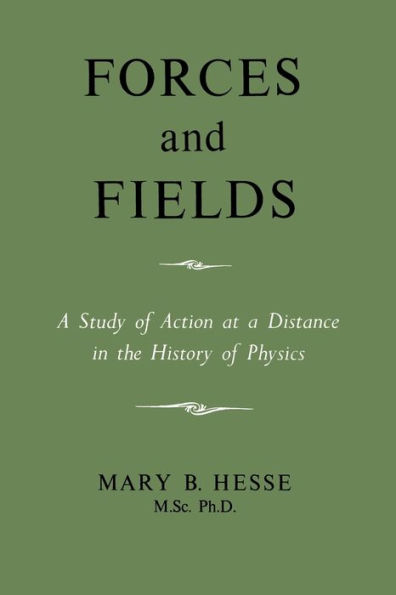
Forces and Fields in Chattanooga, TN
Current price: $16.00
Barnes and Noble
Forces and Fields in Chattanooga, TN
Current price: $16.00
Loading Inventory...
Size: OS
Forces and Fields by Mary Hesse is a history of physics surrounding the question: "How do bodies act on one another across space?" Hesse illustrates this through various answers, discussing period of transition in fundamental physics in which new concepts and ideas have been introduced and made scientifically testable, and makes a certain philosophical interpretation of science from the beginning. Some topics include the logical status of theories, primitive analogies, mechanism in Greek science, the Greek inheritance, Corpuscular Philosophy, The Theory of Gravitation and The Theory of Relativity, as well as others. Mary B. Hesse (born 1924) was a contemporary English philosopher of science. She is now professor emerita of the philosophy of science at Cambridge University. Her publication Models and Analogies in Science is a widely cited and accessible introduction to the topic. Hesse argues, contra Duhem, that models and analogies are integral to understanding scientific practice in general and scientific advancement in particular, especially how the domain of a scientific theory is extended and how theories generate genuinely novel predictions. Examples of such models include the famous billiard ball model of the dynamical theory of gases and models of light based on analogies to sound and water waves. Hesse thinks that, in order help us understand a new system or phenomenon, we will often create an analogical model that compares this new system or phenomenon with a more familiar system or phenomenon. In her book, Hesse makes a distinction between three types of analogues in scientific models: positive analogies, negative analogies, and neutral analogies. Positive analogies are those features which are known or thought to be shared by both systems, negative analogies are those features which are known or thought to be present in one system but absent in the other, and neutral analogies are those features whose status as positive or negative analogies is uncertain at present. Neutral analogies are by far the most interesting of the three types of analogies, for they suggest ways to test the limits of our models, guiding the way for scientific advancement. In the late 19th century, for example, the idea that light-waves have a physical medium called the luminiferous ether would have been best thought of as a neutral analogy with water and sound waves. Eventually, due to a null result in the Michelson-Morley and Trouton-Noble experiments, as well as other similar experiments, this analogy came to be accepted as a negative analogy - we now accept that light has no physical medium, unlike sound and water waves. The discovery of this negative analogy led to further advancement, including the unification of electro-magnetic theory with optics, and the eventual creation of new and more informative models of light.
Forces and Fields by Mary Hesse is a history of physics surrounding the question: "How do bodies act on one another across space?" Hesse illustrates this through various answers, discussing period of transition in fundamental physics in which new concepts and ideas have been introduced and made scientifically testable, and makes a certain philosophical interpretation of science from the beginning. Some topics include the logical status of theories, primitive analogies, mechanism in Greek science, the Greek inheritance, Corpuscular Philosophy, The Theory of Gravitation and The Theory of Relativity, as well as others. Mary B. Hesse (born 1924) was a contemporary English philosopher of science. She is now professor emerita of the philosophy of science at Cambridge University. Her publication Models and Analogies in Science is a widely cited and accessible introduction to the topic. Hesse argues, contra Duhem, that models and analogies are integral to understanding scientific practice in general and scientific advancement in particular, especially how the domain of a scientific theory is extended and how theories generate genuinely novel predictions. Examples of such models include the famous billiard ball model of the dynamical theory of gases and models of light based on analogies to sound and water waves. Hesse thinks that, in order help us understand a new system or phenomenon, we will often create an analogical model that compares this new system or phenomenon with a more familiar system or phenomenon. In her book, Hesse makes a distinction between three types of analogues in scientific models: positive analogies, negative analogies, and neutral analogies. Positive analogies are those features which are known or thought to be shared by both systems, negative analogies are those features which are known or thought to be present in one system but absent in the other, and neutral analogies are those features whose status as positive or negative analogies is uncertain at present. Neutral analogies are by far the most interesting of the three types of analogies, for they suggest ways to test the limits of our models, guiding the way for scientific advancement. In the late 19th century, for example, the idea that light-waves have a physical medium called the luminiferous ether would have been best thought of as a neutral analogy with water and sound waves. Eventually, due to a null result in the Michelson-Morley and Trouton-Noble experiments, as well as other similar experiments, this analogy came to be accepted as a negative analogy - we now accept that light has no physical medium, unlike sound and water waves. The discovery of this negative analogy led to further advancement, including the unification of electro-magnetic theory with optics, and the eventual creation of new and more informative models of light.
You May Also Like
















More About Barnes and Noble at Hamilton Place
Barnes & Noble is the world’s largest retail bookseller and a leading retailer of content, digital media and educational products. Our Nook Digital business offers a lineup of NOOK® tablets and e-Readers and an expansive collection of digital reading content through the NOOK Store®. Barnes & Noble’s mission is to operate the best omni-channel specialty retail business in America, helping both our customers and booksellers reach their aspirations, while being a credit to the communities we serve.
2100 Hamilton Pl Blvd, Chattanooga, TN 37421, United States
Find Barnes and Noble at Hamilton Place in Chattanooga, TN
Visit Barnes and Noble at Hamilton Place in Chattanooga, TN
