
Home
Exploring British Sign Language via Systemic Functional Linguistics: A Metafunctional Approach
Barnes and Noble
Loading Inventory...
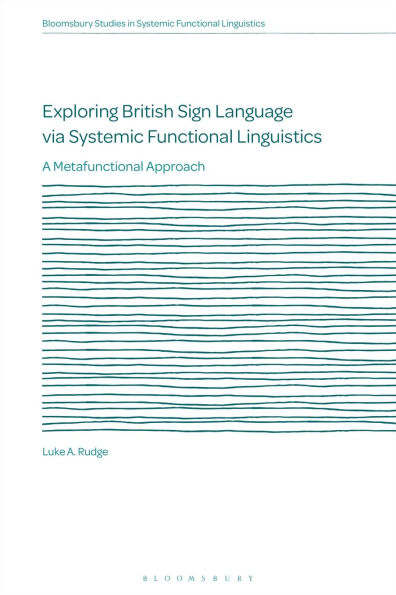
Exploring British Sign Language via Systemic Functional Linguistics: A Metafunctional Approach in Chattanooga, TN
Current price: $135.00
Barnes and Noble
Exploring British Sign Language via Systemic Functional Linguistics: A Metafunctional Approach in Chattanooga, TN
Current price: $135.00
Loading Inventory...
Size: Hardcover
One of many natural sign languages in use around the world, British Sign Language (BSL) operates as a fully-fledged semiotic system in the visual-spatial modality, through the simultaneous use of embodied articulators. Filling a gap in current research, this book investigates visual-spatial communications from a functional perspective.
Presenting a description and analysis of BSL from the perspective of Hallidayan Systemic Functional Linguistics, Luke A. Rudge explores how BSL users make meaning from three different yet interrelated perspectives:
- How exchanges of information are managed at a social level (the interpersonal metafunction)
- How experience is encoded in the language (the experiential metafunction)
- How communications are organised into coherent parts and wholes (the textual metafunction)
Examining these perspectives both separately and together,
Exploring British Sign Language via Systemic Functional Linguistics
places them within the context of current observations in sign linguistics, providing a complementary viewpoint on how visual-spatial communications may be understood as social semiosis.
Presenting a description and analysis of BSL from the perspective of Hallidayan Systemic Functional Linguistics, Luke A. Rudge explores how BSL users make meaning from three different yet interrelated perspectives:
- How exchanges of information are managed at a social level (the interpersonal metafunction)
- How experience is encoded in the language (the experiential metafunction)
- How communications are organised into coherent parts and wholes (the textual metafunction)
Examining these perspectives both separately and together,
Exploring British Sign Language via Systemic Functional Linguistics
places them within the context of current observations in sign linguistics, providing a complementary viewpoint on how visual-spatial communications may be understood as social semiosis.
One of many natural sign languages in use around the world, British Sign Language (BSL) operates as a fully-fledged semiotic system in the visual-spatial modality, through the simultaneous use of embodied articulators. Filling a gap in current research, this book investigates visual-spatial communications from a functional perspective.
Presenting a description and analysis of BSL from the perspective of Hallidayan Systemic Functional Linguistics, Luke A. Rudge explores how BSL users make meaning from three different yet interrelated perspectives:
- How exchanges of information are managed at a social level (the interpersonal metafunction)
- How experience is encoded in the language (the experiential metafunction)
- How communications are organised into coherent parts and wholes (the textual metafunction)
Examining these perspectives both separately and together,
Exploring British Sign Language via Systemic Functional Linguistics
places them within the context of current observations in sign linguistics, providing a complementary viewpoint on how visual-spatial communications may be understood as social semiosis.
Presenting a description and analysis of BSL from the perspective of Hallidayan Systemic Functional Linguistics, Luke A. Rudge explores how BSL users make meaning from three different yet interrelated perspectives:
- How exchanges of information are managed at a social level (the interpersonal metafunction)
- How experience is encoded in the language (the experiential metafunction)
- How communications are organised into coherent parts and wholes (the textual metafunction)
Examining these perspectives both separately and together,
Exploring British Sign Language via Systemic Functional Linguistics
places them within the context of current observations in sign linguistics, providing a complementary viewpoint on how visual-spatial communications may be understood as social semiosis.
You May Also Like















More About Barnes and Noble at Hamilton Place
Barnes & Noble is the world’s largest retail bookseller and a leading retailer of content, digital media and educational products. Our Nook Digital business offers a lineup of NOOK® tablets and e-Readers and an expansive collection of digital reading content through the NOOK Store®. Barnes & Noble’s mission is to operate the best omni-channel specialty retail business in America, helping both our customers and booksellers reach their aspirations, while being a credit to the communities we serve.
2100 Hamilton Pl Blvd, Chattanooga, TN 37421, United States
Find Barnes and Noble at Hamilton Place in Chattanooga, TN
Visit Barnes and Noble at Hamilton Place in Chattanooga, TN
