
Home
Expert Political Judgment: How Good Is It? Can We Know? - New Edition
Barnes and Noble
Loading Inventory...
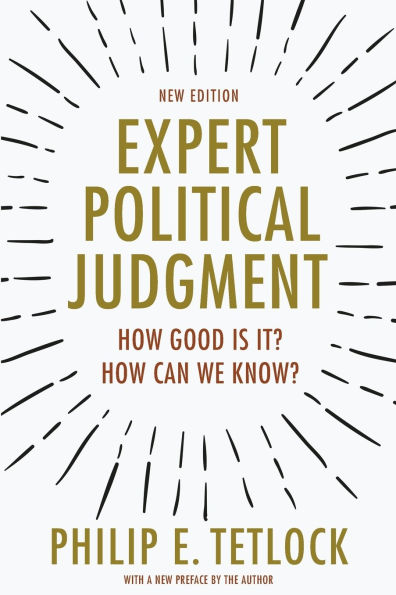
Expert Political Judgment: How Good Is It? Can We Know? - New Edition in Chattanooga, TN
Current price: $125.00
Barnes and Noble
Expert Political Judgment: How Good Is It? Can We Know? - New Edition in Chattanooga, TN
Current price: $125.00
Loading Inventory...
Size: Hardcover
Since its original publication,
Expert Political Judgment
by
New York Times
bestselling author Philip Tetlock has established itself as a contemporary classic in the literature on evaluating expert opinion.
Tetlock first discusses arguments about whether the world is too complex for people to find the tools to understand political phenomena, let alone predict the future. He evaluates predictions from experts in different fields, comparing them to predictions by well-informed laity or those based on simple extrapolation from current trends. He goes on to analyze which styles of thinking are more successful in forecasting. Classifying thinking styles using Isaiah Berlin's prototypes of the fox and the hedgehog, Tetlock contends that the foxthe thinker who knows many little things, draws from an eclectic array of traditions, and is better able to improvise in response to changing eventsis more successful in predicting the future than the hedgehog, who knows one big thing, toils devotedly within one tradition, and imposes formulaic solutions on ill-defined problems. He notes a perversely inverse relationship between the best scientific indicators of good judgement and the qualities that the media most prizes in punditsthe single-minded determination required to prevail in ideological combat.
Clearly written and impeccably researched, the book fills a huge void in the literature on evaluating expert opinion. It will appeal across many academic disciplines as well as to corporations seeking to develop standards for judging expert decision-making. Now with a new preface in which Tetlock discusses the latest research in the field, the book explores what constitutes good judgment in predicting future events and looks at why experts are often wrong in their forecasts.
Expert Political Judgment
by
New York Times
bestselling author Philip Tetlock has established itself as a contemporary classic in the literature on evaluating expert opinion.
Tetlock first discusses arguments about whether the world is too complex for people to find the tools to understand political phenomena, let alone predict the future. He evaluates predictions from experts in different fields, comparing them to predictions by well-informed laity or those based on simple extrapolation from current trends. He goes on to analyze which styles of thinking are more successful in forecasting. Classifying thinking styles using Isaiah Berlin's prototypes of the fox and the hedgehog, Tetlock contends that the foxthe thinker who knows many little things, draws from an eclectic array of traditions, and is better able to improvise in response to changing eventsis more successful in predicting the future than the hedgehog, who knows one big thing, toils devotedly within one tradition, and imposes formulaic solutions on ill-defined problems. He notes a perversely inverse relationship between the best scientific indicators of good judgement and the qualities that the media most prizes in punditsthe single-minded determination required to prevail in ideological combat.
Clearly written and impeccably researched, the book fills a huge void in the literature on evaluating expert opinion. It will appeal across many academic disciplines as well as to corporations seeking to develop standards for judging expert decision-making. Now with a new preface in which Tetlock discusses the latest research in the field, the book explores what constitutes good judgment in predicting future events and looks at why experts are often wrong in their forecasts.
Since its original publication,
Expert Political Judgment
by
New York Times
bestselling author Philip Tetlock has established itself as a contemporary classic in the literature on evaluating expert opinion.
Tetlock first discusses arguments about whether the world is too complex for people to find the tools to understand political phenomena, let alone predict the future. He evaluates predictions from experts in different fields, comparing them to predictions by well-informed laity or those based on simple extrapolation from current trends. He goes on to analyze which styles of thinking are more successful in forecasting. Classifying thinking styles using Isaiah Berlin's prototypes of the fox and the hedgehog, Tetlock contends that the foxthe thinker who knows many little things, draws from an eclectic array of traditions, and is better able to improvise in response to changing eventsis more successful in predicting the future than the hedgehog, who knows one big thing, toils devotedly within one tradition, and imposes formulaic solutions on ill-defined problems. He notes a perversely inverse relationship between the best scientific indicators of good judgement and the qualities that the media most prizes in punditsthe single-minded determination required to prevail in ideological combat.
Clearly written and impeccably researched, the book fills a huge void in the literature on evaluating expert opinion. It will appeal across many academic disciplines as well as to corporations seeking to develop standards for judging expert decision-making. Now with a new preface in which Tetlock discusses the latest research in the field, the book explores what constitutes good judgment in predicting future events and looks at why experts are often wrong in their forecasts.
Expert Political Judgment
by
New York Times
bestselling author Philip Tetlock has established itself as a contemporary classic in the literature on evaluating expert opinion.
Tetlock first discusses arguments about whether the world is too complex for people to find the tools to understand political phenomena, let alone predict the future. He evaluates predictions from experts in different fields, comparing them to predictions by well-informed laity or those based on simple extrapolation from current trends. He goes on to analyze which styles of thinking are more successful in forecasting. Classifying thinking styles using Isaiah Berlin's prototypes of the fox and the hedgehog, Tetlock contends that the foxthe thinker who knows many little things, draws from an eclectic array of traditions, and is better able to improvise in response to changing eventsis more successful in predicting the future than the hedgehog, who knows one big thing, toils devotedly within one tradition, and imposes formulaic solutions on ill-defined problems. He notes a perversely inverse relationship between the best scientific indicators of good judgement and the qualities that the media most prizes in punditsthe single-minded determination required to prevail in ideological combat.
Clearly written and impeccably researched, the book fills a huge void in the literature on evaluating expert opinion. It will appeal across many academic disciplines as well as to corporations seeking to develop standards for judging expert decision-making. Now with a new preface in which Tetlock discusses the latest research in the field, the book explores what constitutes good judgment in predicting future events and looks at why experts are often wrong in their forecasts.
You May Also Like










More About Barnes and Noble at Hamilton Place
Barnes & Noble is the world’s largest retail bookseller and a leading retailer of content, digital media and educational products. Our Nook Digital business offers a lineup of NOOK® tablets and e-Readers and an expansive collection of digital reading content through the NOOK Store®. Barnes & Noble’s mission is to operate the best omni-channel specialty retail business in America, helping both our customers and booksellers reach their aspirations, while being a credit to the communities we serve.
2100 Hamilton Pl Blvd, Chattanooga, TN 37421, United States
Find Barnes and Noble at Hamilton Place in Chattanooga, TN
Visit Barnes and Noble at Hamilton Place in Chattanooga, TN
