
Home
English Interlanguage Morphology: Irregular Verbs Young Austrian EL2 Learners-Psycholinguistic Evidence and Implications for the Classroom
Barnes and Noble
Loading Inventory...
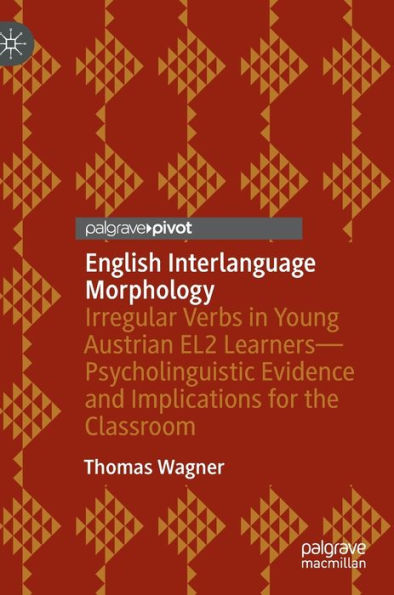
English Interlanguage Morphology: Irregular Verbs Young Austrian EL2 Learners-Psycholinguistic Evidence and Implications for the Classroom in Chattanooga, TN
Current price: $49.99
Barnes and Noble
English Interlanguage Morphology: Irregular Verbs Young Austrian EL2 Learners-Psycholinguistic Evidence and Implications for the Classroom in Chattanooga, TN
Current price: $49.99
Loading Inventory...
Size: Hardcover
This book examines psycholinguistic elements of irregular verb morphology in English, using two empirical studies of young language learners in Austria to make evidence-based didactic recommendations for classroom use. The author first provides an up-to-date overview of the so-called past tense debate, encompassing the last four decades of linguistic, psycholinguistic, and cognitive research, before presenting an in-depth discussion of the notion of irregular and semi-regular verbal morphology in both German and English, with a focus on vowel change and apophony. Turning to his original research, he applies generalised linear mixed model analyses as well as conditional inference trees to the behavioural data, avoiding common pitfalls that come with traditional ANOVAs in repeated measure designs, and discusses the concrete implications of the experimental results on second language acquisition and instructed EFL teaching, with a focus on Input Processing. This book will be essential reading for SLA and applied linguistics researchers as well as graduate and postgraduate students in cognitive linguistics, psycholinguistics, and language acquisition.
This book examines psycholinguistic elements of irregular verb morphology in English, using two empirical studies of young language learners in Austria to make evidence-based didactic recommendations for classroom use. The author first provides an up-to-date overview of the so-called past tense debate, encompassing the last four decades of linguistic, psycholinguistic, and cognitive research, before presenting an in-depth discussion of the notion of irregular and semi-regular verbal morphology in both German and English, with a focus on vowel change and apophony. Turning to his original research, he applies generalised linear mixed model analyses as well as conditional inference trees to the behavioural data, avoiding common pitfalls that come with traditional ANOVAs in repeated measure designs, and discusses the concrete implications of the experimental results on second language acquisition and instructed EFL teaching, with a focus on Input Processing. This book will be essential reading for SLA and applied linguistics researchers as well as graduate and postgraduate students in cognitive linguistics, psycholinguistics, and language acquisition.
You May Also Like












More About Barnes and Noble at Hamilton Place
Barnes & Noble is the world’s largest retail bookseller and a leading retailer of content, digital media and educational products. Our Nook Digital business offers a lineup of NOOK® tablets and e-Readers and an expansive collection of digital reading content through the NOOK Store®. Barnes & Noble’s mission is to operate the best omni-channel specialty retail business in America, helping both our customers and booksellers reach their aspirations, while being a credit to the communities we serve.
2100 Hamilton Pl Blvd, Chattanooga, TN 37421, United States
Find Barnes and Noble at Hamilton Place in Chattanooga, TN
Visit Barnes and Noble at Hamilton Place in Chattanooga, TN
