
Home
Encounters Planning Thought: 16 Autobiographical Essays from Key Thinkers Spatial
Barnes and Noble
Loading Inventory...
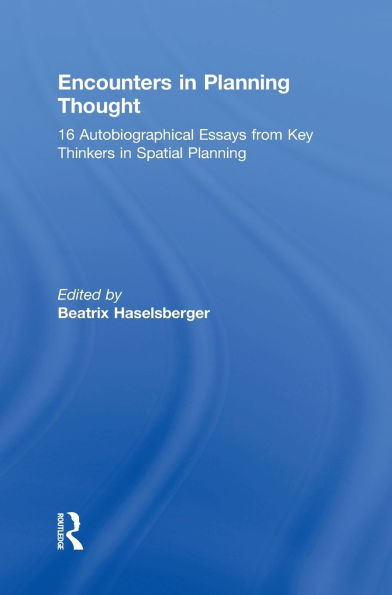
Encounters Planning Thought: 16 Autobiographical Essays from Key Thinkers Spatial in Chattanooga, TN
Current price: $240.00
Barnes and Noble
Encounters Planning Thought: 16 Autobiographical Essays from Key Thinkers Spatial in Chattanooga, TN
Current price: $240.00
Loading Inventory...
Size: Hardcover
Encounters in Planning Thought
builds on the intellectual legacy of spatial planning through essays by leading scholars from around the world, including John Friedmann, Peter Marcuse, Patsy Healey, Andreas Faludi, Judith Innes, Rachelle Alterman and many more. Each author provides a fascinating and inspiring unravelling of his or her own intellectual journey in the context of events, political and economic forces, and prevailing ideas and practices, as well as their own personal lives.
This is crucial reading for those interested in spatial planning, including those studying the theory and history of spatial planning.
sets out a comprehensive, intellectual, institutional and practical agenda for the discipline of spatial planning as it heads towards its next half-century. Together, the essays form a solid base on which to understand the most salient elements to be taken forward by current and future generations of spatial planners.
builds on the intellectual legacy of spatial planning through essays by leading scholars from around the world, including John Friedmann, Peter Marcuse, Patsy Healey, Andreas Faludi, Judith Innes, Rachelle Alterman and many more. Each author provides a fascinating and inspiring unravelling of his or her own intellectual journey in the context of events, political and economic forces, and prevailing ideas and practices, as well as their own personal lives.
This is crucial reading for those interested in spatial planning, including those studying the theory and history of spatial planning.
sets out a comprehensive, intellectual, institutional and practical agenda for the discipline of spatial planning as it heads towards its next half-century. Together, the essays form a solid base on which to understand the most salient elements to be taken forward by current and future generations of spatial planners.
Encounters in Planning Thought
builds on the intellectual legacy of spatial planning through essays by leading scholars from around the world, including John Friedmann, Peter Marcuse, Patsy Healey, Andreas Faludi, Judith Innes, Rachelle Alterman and many more. Each author provides a fascinating and inspiring unravelling of his or her own intellectual journey in the context of events, political and economic forces, and prevailing ideas and practices, as well as their own personal lives.
This is crucial reading for those interested in spatial planning, including those studying the theory and history of spatial planning.
sets out a comprehensive, intellectual, institutional and practical agenda for the discipline of spatial planning as it heads towards its next half-century. Together, the essays form a solid base on which to understand the most salient elements to be taken forward by current and future generations of spatial planners.
builds on the intellectual legacy of spatial planning through essays by leading scholars from around the world, including John Friedmann, Peter Marcuse, Patsy Healey, Andreas Faludi, Judith Innes, Rachelle Alterman and many more. Each author provides a fascinating and inspiring unravelling of his or her own intellectual journey in the context of events, political and economic forces, and prevailing ideas and practices, as well as their own personal lives.
This is crucial reading for those interested in spatial planning, including those studying the theory and history of spatial planning.
sets out a comprehensive, intellectual, institutional and practical agenda for the discipline of spatial planning as it heads towards its next half-century. Together, the essays form a solid base on which to understand the most salient elements to be taken forward by current and future generations of spatial planners.
You May Also Like














More About Barnes and Noble at Hamilton Place
Barnes & Noble is the world’s largest retail bookseller and a leading retailer of content, digital media and educational products. Our Nook Digital business offers a lineup of NOOK® tablets and e-Readers and an expansive collection of digital reading content through the NOOK Store®. Barnes & Noble’s mission is to operate the best omni-channel specialty retail business in America, helping both our customers and booksellers reach their aspirations, while being a credit to the communities we serve.
2100 Hamilton Pl Blvd, Chattanooga, TN 37421, United States
Find Barnes and Noble at Hamilton Place in Chattanooga, TN
Visit Barnes and Noble at Hamilton Place in Chattanooga, TN
