
Home
Enchanted Rendezvous: John C. Houbolt and the Genesis of the Lunar-Orbit Rendezvous Concept
Barnes and Noble
Loading Inventory...
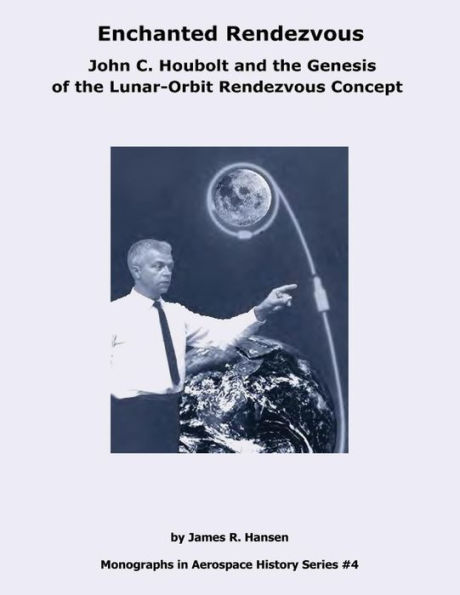
Enchanted Rendezvous: John C. Houbolt and the Genesis of the Lunar-Orbit Rendezvous Concept in Chattanooga, TN
Current price: $15.99
Barnes and Noble
Enchanted Rendezvous: John C. Houbolt and the Genesis of the Lunar-Orbit Rendezvous Concept in Chattanooga, TN
Current price: $15.99
Loading Inventory...
Size: OS
One of the most critical technical decisions made during the conduct of Project Apollo was the method of flying to the Moon, landing on the surface, and returning to Earth. Within NASA during this debate several modes emerged. The one eventually chosen was lunar-orbit rendezvous (LOR), a proposal to send the entire lunar spacecraft up in one launch. It would head to the Moon, enter into orbit, and dispatch a small lander to the lunar surface. It was the simplest of the various methods, both in terms of development and operational costs, but it was risky. Since rendezvous would take place in lunar, instead of Earth, orbit there was no room for error or the crew could not get home. Moreover, some of the trickiest course corrections and maneuvers had to be done after the spacecraft had been committed to a circumlunar flight. Between the time of NASA's conceptualization of the lunar landing program and the decision in favor of LOR in 1962, a debate raged between advocates of the various methods. John C. Houbolt, an engineer at the Langley Research Center in Hampton, Virginia, was one of the most vocal of those supporting LOR and his campaign in 1961 and 1962 helped to shape in a fundamental way the deliberations. This monograph is an important contribution to the study of NASA history in general, and the process of accomplishing a large scale technological program (in this case Apollo) in particular. In many ways, the lunar mode decision was an example of heterogeneous engineering, a process that recognizes that technological issues are also simultaneously organizational, economic, social, and political. Various interests often clash in the decision-making process as difficult calculations have to be made and decisions taken. What perhaps should be suggested is that a complex web or system of ties between various people, institutions, and interests brought forward the lunar-orbit rendezvous mode of going to the Moon in the 1960s.
One of the most critical technical decisions made during the conduct of Project Apollo was the method of flying to the Moon, landing on the surface, and returning to Earth. Within NASA during this debate several modes emerged. The one eventually chosen was lunar-orbit rendezvous (LOR), a proposal to send the entire lunar spacecraft up in one launch. It would head to the Moon, enter into orbit, and dispatch a small lander to the lunar surface. It was the simplest of the various methods, both in terms of development and operational costs, but it was risky. Since rendezvous would take place in lunar, instead of Earth, orbit there was no room for error or the crew could not get home. Moreover, some of the trickiest course corrections and maneuvers had to be done after the spacecraft had been committed to a circumlunar flight. Between the time of NASA's conceptualization of the lunar landing program and the decision in favor of LOR in 1962, a debate raged between advocates of the various methods. John C. Houbolt, an engineer at the Langley Research Center in Hampton, Virginia, was one of the most vocal of those supporting LOR and his campaign in 1961 and 1962 helped to shape in a fundamental way the deliberations. This monograph is an important contribution to the study of NASA history in general, and the process of accomplishing a large scale technological program (in this case Apollo) in particular. In many ways, the lunar mode decision was an example of heterogeneous engineering, a process that recognizes that technological issues are also simultaneously organizational, economic, social, and political. Various interests often clash in the decision-making process as difficult calculations have to be made and decisions taken. What perhaps should be suggested is that a complex web or system of ties between various people, institutions, and interests brought forward the lunar-orbit rendezvous mode of going to the Moon in the 1960s.
You May Also Like









![BORN TO BE [Version C] [Barnes & Noble Exclusive]](https://prodimage.images-bn.com/pimages/0196922726071_p0_v2_s600x595.jpg)








More About Barnes and Noble at Hamilton Place
Barnes & Noble is the world’s largest retail bookseller and a leading retailer of content, digital media and educational products. Our Nook Digital business offers a lineup of NOOK® tablets and e-Readers and an expansive collection of digital reading content through the NOOK Store®. Barnes & Noble’s mission is to operate the best omni-channel specialty retail business in America, helping both our customers and booksellers reach their aspirations, while being a credit to the communities we serve.
2100 Hamilton Pl Blvd, Chattanooga, TN 37421, United States
Find Barnes and Noble at Hamilton Place in Chattanooga, TN
Visit Barnes and Noble at Hamilton Place in Chattanooga, TN