
Home
Emmy Noether's Wonderful Theorem
Barnes and Noble
Loading Inventory...
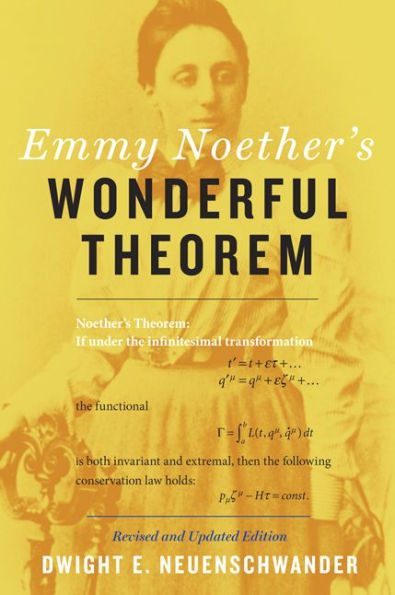
Emmy Noether's Wonderful Theorem in Chattanooga, TN
Current price: $32.95
Barnes and Noble
Emmy Noether's Wonderful Theorem in Chattanooga, TN
Current price: $32.95
Loading Inventory...
Size: Paperback
One of the most important--and beautiful--mathematical solutions ever devised, Noether's theorem touches on every aspect of physics.
"In the judgment of the most competent living mathematicians, Fräulein Noether was the most significant creative mathematical genius thus far produced since the higher education of women began."--Albert Einstein
The year was 1915, and the young mathematician Emmy Noether had just settled into Göttingen University when Albert Einstein visited to lecture on his nearly finished general theory of relativity. Two leading mathematicians of the day, David Hilbert and Felix Klein, dug into the new theory with gusto, but had difficulty reconciling it with what was known about the conservation of energy. Knowing of her expertise in invariance theory, they requested Noether's help. To solve the problem, she developed a novel theorem, applicable across all of physics, which relates conservation laws to continuous symmetries--one of the most important pieces of mathematical reasoning ever developed.
Noether's "first" and "second" theorem was published in 1918. The first theorem relates symmetries under global spacetime transformations to the conservation of energy and momentum, and symmetry under global gauge transformations to charge conservation. In continuum mechanics and field theories, these conservation laws are expressed as equations of continuity. The second theorem, an extension of the first, allows transformations with local gauge invariance, and the equations of continuity acquire the covariant derivative characteristic of coupled matter-field systems. General relativity, it turns out, exhibits local gauge invariance. Noether's theorem also laid the foundation for later generations to apply local gauge invariance to theories of elementary particle interactions.
In Dwight E. Neuenschwander's new edition of
Emmy Noether's Wonderful Theorem
, readers will encounter an updated explanation of Noether's "first" theorem. The discussion of local gauge invariance has been expanded into a detailed presentation of the motivation, proof, and applications of the "second" theorem, including Noether's resolution of concerns about general relativity. Other refinements in the new edition include an enlarged biography of Emmy Noether's life and work, parallels drawn between the present approach and Noether's original 1918 paper, and a summary of the logic behind Noether's theorem.
"In the judgment of the most competent living mathematicians, Fräulein Noether was the most significant creative mathematical genius thus far produced since the higher education of women began."--Albert Einstein
The year was 1915, and the young mathematician Emmy Noether had just settled into Göttingen University when Albert Einstein visited to lecture on his nearly finished general theory of relativity. Two leading mathematicians of the day, David Hilbert and Felix Klein, dug into the new theory with gusto, but had difficulty reconciling it with what was known about the conservation of energy. Knowing of her expertise in invariance theory, they requested Noether's help. To solve the problem, she developed a novel theorem, applicable across all of physics, which relates conservation laws to continuous symmetries--one of the most important pieces of mathematical reasoning ever developed.
Noether's "first" and "second" theorem was published in 1918. The first theorem relates symmetries under global spacetime transformations to the conservation of energy and momentum, and symmetry under global gauge transformations to charge conservation. In continuum mechanics and field theories, these conservation laws are expressed as equations of continuity. The second theorem, an extension of the first, allows transformations with local gauge invariance, and the equations of continuity acquire the covariant derivative characteristic of coupled matter-field systems. General relativity, it turns out, exhibits local gauge invariance. Noether's theorem also laid the foundation for later generations to apply local gauge invariance to theories of elementary particle interactions.
In Dwight E. Neuenschwander's new edition of
Emmy Noether's Wonderful Theorem
, readers will encounter an updated explanation of Noether's "first" theorem. The discussion of local gauge invariance has been expanded into a detailed presentation of the motivation, proof, and applications of the "second" theorem, including Noether's resolution of concerns about general relativity. Other refinements in the new edition include an enlarged biography of Emmy Noether's life and work, parallels drawn between the present approach and Noether's original 1918 paper, and a summary of the logic behind Noether's theorem.
One of the most important--and beautiful--mathematical solutions ever devised, Noether's theorem touches on every aspect of physics.
"In the judgment of the most competent living mathematicians, Fräulein Noether was the most significant creative mathematical genius thus far produced since the higher education of women began."--Albert Einstein
The year was 1915, and the young mathematician Emmy Noether had just settled into Göttingen University when Albert Einstein visited to lecture on his nearly finished general theory of relativity. Two leading mathematicians of the day, David Hilbert and Felix Klein, dug into the new theory with gusto, but had difficulty reconciling it with what was known about the conservation of energy. Knowing of her expertise in invariance theory, they requested Noether's help. To solve the problem, she developed a novel theorem, applicable across all of physics, which relates conservation laws to continuous symmetries--one of the most important pieces of mathematical reasoning ever developed.
Noether's "first" and "second" theorem was published in 1918. The first theorem relates symmetries under global spacetime transformations to the conservation of energy and momentum, and symmetry under global gauge transformations to charge conservation. In continuum mechanics and field theories, these conservation laws are expressed as equations of continuity. The second theorem, an extension of the first, allows transformations with local gauge invariance, and the equations of continuity acquire the covariant derivative characteristic of coupled matter-field systems. General relativity, it turns out, exhibits local gauge invariance. Noether's theorem also laid the foundation for later generations to apply local gauge invariance to theories of elementary particle interactions.
In Dwight E. Neuenschwander's new edition of
Emmy Noether's Wonderful Theorem
, readers will encounter an updated explanation of Noether's "first" theorem. The discussion of local gauge invariance has been expanded into a detailed presentation of the motivation, proof, and applications of the "second" theorem, including Noether's resolution of concerns about general relativity. Other refinements in the new edition include an enlarged biography of Emmy Noether's life and work, parallels drawn between the present approach and Noether's original 1918 paper, and a summary of the logic behind Noether's theorem.
"In the judgment of the most competent living mathematicians, Fräulein Noether was the most significant creative mathematical genius thus far produced since the higher education of women began."--Albert Einstein
The year was 1915, and the young mathematician Emmy Noether had just settled into Göttingen University when Albert Einstein visited to lecture on his nearly finished general theory of relativity. Two leading mathematicians of the day, David Hilbert and Felix Klein, dug into the new theory with gusto, but had difficulty reconciling it with what was known about the conservation of energy. Knowing of her expertise in invariance theory, they requested Noether's help. To solve the problem, she developed a novel theorem, applicable across all of physics, which relates conservation laws to continuous symmetries--one of the most important pieces of mathematical reasoning ever developed.
Noether's "first" and "second" theorem was published in 1918. The first theorem relates symmetries under global spacetime transformations to the conservation of energy and momentum, and symmetry under global gauge transformations to charge conservation. In continuum mechanics and field theories, these conservation laws are expressed as equations of continuity. The second theorem, an extension of the first, allows transformations with local gauge invariance, and the equations of continuity acquire the covariant derivative characteristic of coupled matter-field systems. General relativity, it turns out, exhibits local gauge invariance. Noether's theorem also laid the foundation for later generations to apply local gauge invariance to theories of elementary particle interactions.
In Dwight E. Neuenschwander's new edition of
Emmy Noether's Wonderful Theorem
, readers will encounter an updated explanation of Noether's "first" theorem. The discussion of local gauge invariance has been expanded into a detailed presentation of the motivation, proof, and applications of the "second" theorem, including Noether's resolution of concerns about general relativity. Other refinements in the new edition include an enlarged biography of Emmy Noether's life and work, parallels drawn between the present approach and Noether's original 1918 paper, and a summary of the logic behind Noether's theorem.
You May Also Like















More About Barnes and Noble at Hamilton Place
Barnes & Noble is the world’s largest retail bookseller and a leading retailer of content, digital media and educational products. Our Nook Digital business offers a lineup of NOOK® tablets and e-Readers and an expansive collection of digital reading content through the NOOK Store®. Barnes & Noble’s mission is to operate the best omni-channel specialty retail business in America, helping both our customers and booksellers reach their aspirations, while being a credit to the communities we serve.
2100 Hamilton Pl Blvd, Chattanooga, TN 37421, United States
Find Barnes and Noble at Hamilton Place in Chattanooga, TN
Visit Barnes and Noble at Hamilton Place in Chattanooga, TN