
Home
Electromagnetic Behaviour of Metallic Wire Structures
Barnes and Noble
Loading Inventory...
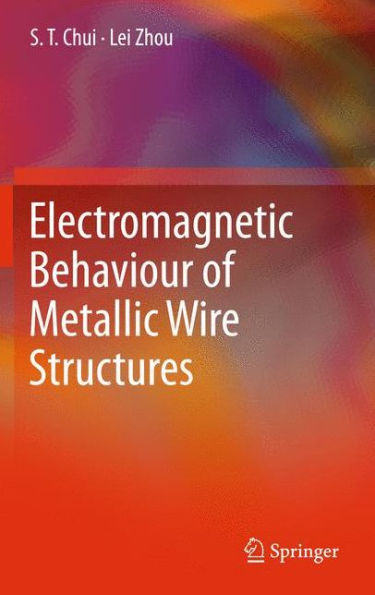
Electromagnetic Behaviour of Metallic Wire Structures in Chattanooga, TN
Current price: $109.99
Barnes and Noble
Electromagnetic Behaviour of Metallic Wire Structures in Chattanooga, TN
Current price: $109.99
Loading Inventory...
Size: Hardcover
Despite the recent development and interest in the photonics of metallic wire structures, the relatively simple concepts and physics often remain obscured or poorly explained to those who do not specialize in the field.
Electromagnetic Behaviour of Metallic Wire Structures
provides a clear and coherent guide to understanding these phenomena without excessive numerical calculations.
Including both background material and detailed derivations of the various different formulae applied,
describes how to extend basic circuit theory relating to voltages, currents, and resistances of metallic wire networks to include situations where the currents are no longer spatially uniform along the wire. This lays a foundation for a deeper understanding of the many new phenomena observed in meta-electromagnetic materials.
Examples of applications are included to support this new approach making
a comprehensive and self-contained volume suitable for use by specialists, non-specialist, researchers and professionals in other relevant fields and even students.
Electromagnetic Behaviour of Metallic Wire Structures
provides a clear and coherent guide to understanding these phenomena without excessive numerical calculations.
Including both background material and detailed derivations of the various different formulae applied,
describes how to extend basic circuit theory relating to voltages, currents, and resistances of metallic wire networks to include situations where the currents are no longer spatially uniform along the wire. This lays a foundation for a deeper understanding of the many new phenomena observed in meta-electromagnetic materials.
Examples of applications are included to support this new approach making
a comprehensive and self-contained volume suitable for use by specialists, non-specialist, researchers and professionals in other relevant fields and even students.
Despite the recent development and interest in the photonics of metallic wire structures, the relatively simple concepts and physics often remain obscured or poorly explained to those who do not specialize in the field.
Electromagnetic Behaviour of Metallic Wire Structures
provides a clear and coherent guide to understanding these phenomena without excessive numerical calculations.
Including both background material and detailed derivations of the various different formulae applied,
describes how to extend basic circuit theory relating to voltages, currents, and resistances of metallic wire networks to include situations where the currents are no longer spatially uniform along the wire. This lays a foundation for a deeper understanding of the many new phenomena observed in meta-electromagnetic materials.
Examples of applications are included to support this new approach making
a comprehensive and self-contained volume suitable for use by specialists, non-specialist, researchers and professionals in other relevant fields and even students.
Electromagnetic Behaviour of Metallic Wire Structures
provides a clear and coherent guide to understanding these phenomena without excessive numerical calculations.
Including both background material and detailed derivations of the various different formulae applied,
describes how to extend basic circuit theory relating to voltages, currents, and resistances of metallic wire networks to include situations where the currents are no longer spatially uniform along the wire. This lays a foundation for a deeper understanding of the many new phenomena observed in meta-electromagnetic materials.
Examples of applications are included to support this new approach making
a comprehensive and self-contained volume suitable for use by specialists, non-specialist, researchers and professionals in other relevant fields and even students.
You May Also Like

















More About Barnes and Noble at Hamilton Place
Barnes & Noble is the world’s largest retail bookseller and a leading retailer of content, digital media and educational products. Our Nook Digital business offers a lineup of NOOK® tablets and e-Readers and an expansive collection of digital reading content through the NOOK Store®. Barnes & Noble’s mission is to operate the best omni-channel specialty retail business in America, helping both our customers and booksellers reach their aspirations, while being a credit to the communities we serve.
2100 Hamilton Pl Blvd, Chattanooga, TN 37421, United States
Find Barnes and Noble at Hamilton Place in Chattanooga, TN
Visit Barnes and Noble at Hamilton Place in Chattanooga, TN
