
Home
Electro-Osmosis of Polymer Solutions: Linear and Nonlinear Behavior
Barnes and Noble
Loading Inventory...
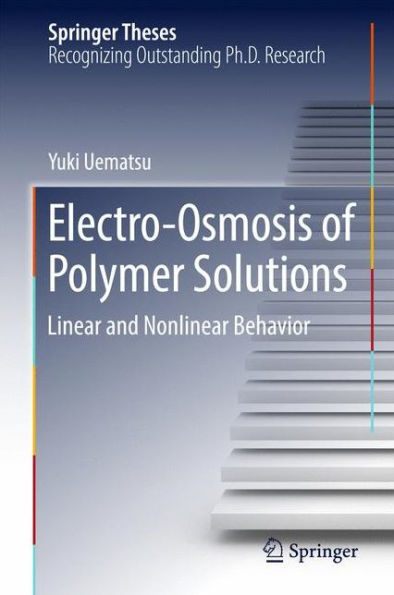
Electro-Osmosis of Polymer Solutions: Linear and Nonlinear Behavior in Chattanooga, TN
Current price: $109.99
Barnes and Noble
Electro-Osmosis of Polymer Solutions: Linear and Nonlinear Behavior in Chattanooga, TN
Current price: $109.99
Loading Inventory...
Size: Hardcover
This thesis focuses on the theoretical description of electro-osmosis of polymer solutions. In particular, it emphasizes the importance of considering non-uniform profiles of the solution viscosity and polymer concentration near a solid surface.
The thesis begins with an introduction to fundamental theories and experimental observations for beginners in this field, concerning electrolyte solutions, electric double layers, and electrokinetics. In Chapter 2, the author discusses the linear response of electro-osmotic flow with respect to applied electric fields in aqueous polyelectrolyte solutions, and predicts a possibility of flow reversal caused by oppositely charged polyelectrolytes adsorbed on a charged surface. In Chapter 3, the author extends the discussion to non-linear electro-osmotic flow driven by applied electric fields in neutral polymer solutions. The dynamics of polymers are modeled and simulated using Brownian dynamics and kinetic theory. Finally, the thesis issummarized in Chapter 4.
The introduction provides a comprehensive review of electrokinetics for graduate students and researchers interested in soft matter physics. An additional attraction is that readers can effectively learn various theoretical approaches to electro-osmosis.
The thesis begins with an introduction to fundamental theories and experimental observations for beginners in this field, concerning electrolyte solutions, electric double layers, and electrokinetics. In Chapter 2, the author discusses the linear response of electro-osmotic flow with respect to applied electric fields in aqueous polyelectrolyte solutions, and predicts a possibility of flow reversal caused by oppositely charged polyelectrolytes adsorbed on a charged surface. In Chapter 3, the author extends the discussion to non-linear electro-osmotic flow driven by applied electric fields in neutral polymer solutions. The dynamics of polymers are modeled and simulated using Brownian dynamics and kinetic theory. Finally, the thesis issummarized in Chapter 4.
The introduction provides a comprehensive review of electrokinetics for graduate students and researchers interested in soft matter physics. An additional attraction is that readers can effectively learn various theoretical approaches to electro-osmosis.
This thesis focuses on the theoretical description of electro-osmosis of polymer solutions. In particular, it emphasizes the importance of considering non-uniform profiles of the solution viscosity and polymer concentration near a solid surface.
The thesis begins with an introduction to fundamental theories and experimental observations for beginners in this field, concerning electrolyte solutions, electric double layers, and electrokinetics. In Chapter 2, the author discusses the linear response of electro-osmotic flow with respect to applied electric fields in aqueous polyelectrolyte solutions, and predicts a possibility of flow reversal caused by oppositely charged polyelectrolytes adsorbed on a charged surface. In Chapter 3, the author extends the discussion to non-linear electro-osmotic flow driven by applied electric fields in neutral polymer solutions. The dynamics of polymers are modeled and simulated using Brownian dynamics and kinetic theory. Finally, the thesis issummarized in Chapter 4.
The introduction provides a comprehensive review of electrokinetics for graduate students and researchers interested in soft matter physics. An additional attraction is that readers can effectively learn various theoretical approaches to electro-osmosis.
The thesis begins with an introduction to fundamental theories and experimental observations for beginners in this field, concerning electrolyte solutions, electric double layers, and electrokinetics. In Chapter 2, the author discusses the linear response of electro-osmotic flow with respect to applied electric fields in aqueous polyelectrolyte solutions, and predicts a possibility of flow reversal caused by oppositely charged polyelectrolytes adsorbed on a charged surface. In Chapter 3, the author extends the discussion to non-linear electro-osmotic flow driven by applied electric fields in neutral polymer solutions. The dynamics of polymers are modeled and simulated using Brownian dynamics and kinetic theory. Finally, the thesis issummarized in Chapter 4.
The introduction provides a comprehensive review of electrokinetics for graduate students and researchers interested in soft matter physics. An additional attraction is that readers can effectively learn various theoretical approaches to electro-osmosis.
You May Also Like












More About Barnes and Noble at Hamilton Place
Barnes & Noble is the world’s largest retail bookseller and a leading retailer of content, digital media and educational products. Our Nook Digital business offers a lineup of NOOK® tablets and e-Readers and an expansive collection of digital reading content through the NOOK Store®. Barnes & Noble’s mission is to operate the best omni-channel specialty retail business in America, helping both our customers and booksellers reach their aspirations, while being a credit to the communities we serve.
2100 Hamilton Pl Blvd, Chattanooga, TN 37421, United States
Find Barnes and Noble at Hamilton Place in Chattanooga, TN
Visit Barnes and Noble at Hamilton Place in Chattanooga, TN
