
Home
Criticism Without Authority: Gene Swenson's and Jill Johnston's Queer Practices
Barnes and Noble
Loading Inventory...
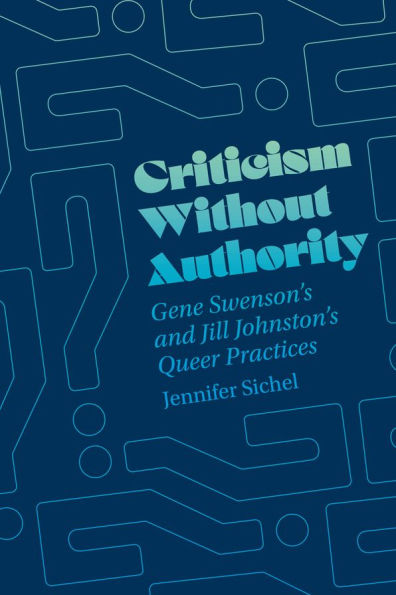
Criticism Without Authority: Gene Swenson's and Jill Johnston's Queer Practices in Chattanooga, TN
Current price: $115.00
Barnes and Noble
Criticism Without Authority: Gene Swenson's and Jill Johnston's Queer Practices in Chattanooga, TN
Current price: $115.00
Loading Inventory...
Size: Hardcover
A reframing of the history of 1960s New York avantgarde art centered on the queer, genrebending criticism of Gene Swenson and Jill Johnston.
In the early 1960s, Gene Swenson and Jill Johnston began to imagine art criticism as something unruly and expansive, rejecting modernist appeals to purity and coherence that had overtaken the field. These critics were deeply enmeshed in New York’s avantgarde art scene, and both were explicitly and unapologetically queer. First working independently of one another, then later in dialogue, Swenson and Johnston demanded criticism become lifesustaining, subverting protocols and distorting its form beyond recognition. They utilized criticism as a means of navigating queer existence and reclaimed terms like
lesbian
,
homosexual
mad
, and
psychotic
as their own.
Jennifer Sichel follows the intertwined paths of Swenson and Johnston, providing a history of queer practices that were central to the development of avantgarde art but have been largely overlooked.
Criticism Without Authority
makes their work visible not just as criticism, but as its own form of art. As Sichel shows, Swenson's and Johnston’s practices, bucking categories and disciplinary formations, resist historical streamlining and stand as a key for unlocking the queerness of postwar art history.
In the early 1960s, Gene Swenson and Jill Johnston began to imagine art criticism as something unruly and expansive, rejecting modernist appeals to purity and coherence that had overtaken the field. These critics were deeply enmeshed in New York’s avantgarde art scene, and both were explicitly and unapologetically queer. First working independently of one another, then later in dialogue, Swenson and Johnston demanded criticism become lifesustaining, subverting protocols and distorting its form beyond recognition. They utilized criticism as a means of navigating queer existence and reclaimed terms like
lesbian
,
homosexual
mad
, and
psychotic
as their own.
Jennifer Sichel follows the intertwined paths of Swenson and Johnston, providing a history of queer practices that were central to the development of avantgarde art but have been largely overlooked.
Criticism Without Authority
makes their work visible not just as criticism, but as its own form of art. As Sichel shows, Swenson's and Johnston’s practices, bucking categories and disciplinary formations, resist historical streamlining and stand as a key for unlocking the queerness of postwar art history.
A reframing of the history of 1960s New York avantgarde art centered on the queer, genrebending criticism of Gene Swenson and Jill Johnston.
In the early 1960s, Gene Swenson and Jill Johnston began to imagine art criticism as something unruly and expansive, rejecting modernist appeals to purity and coherence that had overtaken the field. These critics were deeply enmeshed in New York’s avantgarde art scene, and both were explicitly and unapologetically queer. First working independently of one another, then later in dialogue, Swenson and Johnston demanded criticism become lifesustaining, subverting protocols and distorting its form beyond recognition. They utilized criticism as a means of navigating queer existence and reclaimed terms like
lesbian
,
homosexual
mad
, and
psychotic
as their own.
Jennifer Sichel follows the intertwined paths of Swenson and Johnston, providing a history of queer practices that were central to the development of avantgarde art but have been largely overlooked.
Criticism Without Authority
makes their work visible not just as criticism, but as its own form of art. As Sichel shows, Swenson's and Johnston’s practices, bucking categories and disciplinary formations, resist historical streamlining and stand as a key for unlocking the queerness of postwar art history.
In the early 1960s, Gene Swenson and Jill Johnston began to imagine art criticism as something unruly and expansive, rejecting modernist appeals to purity and coherence that had overtaken the field. These critics were deeply enmeshed in New York’s avantgarde art scene, and both were explicitly and unapologetically queer. First working independently of one another, then later in dialogue, Swenson and Johnston demanded criticism become lifesustaining, subverting protocols and distorting its form beyond recognition. They utilized criticism as a means of navigating queer existence and reclaimed terms like
lesbian
,
homosexual
mad
, and
psychotic
as their own.
Jennifer Sichel follows the intertwined paths of Swenson and Johnston, providing a history of queer practices that were central to the development of avantgarde art but have been largely overlooked.
Criticism Without Authority
makes their work visible not just as criticism, but as its own form of art. As Sichel shows, Swenson's and Johnston’s practices, bucking categories and disciplinary formations, resist historical streamlining and stand as a key for unlocking the queerness of postwar art history.
You May Also Like
![Without Further Ado, Vol. 1 [Mauve Vinyl] [Barnes & Noble Exclusive]](https://prodimage.images-bn.com/pimages/0708857120352_p0_v1_s600x595.jpg)










More About Barnes and Noble at Hamilton Place
Barnes & Noble is the world’s largest retail bookseller and a leading retailer of content, digital media and educational products. Our Nook Digital business offers a lineup of NOOK® tablets and e-Readers and an expansive collection of digital reading content through the NOOK Store®. Barnes & Noble’s mission is to operate the best omni-channel specialty retail business in America, helping both our customers and booksellers reach their aspirations, while being a credit to the communities we serve.
2100 Hamilton Pl Blvd, Chattanooga, TN 37421, United States
Find Barnes and Noble at Hamilton Place in Chattanooga, TN
Visit Barnes and Noble at Hamilton Place in Chattanooga, TN
