
Home
Contemplative Democracy: Politics, Practice, and Pedagogy
Barnes and Noble
Loading Inventory...
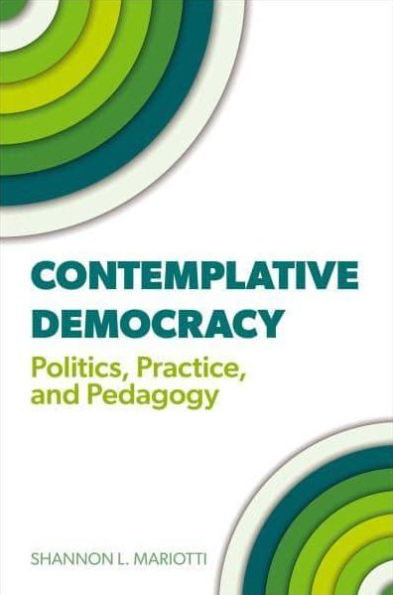
Contemplative Democracy: Politics, Practice, and Pedagogy in Chattanooga, TN
Current price: $99.00
Barnes and Noble
Contemplative Democracy: Politics, Practice, and Pedagogy in Chattanooga, TN
Current price: $99.00
Loading Inventory...
Size: Hardcover
Contemplative practices are increasingly mainstream in the United States. From meditation, mindfulness, and yoga, to writing, walking, and gardening, contemplative practices aim to cultivate embodied awareness, attunement, and attention. What is the political value of the attentional ecologies created by the "Mindfulness Revolution"?
In
Contemplative Democracy
, Shannon L. Mariotti explores how contemplative practices represent a form of world-building that is valuable for meaningful democracy and an overlooked form of ordinary political theory. As Mariotti shows, what appear to be mostly apolitical, self-cultivating activitieseven ones that require withdrawal from societycan also make us more attuned to how we interact with the wider world in any given moment. Meditative practices can advance the goals of autonomy and community that are implied by the concept of democracy. Bringing disparate fields into dialogue, Mariotti highlights resonances between how theorists talk about meaningful democracy and how ordinary people talk about contemplative practice. Analyzing theorists, such as Jacques Rancière and Gloria Anzaldúa, alongside qualitative interviews, participant-observation, and a case study, this book integrates political theorya discipline shaped by "The Enlightenment"with meditative practices questing after other forms of "enlightenment."
Reimagining the work of political theory, employing feminist approaches, and with a focus on educational spaces and democratic modes of pedagogy, Mariotti examines contemplative practices as spaces where ordinary people do the work of democracy, creating new political imaginaries, finding new selves, and founding new states of being. Further,
is an inclusive, accessible, and embodied book that reveals how the larger body politic may be reshaped by the everyday work people do in their own bodies.
In
Contemplative Democracy
, Shannon L. Mariotti explores how contemplative practices represent a form of world-building that is valuable for meaningful democracy and an overlooked form of ordinary political theory. As Mariotti shows, what appear to be mostly apolitical, self-cultivating activitieseven ones that require withdrawal from societycan also make us more attuned to how we interact with the wider world in any given moment. Meditative practices can advance the goals of autonomy and community that are implied by the concept of democracy. Bringing disparate fields into dialogue, Mariotti highlights resonances between how theorists talk about meaningful democracy and how ordinary people talk about contemplative practice. Analyzing theorists, such as Jacques Rancière and Gloria Anzaldúa, alongside qualitative interviews, participant-observation, and a case study, this book integrates political theorya discipline shaped by "The Enlightenment"with meditative practices questing after other forms of "enlightenment."
Reimagining the work of political theory, employing feminist approaches, and with a focus on educational spaces and democratic modes of pedagogy, Mariotti examines contemplative practices as spaces where ordinary people do the work of democracy, creating new political imaginaries, finding new selves, and founding new states of being. Further,
is an inclusive, accessible, and embodied book that reveals how the larger body politic may be reshaped by the everyday work people do in their own bodies.
Contemplative practices are increasingly mainstream in the United States. From meditation, mindfulness, and yoga, to writing, walking, and gardening, contemplative practices aim to cultivate embodied awareness, attunement, and attention. What is the political value of the attentional ecologies created by the "Mindfulness Revolution"?
In
Contemplative Democracy
, Shannon L. Mariotti explores how contemplative practices represent a form of world-building that is valuable for meaningful democracy and an overlooked form of ordinary political theory. As Mariotti shows, what appear to be mostly apolitical, self-cultivating activitieseven ones that require withdrawal from societycan also make us more attuned to how we interact with the wider world in any given moment. Meditative practices can advance the goals of autonomy and community that are implied by the concept of democracy. Bringing disparate fields into dialogue, Mariotti highlights resonances between how theorists talk about meaningful democracy and how ordinary people talk about contemplative practice. Analyzing theorists, such as Jacques Rancière and Gloria Anzaldúa, alongside qualitative interviews, participant-observation, and a case study, this book integrates political theorya discipline shaped by "The Enlightenment"with meditative practices questing after other forms of "enlightenment."
Reimagining the work of political theory, employing feminist approaches, and with a focus on educational spaces and democratic modes of pedagogy, Mariotti examines contemplative practices as spaces where ordinary people do the work of democracy, creating new political imaginaries, finding new selves, and founding new states of being. Further,
is an inclusive, accessible, and embodied book that reveals how the larger body politic may be reshaped by the everyday work people do in their own bodies.
In
Contemplative Democracy
, Shannon L. Mariotti explores how contemplative practices represent a form of world-building that is valuable for meaningful democracy and an overlooked form of ordinary political theory. As Mariotti shows, what appear to be mostly apolitical, self-cultivating activitieseven ones that require withdrawal from societycan also make us more attuned to how we interact with the wider world in any given moment. Meditative practices can advance the goals of autonomy and community that are implied by the concept of democracy. Bringing disparate fields into dialogue, Mariotti highlights resonances between how theorists talk about meaningful democracy and how ordinary people talk about contemplative practice. Analyzing theorists, such as Jacques Rancière and Gloria Anzaldúa, alongside qualitative interviews, participant-observation, and a case study, this book integrates political theorya discipline shaped by "The Enlightenment"with meditative practices questing after other forms of "enlightenment."
Reimagining the work of political theory, employing feminist approaches, and with a focus on educational spaces and democratic modes of pedagogy, Mariotti examines contemplative practices as spaces where ordinary people do the work of democracy, creating new political imaginaries, finding new selves, and founding new states of being. Further,
is an inclusive, accessible, and embodied book that reveals how the larger body politic may be reshaped by the everyday work people do in their own bodies.
You May Also Like











More About Barnes and Noble at Hamilton Place
Barnes & Noble is the world’s largest retail bookseller and a leading retailer of content, digital media and educational products. Our Nook Digital business offers a lineup of NOOK® tablets and e-Readers and an expansive collection of digital reading content through the NOOK Store®. Barnes & Noble’s mission is to operate the best omni-channel specialty retail business in America, helping both our customers and booksellers reach their aspirations, while being a credit to the communities we serve.
2100 Hamilton Pl Blvd, Chattanooga, TN 37421, United States
Find Barnes and Noble at Hamilton Place in Chattanooga, TN
Visit Barnes and Noble at Hamilton Place in Chattanooga, TN
