
Home
Constructing White-Collar Crime: Rationalities, Communication, Power
Barnes and Noble
Loading Inventory...
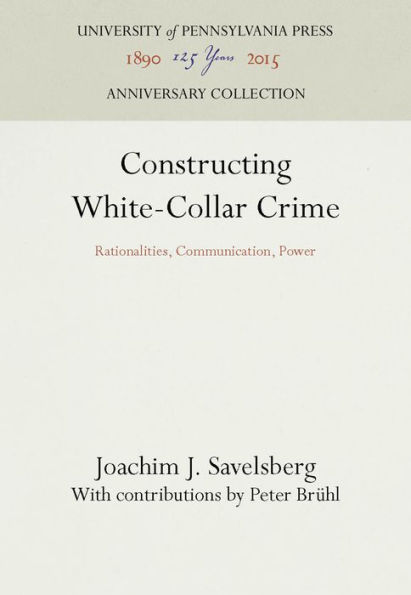
Constructing White-Collar Crime: Rationalities, Communication, Power in Chattanooga, TN
Current price: $84.95
Barnes and Noble
Constructing White-Collar Crime: Rationalities, Communication, Power in Chattanooga, TN
Current price: $84.95
Loading Inventory...
Size: OS
Criminal law norms are socially derived, being constructed in political processes, but only recently has criminological research began to focus on the political construction of criminal law. There has been increasing interest in the quality of these political processes, the decisions that result, and the rationales and social forces guiding these decisions.
In
Constructing White-Collar Crime
, Joachim J. Savelsberg, a sociologist, and Peter Brühl, a lawyer, have provided an interdisciplinary case study of the construction of new German laws against white-collar crime, relating their results to internationally comparative findings. The analysis is empirical; it is theoretically grounded in a sociological approach that contrasts Marxist versus pluralist or differentiation theory, and functionalist versus conflict group or action theory. The authors also analyze their findings in relation to Max Weber's theory of rationalization of law. In addition the research is methodologically innovative, introducing the technique of cognitive mapping into the study of criminal justice legislation. The book represents the authors' attempts to bridge the gap between microsociological and macrosociological approaches to the construction of criminal law.
The authors analyze action rationales, communication patterns, and power structures as they play out in different stages of the law-making process: claims-making in news media; participation of scholars and practitioners in an expert commission and in parliamentary hearings; involvement of industrial lobbying groups during the drafting of the bill in the Department of Justice; and parliamentary deliberations. The analysis demonstrates the considerable weight of economic and political rationales as opposed to justice criteria in the development of criminal legislation. It also indicates that white-collar crime legislation may have counterproductive consequences. The laws are intended to increase the quality of criminal justice by criminalizing the behavior of the powerful, but the less powerful groups within the white-collar classes are more likely to feel the effects.
will be of interest to students and scholars in the areas of sociology, law, and criminology.
In
Constructing White-Collar Crime
, Joachim J. Savelsberg, a sociologist, and Peter Brühl, a lawyer, have provided an interdisciplinary case study of the construction of new German laws against white-collar crime, relating their results to internationally comparative findings. The analysis is empirical; it is theoretically grounded in a sociological approach that contrasts Marxist versus pluralist or differentiation theory, and functionalist versus conflict group or action theory. The authors also analyze their findings in relation to Max Weber's theory of rationalization of law. In addition the research is methodologically innovative, introducing the technique of cognitive mapping into the study of criminal justice legislation. The book represents the authors' attempts to bridge the gap between microsociological and macrosociological approaches to the construction of criminal law.
The authors analyze action rationales, communication patterns, and power structures as they play out in different stages of the law-making process: claims-making in news media; participation of scholars and practitioners in an expert commission and in parliamentary hearings; involvement of industrial lobbying groups during the drafting of the bill in the Department of Justice; and parliamentary deliberations. The analysis demonstrates the considerable weight of economic and political rationales as opposed to justice criteria in the development of criminal legislation. It also indicates that white-collar crime legislation may have counterproductive consequences. The laws are intended to increase the quality of criminal justice by criminalizing the behavior of the powerful, but the less powerful groups within the white-collar classes are more likely to feel the effects.
will be of interest to students and scholars in the areas of sociology, law, and criminology.
Criminal law norms are socially derived, being constructed in political processes, but only recently has criminological research began to focus on the political construction of criminal law. There has been increasing interest in the quality of these political processes, the decisions that result, and the rationales and social forces guiding these decisions.
In
Constructing White-Collar Crime
, Joachim J. Savelsberg, a sociologist, and Peter Brühl, a lawyer, have provided an interdisciplinary case study of the construction of new German laws against white-collar crime, relating their results to internationally comparative findings. The analysis is empirical; it is theoretically grounded in a sociological approach that contrasts Marxist versus pluralist or differentiation theory, and functionalist versus conflict group or action theory. The authors also analyze their findings in relation to Max Weber's theory of rationalization of law. In addition the research is methodologically innovative, introducing the technique of cognitive mapping into the study of criminal justice legislation. The book represents the authors' attempts to bridge the gap between microsociological and macrosociological approaches to the construction of criminal law.
The authors analyze action rationales, communication patterns, and power structures as they play out in different stages of the law-making process: claims-making in news media; participation of scholars and practitioners in an expert commission and in parliamentary hearings; involvement of industrial lobbying groups during the drafting of the bill in the Department of Justice; and parliamentary deliberations. The analysis demonstrates the considerable weight of economic and political rationales as opposed to justice criteria in the development of criminal legislation. It also indicates that white-collar crime legislation may have counterproductive consequences. The laws are intended to increase the quality of criminal justice by criminalizing the behavior of the powerful, but the less powerful groups within the white-collar classes are more likely to feel the effects.
will be of interest to students and scholars in the areas of sociology, law, and criminology.
In
Constructing White-Collar Crime
, Joachim J. Savelsberg, a sociologist, and Peter Brühl, a lawyer, have provided an interdisciplinary case study of the construction of new German laws against white-collar crime, relating their results to internationally comparative findings. The analysis is empirical; it is theoretically grounded in a sociological approach that contrasts Marxist versus pluralist or differentiation theory, and functionalist versus conflict group or action theory. The authors also analyze their findings in relation to Max Weber's theory of rationalization of law. In addition the research is methodologically innovative, introducing the technique of cognitive mapping into the study of criminal justice legislation. The book represents the authors' attempts to bridge the gap between microsociological and macrosociological approaches to the construction of criminal law.
The authors analyze action rationales, communication patterns, and power structures as they play out in different stages of the law-making process: claims-making in news media; participation of scholars and practitioners in an expert commission and in parliamentary hearings; involvement of industrial lobbying groups during the drafting of the bill in the Department of Justice; and parliamentary deliberations. The analysis demonstrates the considerable weight of economic and political rationales as opposed to justice criteria in the development of criminal legislation. It also indicates that white-collar crime legislation may have counterproductive consequences. The laws are intended to increase the quality of criminal justice by criminalizing the behavior of the powerful, but the less powerful groups within the white-collar classes are more likely to feel the effects.
will be of interest to students and scholars in the areas of sociology, law, and criminology.
You May Also Like











More About Barnes and Noble at Hamilton Place
Barnes & Noble is the world’s largest retail bookseller and a leading retailer of content, digital media and educational products. Our Nook Digital business offers a lineup of NOOK® tablets and e-Readers and an expansive collection of digital reading content through the NOOK Store®. Barnes & Noble’s mission is to operate the best omni-channel specialty retail business in America, helping both our customers and booksellers reach their aspirations, while being a credit to the communities we serve.
2100 Hamilton Pl Blvd, Chattanooga, TN 37421, United States
Find Barnes and Noble at Hamilton Place in Chattanooga, TN
Visit Barnes and Noble at Hamilton Place in Chattanooga, TN
