
Home
Conditioning Democratization: Institutional Reforms and EU Membership Conditionality Albania Macedonia
Barnes and Noble
Loading Inventory...
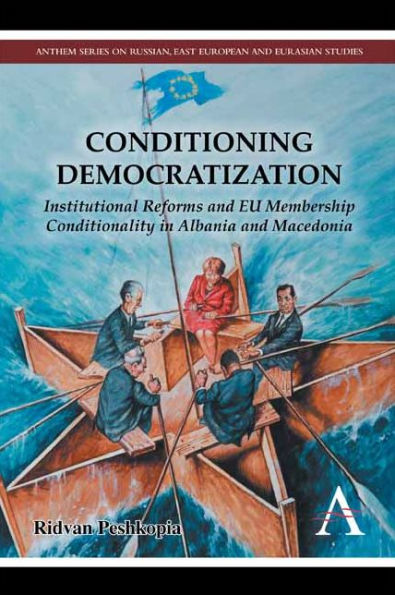
Conditioning Democratization: Institutional Reforms and EU Membership Conditionality Albania Macedonia in Chattanooga, TN
Current price: $130.00
Barnes and Noble
Conditioning Democratization: Institutional Reforms and EU Membership Conditionality Albania Macedonia in Chattanooga, TN
Current price: $130.00
Loading Inventory...
Size: Hardcover
How much, and under what conditions, can the European Union affect democratization and democratic consolidation in prospective member states? What mechanisms does the EU employ to influence reforms in countries emerging from authoritarian rule? Focusing on Albania and Macedonia, two postcommunist countries with a legacy of internal conflict, “Conditioning Democratization” analyzes the relationship between EU accession conditionality and institutional reforms. It focuses on four sectors of reform that are often overlooked in other studies: constitutions, asylum, local decentralization and the judiciary system.
The volume critically reviews the theory of “consociational democracy,” often considered the key to stabilizing deeply divided countries, and reapplies it to the supranational institution of the European Union. In articulate, accessible prose, Ridvan Peshkopia builds on examples from multiple sectors in multiple countries to reconceptualize this theory and show that the EU can indeed use membership conditions as a tool to encourage and direct reform.
The volume critically reviews the theory of “consociational democracy,” often considered the key to stabilizing deeply divided countries, and reapplies it to the supranational institution of the European Union. In articulate, accessible prose, Ridvan Peshkopia builds on examples from multiple sectors in multiple countries to reconceptualize this theory and show that the EU can indeed use membership conditions as a tool to encourage and direct reform.
How much, and under what conditions, can the European Union affect democratization and democratic consolidation in prospective member states? What mechanisms does the EU employ to influence reforms in countries emerging from authoritarian rule? Focusing on Albania and Macedonia, two postcommunist countries with a legacy of internal conflict, “Conditioning Democratization” analyzes the relationship between EU accession conditionality and institutional reforms. It focuses on four sectors of reform that are often overlooked in other studies: constitutions, asylum, local decentralization and the judiciary system.
The volume critically reviews the theory of “consociational democracy,” often considered the key to stabilizing deeply divided countries, and reapplies it to the supranational institution of the European Union. In articulate, accessible prose, Ridvan Peshkopia builds on examples from multiple sectors in multiple countries to reconceptualize this theory and show that the EU can indeed use membership conditions as a tool to encourage and direct reform.
The volume critically reviews the theory of “consociational democracy,” often considered the key to stabilizing deeply divided countries, and reapplies it to the supranational institution of the European Union. In articulate, accessible prose, Ridvan Peshkopia builds on examples from multiple sectors in multiple countries to reconceptualize this theory and show that the EU can indeed use membership conditions as a tool to encourage and direct reform.
You May Also Like
















More About Barnes and Noble at Hamilton Place
Barnes & Noble is the world’s largest retail bookseller and a leading retailer of content, digital media and educational products. Our Nook Digital business offers a lineup of NOOK® tablets and e-Readers and an expansive collection of digital reading content through the NOOK Store®. Barnes & Noble’s mission is to operate the best omni-channel specialty retail business in America, helping both our customers and booksellers reach their aspirations, while being a credit to the communities we serve.
2100 Hamilton Pl Blvd, Chattanooga, TN 37421, United States
Find Barnes and Noble at Hamilton Place in Chattanooga, TN
Visit Barnes and Noble at Hamilton Place in Chattanooga, TN
