
Home
Command and Control Mechanisms the Chickamauga Campaign
Barnes and Noble
Loading Inventory...
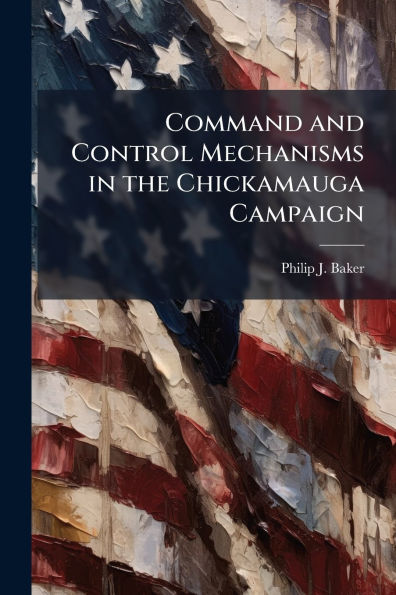
Command and Control Mechanisms the Chickamauga Campaign in Chattanooga, TN
Current price: $31.95
Barnes and Noble
Command and Control Mechanisms the Chickamauga Campaign in Chattanooga, TN
Current price: $31.95
Loading Inventory...
Size: Hardcover
This thesis analyzes how Major General William S. Rosecrans, commander of the Army of the Cumberland, employed the command and control mechanisms available to him as he maneuvered his army from Tullahoma, Tennessee toward Chattanooga, Tennessee in August-September, 1863. It also analyzes how these mechanisms were employed during the battle of Chickamauga itself, on 19-20 September, 1863. General Rosecrans possessed three mechanisms for commanding and controlling his army. The first was the military telegraph, provided by the quasi-military U.S. Military Telegraph service. Next were the assets of the fledgling U.S. Signal Corps, which consisted of signal flags and torches, and a portable version of the telegraph. Finally, there were couriers, who were usually mounted, and were provided by subordinate unit details, or by units specifically formed for courier duty. The thesis concludes that General Rosecrans did not use his command and control mechanisms effectively. Rosecrans relied too heavily on couriers to carry messages over densely wooded, cross-compartmented terrain in order to send orders to his widely dispersed subordinates and receive information from them. While Rosecrans made wide use of the military telegraph, to include using it during the battle itself, he did not effectively use his Signal Corps assets. These assets were used essentially as static observation posts, and only to a limited degree as a means for effecting command and control. The thesis further concludes, however, that General Rosecrans' use of command and control assets was not a decisive factor in the outcome of the campaign or battle. While his reliance upon courier assets added significantly to the time required to obtain Information and send orders, it was not the reason for the Union defeat at Chickamauga.
This work has been selected by scholars as being culturally important, and is part of the knowledge base of civilization as we know it. This work was reproduced from the original artifact, and remains as true to the original work as possible. Therefore, you will see the original copyright references, library stamps (as most of these works have been housed in our most important libraries around the world), and other notations in the work.
This work is in the public domain in the United States of America, and possibly other nations. Within the United States, you may freely copy and distribute this work, as no entity (individual or corporate) has a copyright on the body of the work.
As a reproduction of a historical artifact, this work may contain missing or blurred pages, poor pictures, errant marks, etc. Scholars believe, and we concur, that this work is important enough to be preserved, reproduced, and made generally available to the public. We appreciate your support of the preservation process, and thank you for being an important part of keeping this knowledge alive and relevant.
This work has been selected by scholars as being culturally important, and is part of the knowledge base of civilization as we know it. This work was reproduced from the original artifact, and remains as true to the original work as possible. Therefore, you will see the original copyright references, library stamps (as most of these works have been housed in our most important libraries around the world), and other notations in the work.
This work is in the public domain in the United States of America, and possibly other nations. Within the United States, you may freely copy and distribute this work, as no entity (individual or corporate) has a copyright on the body of the work.
As a reproduction of a historical artifact, this work may contain missing or blurred pages, poor pictures, errant marks, etc. Scholars believe, and we concur, that this work is important enough to be preserved, reproduced, and made generally available to the public. We appreciate your support of the preservation process, and thank you for being an important part of keeping this knowledge alive and relevant.
This thesis analyzes how Major General William S. Rosecrans, commander of the Army of the Cumberland, employed the command and control mechanisms available to him as he maneuvered his army from Tullahoma, Tennessee toward Chattanooga, Tennessee in August-September, 1863. It also analyzes how these mechanisms were employed during the battle of Chickamauga itself, on 19-20 September, 1863. General Rosecrans possessed three mechanisms for commanding and controlling his army. The first was the military telegraph, provided by the quasi-military U.S. Military Telegraph service. Next were the assets of the fledgling U.S. Signal Corps, which consisted of signal flags and torches, and a portable version of the telegraph. Finally, there were couriers, who were usually mounted, and were provided by subordinate unit details, or by units specifically formed for courier duty. The thesis concludes that General Rosecrans did not use his command and control mechanisms effectively. Rosecrans relied too heavily on couriers to carry messages over densely wooded, cross-compartmented terrain in order to send orders to his widely dispersed subordinates and receive information from them. While Rosecrans made wide use of the military telegraph, to include using it during the battle itself, he did not effectively use his Signal Corps assets. These assets were used essentially as static observation posts, and only to a limited degree as a means for effecting command and control. The thesis further concludes, however, that General Rosecrans' use of command and control assets was not a decisive factor in the outcome of the campaign or battle. While his reliance upon courier assets added significantly to the time required to obtain Information and send orders, it was not the reason for the Union defeat at Chickamauga.
This work has been selected by scholars as being culturally important, and is part of the knowledge base of civilization as we know it. This work was reproduced from the original artifact, and remains as true to the original work as possible. Therefore, you will see the original copyright references, library stamps (as most of these works have been housed in our most important libraries around the world), and other notations in the work.
This work is in the public domain in the United States of America, and possibly other nations. Within the United States, you may freely copy and distribute this work, as no entity (individual or corporate) has a copyright on the body of the work.
As a reproduction of a historical artifact, this work may contain missing or blurred pages, poor pictures, errant marks, etc. Scholars believe, and we concur, that this work is important enough to be preserved, reproduced, and made generally available to the public. We appreciate your support of the preservation process, and thank you for being an important part of keeping this knowledge alive and relevant.
This work has been selected by scholars as being culturally important, and is part of the knowledge base of civilization as we know it. This work was reproduced from the original artifact, and remains as true to the original work as possible. Therefore, you will see the original copyright references, library stamps (as most of these works have been housed in our most important libraries around the world), and other notations in the work.
This work is in the public domain in the United States of America, and possibly other nations. Within the United States, you may freely copy and distribute this work, as no entity (individual or corporate) has a copyright on the body of the work.
As a reproduction of a historical artifact, this work may contain missing or blurred pages, poor pictures, errant marks, etc. Scholars believe, and we concur, that this work is important enough to be preserved, reproduced, and made generally available to the public. We appreciate your support of the preservation process, and thank you for being an important part of keeping this knowledge alive and relevant.
You May Also Like










More About Barnes and Noble at Hamilton Place
Barnes & Noble is the world’s largest retail bookseller and a leading retailer of content, digital media and educational products. Our Nook Digital business offers a lineup of NOOK® tablets and e-Readers and an expansive collection of digital reading content through the NOOK Store®. Barnes & Noble’s mission is to operate the best omni-channel specialty retail business in America, helping both our customers and booksellers reach their aspirations, while being a credit to the communities we serve.
2100 Hamilton Pl Blvd, Chattanooga, TN 37421, United States
Find Barnes and Noble at Hamilton Place in Chattanooga, TN
Visit Barnes and Noble at Hamilton Place in Chattanooga, TN
