
Home
Clustering Multidimensional Spatial Datasets With DBSCAN, OPTICS, BIRCH, K-Means, and Two-Step Methods: A comparative Evaluation of Five Algorithms
Barnes and Noble
Loading Inventory...
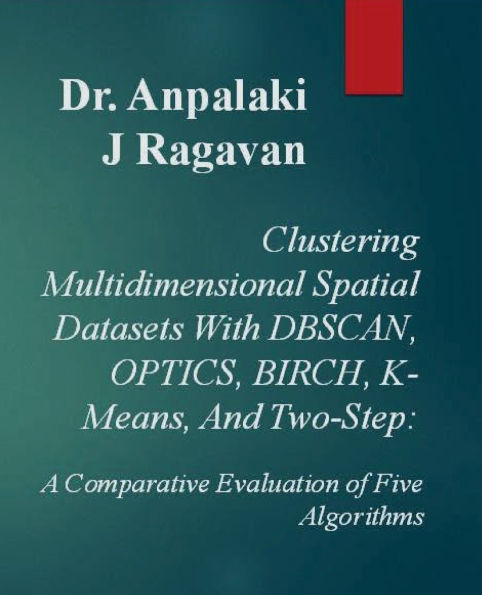
Clustering Multidimensional Spatial Datasets With DBSCAN, OPTICS, BIRCH, K-Means, and Two-Step Methods: A comparative Evaluation of Five Algorithms in Chattanooga, TN
Current price: $40.52
Barnes and Noble
Clustering Multidimensional Spatial Datasets With DBSCAN, OPTICS, BIRCH, K-Means, and Two-Step Methods: A comparative Evaluation of Five Algorithms in Chattanooga, TN
Current price: $40.52
Loading Inventory...
Size: OS
This book presents a systematic machine learning approach to density estimation and clustering of multidimensional real-life spatial datasets, utilizing density-based clustering methods, DBSCAN, and its extension, OPTICS. It compares their clustering performance to that of the traditional centroid-based K-means clustering algorithm, the hierarchical BIRCH clustering algorithm combined with the centroid-based K-means, and the hybrid two-step clustering algorithm (a combination of hierarchical and K-means), evaluating the quality of clusters generated by the five clustering approaches through five quality validation indices, including the DBCV index. This book primarily provides a detailed description of the key concepts and steps involved in applying the DBSCAN and OPTICS algorithms to cluster multidimensional real-life spatial datasets, interpreting the results, analyzing them critically, and comparing the results with those of three other popular clustering methods. The dbscan R package, used for clustering with DBSCAN and OPTICS algorithms, utilizes a space-partitioning data structure called a K-d tree to perform fast K-distance search and fixed-radius nearest neighbor search, including all neighbors within a fixed radius, thereby identifying clusters efficiently. This approach is a widely adopted, robust platform for identifying arbitrary-shaped clusters in large spatial datasets. This book provides a detailed description of the K-distance concept and its application in determining the optimal value for the radius input parameter through K-distance plots. BIRCH within the stream R package was used to efficiently cluster and identify densely populated regions in multidimensional spatial datasets, delivering the best possible clustering results with minimal input/output cost. This book provides a detailed description of the five clustering algorithms used, complemented by procedures for estimating and choosing input parameters, inference of results, and computing, supported by dimension reduction techniques t-SNE using the tsne R package and principal component analysis through factor analysis in SPSS for extracting components in 2 and 3 dimensions for visual enhancement. It also describes the dimension reduction process in detail and compares the results from the two dimension reduction techniques. This book will be particularly beneficial to those wishing to employ these density-based techniques in research or applications across statistics, data mining and analysis, clinical research, social science, market segmentation, consumer analysis, and many other disciplines.
This book presents a systematic machine learning approach to density estimation and clustering of multidimensional real-life spatial datasets, utilizing density-based clustering methods, DBSCAN, and its extension, OPTICS. It compares their clustering performance to that of the traditional centroid-based K-means clustering algorithm, the hierarchical BIRCH clustering algorithm combined with the centroid-based K-means, and the hybrid two-step clustering algorithm (a combination of hierarchical and K-means), evaluating the quality of clusters generated by the five clustering approaches through five quality validation indices, including the DBCV index. This book primarily provides a detailed description of the key concepts and steps involved in applying the DBSCAN and OPTICS algorithms to cluster multidimensional real-life spatial datasets, interpreting the results, analyzing them critically, and comparing the results with those of three other popular clustering methods. The dbscan R package, used for clustering with DBSCAN and OPTICS algorithms, utilizes a space-partitioning data structure called a K-d tree to perform fast K-distance search and fixed-radius nearest neighbor search, including all neighbors within a fixed radius, thereby identifying clusters efficiently. This approach is a widely adopted, robust platform for identifying arbitrary-shaped clusters in large spatial datasets. This book provides a detailed description of the K-distance concept and its application in determining the optimal value for the radius input parameter through K-distance plots. BIRCH within the stream R package was used to efficiently cluster and identify densely populated regions in multidimensional spatial datasets, delivering the best possible clustering results with minimal input/output cost. This book provides a detailed description of the five clustering algorithms used, complemented by procedures for estimating and choosing input parameters, inference of results, and computing, supported by dimension reduction techniques t-SNE using the tsne R package and principal component analysis through factor analysis in SPSS for extracting components in 2 and 3 dimensions for visual enhancement. It also describes the dimension reduction process in detail and compares the results from the two dimension reduction techniques. This book will be particularly beneficial to those wishing to employ these density-based techniques in research or applications across statistics, data mining and analysis, clinical research, social science, market segmentation, consumer analysis, and many other disciplines.
You May Also Like


















More About Barnes and Noble at Hamilton Place
Barnes & Noble is the world’s largest retail bookseller and a leading retailer of content, digital media and educational products. Our Nook Digital business offers a lineup of NOOK® tablets and e-Readers and an expansive collection of digital reading content through the NOOK Store®. Barnes & Noble’s mission is to operate the best omni-channel specialty retail business in America, helping both our customers and booksellers reach their aspirations, while being a credit to the communities we serve.
2100 Hamilton Pl Blvd, Chattanooga, TN 37421, United States
Find Barnes and Noble at Hamilton Place in Chattanooga, TN
Visit Barnes and Noble at Hamilton Place in Chattanooga, TN
