
Home
Classification and Development of North American Indian Cultures: A Statistical Analysis of the Driver-Massey Sample Transactions, American Philosophical Society (vol. 65, part 3)
Barnes and Noble
Loading Inventory...
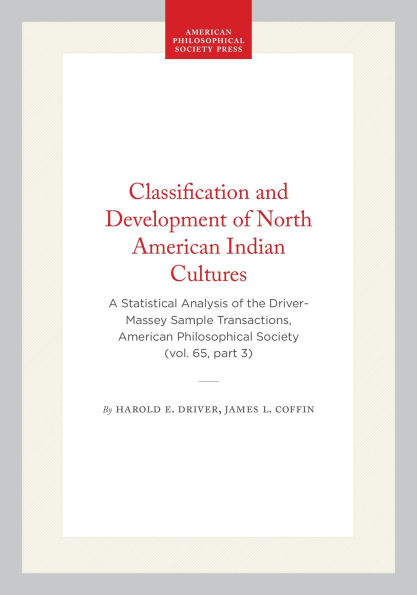
Classification and Development of North American Indian Cultures: A Statistical Analysis of the Driver-Massey Sample Transactions, American Philosophical Society (vol. 65, part 3) in Chattanooga, TN
Current price: $90.00
Barnes and Noble
Classification and Development of North American Indian Cultures: A Statistical Analysis of the Driver-Massey Sample Transactions, American Philosophical Society (vol. 65, part 3) in Chattanooga, TN
Current price: $90.00
Loading Inventory...
Size: OS
This is a print on demand publication. This correlation analysis of the cultural data in the DriverMassey sample includes both tribe by tribe (Qtype) & trait by trait (Rtype) comparisons of 392 culture traits among 245 tribes. The tribes were chosen to match the North American part of Murdock’s (1967) sample. In addition, both groups of tribes & individual traits were correlated with the Voegelins’ (1966) genetic language classification & with Georg Neumann’s classification of physical types. Perhaps the most important finding is that most of the intertrait correlations cannot be explained or interpreted in functional or causal terms, but rather must be attributed to unknown causes, events, accidents, & agents of history. The principal methods used are the matrix ordering & tree diagram computer programs of Jorgensen (1969). The authors have intentionally avoided factor analysis & other matrix reduction techniques because they believe that such methods tend to obscure more than they reveal, by compacting the data into too small a number of factors. Their purpose has been to display all of the intertribal relationships in the largest tree diagram in anthropology to date, & also to exhibit the highest individual intertrait correlations in clusters & macroclusters. Illus.
This is a print on demand publication. This correlation analysis of the cultural data in the DriverMassey sample includes both tribe by tribe (Qtype) & trait by trait (Rtype) comparisons of 392 culture traits among 245 tribes. The tribes were chosen to match the North American part of Murdock’s (1967) sample. In addition, both groups of tribes & individual traits were correlated with the Voegelins’ (1966) genetic language classification & with Georg Neumann’s classification of physical types. Perhaps the most important finding is that most of the intertrait correlations cannot be explained or interpreted in functional or causal terms, but rather must be attributed to unknown causes, events, accidents, & agents of history. The principal methods used are the matrix ordering & tree diagram computer programs of Jorgensen (1969). The authors have intentionally avoided factor analysis & other matrix reduction techniques because they believe that such methods tend to obscure more than they reveal, by compacting the data into too small a number of factors. Their purpose has been to display all of the intertribal relationships in the largest tree diagram in anthropology to date, & also to exhibit the highest individual intertrait correlations in clusters & macroclusters. Illus.
You May Also Like













More About Barnes and Noble at Hamilton Place
Barnes & Noble is the world’s largest retail bookseller and a leading retailer of content, digital media and educational products. Our Nook Digital business offers a lineup of NOOK® tablets and e-Readers and an expansive collection of digital reading content through the NOOK Store®. Barnes & Noble’s mission is to operate the best omni-channel specialty retail business in America, helping both our customers and booksellers reach their aspirations, while being a credit to the communities we serve.
2100 Hamilton Pl Blvd, Chattanooga, TN 37421, United States
Find Barnes and Noble at Hamilton Place in Chattanooga, TN
Visit Barnes and Noble at Hamilton Place in Chattanooga, TN
