
Home
Christ in the Church A Volume of Religious Essays: Large Print Edition
Barnes and Noble
Loading Inventory...
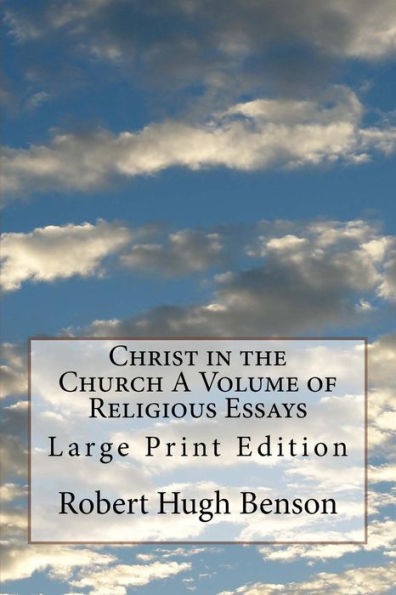
Christ in the Church A Volume of Religious Essays: Large Print Edition in Chattanooga, TN
Current price: $15.24
Barnes and Noble
Christ in the Church A Volume of Religious Essays: Large Print Edition in Chattanooga, TN
Current price: $15.24
Loading Inventory...
Size: OS
Excerpt: It has been believed by all Christians up to the present -- Christians, that is, in the historical sense of the word -- that the Personality of the Figure whom we know as Jesus Christ was the Personality of God; that God sent forth His Son to redeem and teach the world; that this was accomplished by His Life and Death and Resurrection; and that it should be the endeavor of all who call themselves His disciples to imitate the example which He set. Let us scrutinize that statement a little more closely. 1. It is believed by Christians that this work of Redemption and Revelation was accomplished through Human Nature assumed into union with the Divine -- that God did not, so to speak, act merely in virtue of His Deity, but through Humanity as well -- that, first a nation, then a tribe, then a family, and then a person, were successively drawn from the world as a whole -- Israel, Judah, the line of David, and, finally, Mary -- and then, by an unique act of the power of the Holy Ghost, a created substance was produced so perfect and so pure as to be worthy, in a sense, of becoming the vehicle of the Deity; -- this is, in short, the entire summary of the Old Testament -- that this substance was then assumed into union with God, and used for His Divine purposes -- in short, that the Sacred Humanity of Jesus Christ, by which He lived and suffered and died as man, was the instrument of both Revelation and Redemption; that by a human voice He spoke, that human hands were raised to bless, that a human heart loved and agonized, and that these human hands, heart, and voice -- broken, pierced, and silenced as they were -- were the heart, hands and voice of Very God. Consider that claim carefully. Though the Person was the Person of God, the nature by which He was accessible and energetic was the nature of man. It is by union with that Humanity that Christians believe themselves redeemed. Thus in that last emphatic act of the life of His Humiliation He took Bread, and cried, not Here is my Essential Self, but "This is my Body which is given for you," since that Body was the instrument of Redemption. And, if the Christian claim is to be believed, this act was but a continuation (though in another sense) of that first act known as the Incarnation. He who leaned over the Bread at that "last sad Supper with His own's had, in another but similar manner, leaned over Mary herself with similar words upon His lips. God, according to the Christian belief, used in both actions alike a material substance for His Divine Purpose. 2. Up to this point practically all those known as "orthodox Christians" are more or less agreed, if they will but take the trouble to think out their religion to its roots. And it is at this point also that Catholic Christianity parts company from the rest. For, while Protestants find in the individual Life of Jesus Christ in the Gospels the record of the sum of all His dealings, and in His words "It is finished" a proof that Revelation is concluded and Redemption ended, Catholics believe that there is a sense in which that ending was but a beginning -- an inauguration rather than a climax.
Excerpt: It has been believed by all Christians up to the present -- Christians, that is, in the historical sense of the word -- that the Personality of the Figure whom we know as Jesus Christ was the Personality of God; that God sent forth His Son to redeem and teach the world; that this was accomplished by His Life and Death and Resurrection; and that it should be the endeavor of all who call themselves His disciples to imitate the example which He set. Let us scrutinize that statement a little more closely. 1. It is believed by Christians that this work of Redemption and Revelation was accomplished through Human Nature assumed into union with the Divine -- that God did not, so to speak, act merely in virtue of His Deity, but through Humanity as well -- that, first a nation, then a tribe, then a family, and then a person, were successively drawn from the world as a whole -- Israel, Judah, the line of David, and, finally, Mary -- and then, by an unique act of the power of the Holy Ghost, a created substance was produced so perfect and so pure as to be worthy, in a sense, of becoming the vehicle of the Deity; -- this is, in short, the entire summary of the Old Testament -- that this substance was then assumed into union with God, and used for His Divine purposes -- in short, that the Sacred Humanity of Jesus Christ, by which He lived and suffered and died as man, was the instrument of both Revelation and Redemption; that by a human voice He spoke, that human hands were raised to bless, that a human heart loved and agonized, and that these human hands, heart, and voice -- broken, pierced, and silenced as they were -- were the heart, hands and voice of Very God. Consider that claim carefully. Though the Person was the Person of God, the nature by which He was accessible and energetic was the nature of man. It is by union with that Humanity that Christians believe themselves redeemed. Thus in that last emphatic act of the life of His Humiliation He took Bread, and cried, not Here is my Essential Self, but "This is my Body which is given for you," since that Body was the instrument of Redemption. And, if the Christian claim is to be believed, this act was but a continuation (though in another sense) of that first act known as the Incarnation. He who leaned over the Bread at that "last sad Supper with His own's had, in another but similar manner, leaned over Mary herself with similar words upon His lips. God, according to the Christian belief, used in both actions alike a material substance for His Divine Purpose. 2. Up to this point practically all those known as "orthodox Christians" are more or less agreed, if they will but take the trouble to think out their religion to its roots. And it is at this point also that Catholic Christianity parts company from the rest. For, while Protestants find in the individual Life of Jesus Christ in the Gospels the record of the sum of all His dealings, and in His words "It is finished" a proof that Revelation is concluded and Redemption ended, Catholics believe that there is a sense in which that ending was but a beginning -- an inauguration rather than a climax.
You May Also Like















More About Barnes and Noble at Hamilton Place
Barnes & Noble is the world’s largest retail bookseller and a leading retailer of content, digital media and educational products. Our Nook Digital business offers a lineup of NOOK® tablets and e-Readers and an expansive collection of digital reading content through the NOOK Store®. Barnes & Noble’s mission is to operate the best omni-channel specialty retail business in America, helping both our customers and booksellers reach their aspirations, while being a credit to the communities we serve.
2100 Hamilton Pl Blvd, Chattanooga, TN 37421, United States
Find Barnes and Noble at Hamilton Place in Chattanooga, TN
Visit Barnes and Noble at Hamilton Place in Chattanooga, TN
