
Home
Challenging Status Quo Retrenchment: New Directions Critical Research
Barnes and Noble
Loading Inventory...
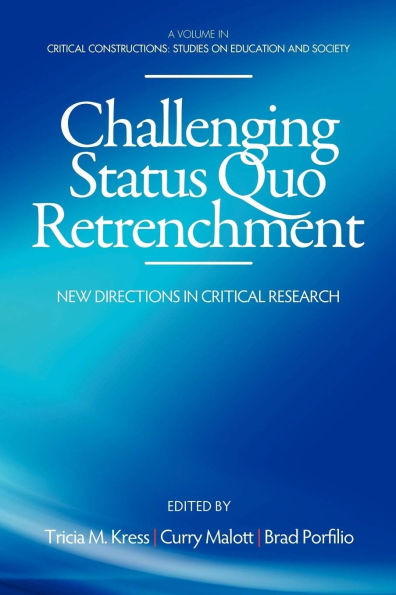
Challenging Status Quo Retrenchment: New Directions Critical Research in Chattanooga, TN
Current price: $100.00
Barnes and Noble
Challenging Status Quo Retrenchment: New Directions Critical Research in Chattanooga, TN
Current price: $100.00
Loading Inventory...
Size: Hardcover
This year (2012) marks ten years of No Child Left Behind and the U.S. federal government’s official designation of what qualifies as “scientifically based research” (SBR) in education. Combined, these two policies have resulted in a narrowing of education via standardization and high stakes testing (Au, 2007) as well as the curtailment of forms of inquiry that are deemed legitimate for examining education (Wright, 2006). While there has been much debate about the benefits and limitations of the NCLB legislation (e.g., Au, 2010) and SBR (e.g., Eisenhart & Towne, 2003), critical researchers have held strong to their position: The reductionistic narrowing of education curricula and educational research cannot solve the present and historical inequities in society and education (Shields, 2012). Contrarily, reductionism (via standardization and/or methodological prescription) exacerbates the challenges we face because it effectively erases the epistemological, ontological, and axiological diversity necessary for disrupting hegemonic social structures that lie at the root of human suffering (Kincheloe, 2004). Not only has NCLB proven incapable of overcoming inequalities, but there seems to be sufficient evidence to suggest it was never really intended to eliminate poverty and human suffering. That is, it seems NCLB, despite its lofty title and public discourse, is actually designed to advance the agenda of handing public education over to forprofit corporations to manage and privatize thereby intensifying the capitalist class’ war on those who rely on a wage to survive (Malott, 2010). In the present ethos, reductionism upholds and retrenches the status quo (i.e. the basic structures of power), and it puts at risk education and educational research as means of working toward social justice (Biesta, 2007). Because social justice can be interpreted in multiple ways, we might note that we understand critical social justice as oriented toward action and social change. Thus, critical education and research may have potential to contribute to a number of social justice imperatives, such as: redistributing land from the neocolonizing settlerstate to Indigenous peoples, halting exploitative labor relations and hazardous working conditions for wageearners, and engaging in reparations with formerly enslaved communities.
This year (2012) marks ten years of No Child Left Behind and the U.S. federal government’s official designation of what qualifies as “scientifically based research” (SBR) in education. Combined, these two policies have resulted in a narrowing of education via standardization and high stakes testing (Au, 2007) as well as the curtailment of forms of inquiry that are deemed legitimate for examining education (Wright, 2006). While there has been much debate about the benefits and limitations of the NCLB legislation (e.g., Au, 2010) and SBR (e.g., Eisenhart & Towne, 2003), critical researchers have held strong to their position: The reductionistic narrowing of education curricula and educational research cannot solve the present and historical inequities in society and education (Shields, 2012). Contrarily, reductionism (via standardization and/or methodological prescription) exacerbates the challenges we face because it effectively erases the epistemological, ontological, and axiological diversity necessary for disrupting hegemonic social structures that lie at the root of human suffering (Kincheloe, 2004). Not only has NCLB proven incapable of overcoming inequalities, but there seems to be sufficient evidence to suggest it was never really intended to eliminate poverty and human suffering. That is, it seems NCLB, despite its lofty title and public discourse, is actually designed to advance the agenda of handing public education over to forprofit corporations to manage and privatize thereby intensifying the capitalist class’ war on those who rely on a wage to survive (Malott, 2010). In the present ethos, reductionism upholds and retrenches the status quo (i.e. the basic structures of power), and it puts at risk education and educational research as means of working toward social justice (Biesta, 2007). Because social justice can be interpreted in multiple ways, we might note that we understand critical social justice as oriented toward action and social change. Thus, critical education and research may have potential to contribute to a number of social justice imperatives, such as: redistributing land from the neocolonizing settlerstate to Indigenous peoples, halting exploitative labor relations and hazardous working conditions for wageearners, and engaging in reparations with formerly enslaved communities.
You May Also Like








More About Barnes and Noble at Hamilton Place
Barnes & Noble is the world’s largest retail bookseller and a leading retailer of content, digital media and educational products. Our Nook Digital business offers a lineup of NOOK® tablets and e-Readers and an expansive collection of digital reading content through the NOOK Store®. Barnes & Noble’s mission is to operate the best omni-channel specialty retail business in America, helping both our customers and booksellers reach their aspirations, while being a credit to the communities we serve.
2100 Hamilton Pl Blvd, Chattanooga, TN 37421, United States
Find Barnes and Noble at Hamilton Place in Chattanooga, TN
Visit Barnes and Noble at Hamilton Place in Chattanooga, TN