
Home
Beyond Left, Right, and Center: The Politics of Gender Ethnicity Contemporary Germany
Barnes and Noble
Loading Inventory...
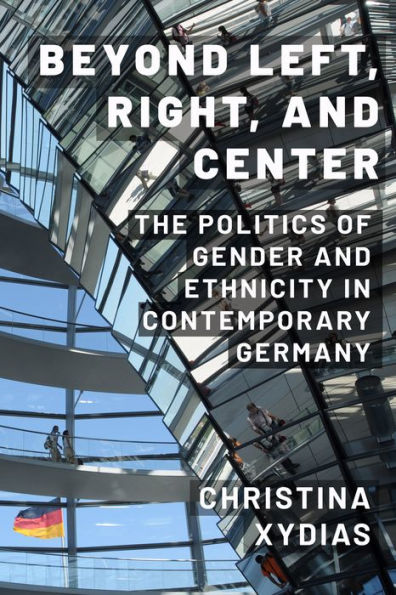
Beyond Left, Right, and Center: The Politics of Gender Ethnicity Contemporary Germany in Chattanooga, TN
Current price: $104.50
Barnes and Noble
Beyond Left, Right, and Center: The Politics of Gender Ethnicity Contemporary Germany in Chattanooga, TN
Current price: $104.50
Loading Inventory...
Size: Hardcover
Women’s political representation is often expected to be better on “the left.” However, the reality is more complicated. Using Germany’s multi-party system as its central case study,
Beyond Left, Right, and Center
challenges this conventional wisdom on political ideology.
Christina Xydias shows that some right-leaning parties advocate for women’s rights and interests, while left- and right-leaning parties can be equally indifferent to lack of representation for women from marginalized groups. These findings follow from analyses of election results, transcripts from debates and speeches, and personal interviews, as well as from a close reading of intertwined military and citizenship policies that illustrate how women’s and ethnic minority groups’ rights are constructed.
concludes with an analysis of women’s representation across OECD countries, showing that right-leaning parties are more likely to support women’s rights and interests in societies that are more egalitarian.
Beyond Left, Right, and Center
challenges this conventional wisdom on political ideology.
Christina Xydias shows that some right-leaning parties advocate for women’s rights and interests, while left- and right-leaning parties can be equally indifferent to lack of representation for women from marginalized groups. These findings follow from analyses of election results, transcripts from debates and speeches, and personal interviews, as well as from a close reading of intertwined military and citizenship policies that illustrate how women’s and ethnic minority groups’ rights are constructed.
concludes with an analysis of women’s representation across OECD countries, showing that right-leaning parties are more likely to support women’s rights and interests in societies that are more egalitarian.
Women’s political representation is often expected to be better on “the left.” However, the reality is more complicated. Using Germany’s multi-party system as its central case study,
Beyond Left, Right, and Center
challenges this conventional wisdom on political ideology.
Christina Xydias shows that some right-leaning parties advocate for women’s rights and interests, while left- and right-leaning parties can be equally indifferent to lack of representation for women from marginalized groups. These findings follow from analyses of election results, transcripts from debates and speeches, and personal interviews, as well as from a close reading of intertwined military and citizenship policies that illustrate how women’s and ethnic minority groups’ rights are constructed.
concludes with an analysis of women’s representation across OECD countries, showing that right-leaning parties are more likely to support women’s rights and interests in societies that are more egalitarian.
Beyond Left, Right, and Center
challenges this conventional wisdom on political ideology.
Christina Xydias shows that some right-leaning parties advocate for women’s rights and interests, while left- and right-leaning parties can be equally indifferent to lack of representation for women from marginalized groups. These findings follow from analyses of election results, transcripts from debates and speeches, and personal interviews, as well as from a close reading of intertwined military and citizenship policies that illustrate how women’s and ethnic minority groups’ rights are constructed.
concludes with an analysis of women’s representation across OECD countries, showing that right-leaning parties are more likely to support women’s rights and interests in societies that are more egalitarian.
You May Also Like
![Left, Right and Centre [Blu-ray]](https://prodimage.images-bn.com/pimages/0843501042564_p0_v1_s600x595.jpg)













More About Barnes and Noble at Hamilton Place
Barnes & Noble is the world’s largest retail bookseller and a leading retailer of content, digital media and educational products. Our Nook Digital business offers a lineup of NOOK® tablets and e-Readers and an expansive collection of digital reading content through the NOOK Store®. Barnes & Noble’s mission is to operate the best omni-channel specialty retail business in America, helping both our customers and booksellers reach their aspirations, while being a credit to the communities we serve.
2100 Hamilton Pl Blvd, Chattanooga, TN 37421, United States
Find Barnes and Noble at Hamilton Place in Chattanooga, TN
Visit Barnes and Noble at Hamilton Place in Chattanooga, TN
