
Home
Better Healthcare Through Math: Bending The Access And Cost Curves
Barnes and Noble
Loading Inventory...
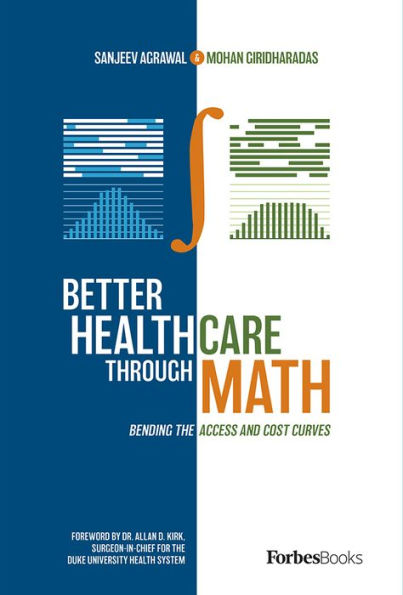
Better Healthcare Through Math: Bending The Access And Cost Curves in Chattanooga, TN
Current price: $24.99
Barnes and Noble
Better Healthcare Through Math: Bending The Access And Cost Curves in Chattanooga, TN
Current price: $24.99
Loading Inventory...
Size: OS
GETTING A DOCTOR’S APPOINTMENT SHOULDN’T BE HARDER THAN BOOKING A VACATION
The US healthcare system excels in research, innovation, and clinical care, but is failing to keep up with the operational challenges of the digital age. Today’s healthcare organizations face immense financial challenges, and their most valuable resources—people, rooms, and equipment—are being used inefficiently.
The result? Long wait times for patients, overstressed staff, underused assets, and poor ROI for organizations.
Why do health systems struggle with optimization? The fundamental problem is one of matching an unpredictable demand for services with a constrained supply. The math being used to solve this problem is a holdover from the paperandpencil era.
In Better Healthcare Through Math, authors Mohan Giridharadas and Sanjeev Agrawal show you that there is a better way. Healthcare systems can harness the power of sophisticated, analyticsdriven mathematics to optimize the matching of supply and demand. By upgrading to software systems built on better math, they can enable staff to make databased decisions to flatten peaks of demand and create smoother patient flow.
The US healthcare system excels in research, innovation, and clinical care, but is failing to keep up with the operational challenges of the digital age. Today’s healthcare organizations face immense financial challenges, and their most valuable resources—people, rooms, and equipment—are being used inefficiently.
The result? Long wait times for patients, overstressed staff, underused assets, and poor ROI for organizations.
Why do health systems struggle with optimization? The fundamental problem is one of matching an unpredictable demand for services with a constrained supply. The math being used to solve this problem is a holdover from the paperandpencil era.
In Better Healthcare Through Math, authors Mohan Giridharadas and Sanjeev Agrawal show you that there is a better way. Healthcare systems can harness the power of sophisticated, analyticsdriven mathematics to optimize the matching of supply and demand. By upgrading to software systems built on better math, they can enable staff to make databased decisions to flatten peaks of demand and create smoother patient flow.
GETTING A DOCTOR’S APPOINTMENT SHOULDN’T BE HARDER THAN BOOKING A VACATION
The US healthcare system excels in research, innovation, and clinical care, but is failing to keep up with the operational challenges of the digital age. Today’s healthcare organizations face immense financial challenges, and their most valuable resources—people, rooms, and equipment—are being used inefficiently.
The result? Long wait times for patients, overstressed staff, underused assets, and poor ROI for organizations.
Why do health systems struggle with optimization? The fundamental problem is one of matching an unpredictable demand for services with a constrained supply. The math being used to solve this problem is a holdover from the paperandpencil era.
In Better Healthcare Through Math, authors Mohan Giridharadas and Sanjeev Agrawal show you that there is a better way. Healthcare systems can harness the power of sophisticated, analyticsdriven mathematics to optimize the matching of supply and demand. By upgrading to software systems built on better math, they can enable staff to make databased decisions to flatten peaks of demand and create smoother patient flow.
The US healthcare system excels in research, innovation, and clinical care, but is failing to keep up with the operational challenges of the digital age. Today’s healthcare organizations face immense financial challenges, and their most valuable resources—people, rooms, and equipment—are being used inefficiently.
The result? Long wait times for patients, overstressed staff, underused assets, and poor ROI for organizations.
Why do health systems struggle with optimization? The fundamental problem is one of matching an unpredictable demand for services with a constrained supply. The math being used to solve this problem is a holdover from the paperandpencil era.
In Better Healthcare Through Math, authors Mohan Giridharadas and Sanjeev Agrawal show you that there is a better way. Healthcare systems can harness the power of sophisticated, analyticsdriven mathematics to optimize the matching of supply and demand. By upgrading to software systems built on better math, they can enable staff to make databased decisions to flatten peaks of demand and create smoother patient flow.
You May Also Like












More About Barnes and Noble at Hamilton Place
Barnes & Noble is the world’s largest retail bookseller and a leading retailer of content, digital media and educational products. Our Nook Digital business offers a lineup of NOOK® tablets and e-Readers and an expansive collection of digital reading content through the NOOK Store®. Barnes & Noble’s mission is to operate the best omni-channel specialty retail business in America, helping both our customers and booksellers reach their aspirations, while being a credit to the communities we serve.
2100 Hamilton Pl Blvd, Chattanooga, TN 37421, United States
Find Barnes and Noble at Hamilton Place in Chattanooga, TN
Visit Barnes and Noble at Hamilton Place in Chattanooga, TN
