
Home
Baseball's Pivotal Era, 1945-1951
Barnes and Noble
Loading Inventory...
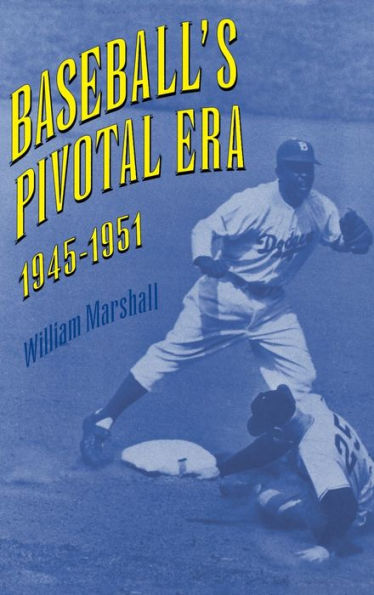
Baseball's Pivotal Era, 1945-1951 in Chattanooga, TN
Current price: $60.00
Barnes and Noble
Baseball's Pivotal Era, 1945-1951 in Chattanooga, TN
Current price: $60.00
Loading Inventory...
Size: Hardcover
With personal interviews of players and owners and with over two decades of research in newspapers and archives, Bill Marshall tells of the players, the pennant races, and the officials who shaped one of the most memorable eras in sports and American history.
At the end of World War II, soldiers returning from overseas hungered to resume their love affair with baseball. Spectators still identified with players, whose salaries and offseason employment as postmen, plumbers, farmers, and insurance salesmen resembled their own. It was a time when kids played baseball on sandlots and in pastures, fans followed the game on the radio, and tickets were affordable. The outstanding play of Joe DiMaggio, Stan Musial, Ted Williams, Bob Feller, Don Newcombe, Warren Spahn, and many others dominated the field. But perhaps no performance was more important than that of Jackie Robinson, whose entrance into the game broke the color barrier, won him the respect of millions of Americans, and helped set the stage for the civil rights movement.
Baseball's Pivotal Era, 19451951
also records the attempt to organize the Pittsburgh Pirates and the Mexican League's success in luring players south of the border that led to a series of lawsuits that almost undermined baseball's reserve clause and antitrust exemption. The result was spring training pay, uniform contracts, minimum salary levels, player representation, and a pension plan—the very issues that would divide players and owners almost fifty years later.
During these years, the game was led by A.B. "Happy" Chandler, a handshaking, speechmaking, singing Kentucky politician. Most owners thought he would be easily manipulated, unlike baseball's first commissioner, the autocratic Judge Kennesaw Mountain Landis. Instead, Chandler's style led one owner to complain that he was the "player's commissioner, the fan's commissioner, the press and radio commissioner, everybody's commissioner but the men who pay him."
At the end of World War II, soldiers returning from overseas hungered to resume their love affair with baseball. Spectators still identified with players, whose salaries and offseason employment as postmen, plumbers, farmers, and insurance salesmen resembled their own. It was a time when kids played baseball on sandlots and in pastures, fans followed the game on the radio, and tickets were affordable. The outstanding play of Joe DiMaggio, Stan Musial, Ted Williams, Bob Feller, Don Newcombe, Warren Spahn, and many others dominated the field. But perhaps no performance was more important than that of Jackie Robinson, whose entrance into the game broke the color barrier, won him the respect of millions of Americans, and helped set the stage for the civil rights movement.
Baseball's Pivotal Era, 19451951
also records the attempt to organize the Pittsburgh Pirates and the Mexican League's success in luring players south of the border that led to a series of lawsuits that almost undermined baseball's reserve clause and antitrust exemption. The result was spring training pay, uniform contracts, minimum salary levels, player representation, and a pension plan—the very issues that would divide players and owners almost fifty years later.
During these years, the game was led by A.B. "Happy" Chandler, a handshaking, speechmaking, singing Kentucky politician. Most owners thought he would be easily manipulated, unlike baseball's first commissioner, the autocratic Judge Kennesaw Mountain Landis. Instead, Chandler's style led one owner to complain that he was the "player's commissioner, the fan's commissioner, the press and radio commissioner, everybody's commissioner but the men who pay him."
With personal interviews of players and owners and with over two decades of research in newspapers and archives, Bill Marshall tells of the players, the pennant races, and the officials who shaped one of the most memorable eras in sports and American history.
At the end of World War II, soldiers returning from overseas hungered to resume their love affair with baseball. Spectators still identified with players, whose salaries and offseason employment as postmen, plumbers, farmers, and insurance salesmen resembled their own. It was a time when kids played baseball on sandlots and in pastures, fans followed the game on the radio, and tickets were affordable. The outstanding play of Joe DiMaggio, Stan Musial, Ted Williams, Bob Feller, Don Newcombe, Warren Spahn, and many others dominated the field. But perhaps no performance was more important than that of Jackie Robinson, whose entrance into the game broke the color barrier, won him the respect of millions of Americans, and helped set the stage for the civil rights movement.
Baseball's Pivotal Era, 19451951
also records the attempt to organize the Pittsburgh Pirates and the Mexican League's success in luring players south of the border that led to a series of lawsuits that almost undermined baseball's reserve clause and antitrust exemption. The result was spring training pay, uniform contracts, minimum salary levels, player representation, and a pension plan—the very issues that would divide players and owners almost fifty years later.
During these years, the game was led by A.B. "Happy" Chandler, a handshaking, speechmaking, singing Kentucky politician. Most owners thought he would be easily manipulated, unlike baseball's first commissioner, the autocratic Judge Kennesaw Mountain Landis. Instead, Chandler's style led one owner to complain that he was the "player's commissioner, the fan's commissioner, the press and radio commissioner, everybody's commissioner but the men who pay him."
At the end of World War II, soldiers returning from overseas hungered to resume their love affair with baseball. Spectators still identified with players, whose salaries and offseason employment as postmen, plumbers, farmers, and insurance salesmen resembled their own. It was a time when kids played baseball on sandlots and in pastures, fans followed the game on the radio, and tickets were affordable. The outstanding play of Joe DiMaggio, Stan Musial, Ted Williams, Bob Feller, Don Newcombe, Warren Spahn, and many others dominated the field. But perhaps no performance was more important than that of Jackie Robinson, whose entrance into the game broke the color barrier, won him the respect of millions of Americans, and helped set the stage for the civil rights movement.
Baseball's Pivotal Era, 19451951
also records the attempt to organize the Pittsburgh Pirates and the Mexican League's success in luring players south of the border that led to a series of lawsuits that almost undermined baseball's reserve clause and antitrust exemption. The result was spring training pay, uniform contracts, minimum salary levels, player representation, and a pension plan—the very issues that would divide players and owners almost fifty years later.
During these years, the game was led by A.B. "Happy" Chandler, a handshaking, speechmaking, singing Kentucky politician. Most owners thought he would be easily manipulated, unlike baseball's first commissioner, the autocratic Judge Kennesaw Mountain Landis. Instead, Chandler's style led one owner to complain that he was the "player's commissioner, the fan's commissioner, the press and radio commissioner, everybody's commissioner but the men who pay him."
You May Also Like













More About Barnes and Noble at Hamilton Place
Barnes & Noble is the world’s largest retail bookseller and a leading retailer of content, digital media and educational products. Our Nook Digital business offers a lineup of NOOK® tablets and e-Readers and an expansive collection of digital reading content through the NOOK Store®. Barnes & Noble’s mission is to operate the best omni-channel specialty retail business in America, helping both our customers and booksellers reach their aspirations, while being a credit to the communities we serve.
2100 Hamilton Pl Blvd, Chattanooga, TN 37421, United States
Find Barnes and Noble at Hamilton Place in Chattanooga, TN
Visit Barnes and Noble at Hamilton Place in Chattanooga, TN
