
Home
Baroque Sovereignty: Carlos de Sigüenza y Góngora and the Creole Archive of Colonial Mexico
Barnes and Noble
Loading Inventory...
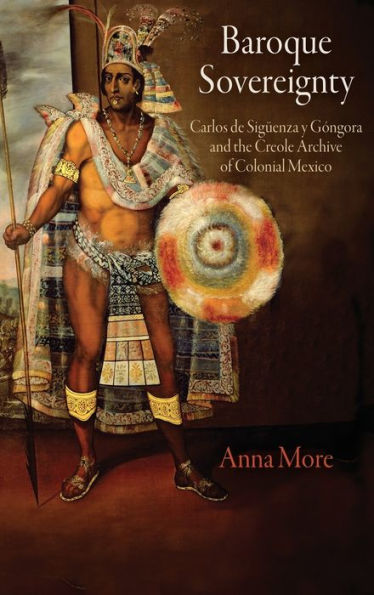
Baroque Sovereignty: Carlos de Sigüenza y Góngora and the Creole Archive of Colonial Mexico in Chattanooga, TN
Current price: $90.00
Barnes and Noble
Baroque Sovereignty: Carlos de Sigüenza y Góngora and the Creole Archive of Colonial Mexico in Chattanooga, TN
Current price: $90.00
Loading Inventory...
Size: Hardcover
In the seventeenth century, even as the Spanish Habsburg monarchy entered its irreversible decline, the capital of its most important overseas territory was flourishing. Nexus of both Atlantic and Pacific trade routes and home to an ethnically diverse population, Mexico City produced a distinctive Baroque culture that combined local and European influences. In this context, the American-born descendants of European immigrants—or creoles, as they called themselves—began to envision a new society beyond the terms of Spanish imperialism, and the writings of the Mexican polymath Carlos de Sigüenza y Góngora (1645-1700) were instrumental in this process. Mathematician, antiquarian, poet, and secular priest, Sigüenza authored works on such topics as the 1680 comet, the defense of New Spain, pre-Columbian history, and the massive 1692 Mexico City riot. He wrote all of these, in his words, "out of love for my
patria
."
Through readings of Sigüenza y Góngora's diverse works,
Baroque Sovereignty
locates the colonial Baroque at the crossroads of a conflicted Spanish imperial rule and the political imaginary of an emergent local elite. Arguing that Spanish imperialism was founded on an ideal of Christian conversion no longer applicable at the end of the seventeenth century, More discovers in Sigüenza y Góngora's works an alternative basis for local governance. The creole archive, understood as both the collection of local artifacts and their interpretation, solved the intractable problem of Spanish imperial sovereignty by establishing a material genealogy and authority for New Spain's creole elite. In an analysis that contributes substantially to early modern colonial studies and theories of memory and knowledge, More posits the centrality of the creole archive for understanding how a local political imaginary emerged from the ruins of Spanish imperialism.
patria
."
Through readings of Sigüenza y Góngora's diverse works,
Baroque Sovereignty
locates the colonial Baroque at the crossroads of a conflicted Spanish imperial rule and the political imaginary of an emergent local elite. Arguing that Spanish imperialism was founded on an ideal of Christian conversion no longer applicable at the end of the seventeenth century, More discovers in Sigüenza y Góngora's works an alternative basis for local governance. The creole archive, understood as both the collection of local artifacts and their interpretation, solved the intractable problem of Spanish imperial sovereignty by establishing a material genealogy and authority for New Spain's creole elite. In an analysis that contributes substantially to early modern colonial studies and theories of memory and knowledge, More posits the centrality of the creole archive for understanding how a local political imaginary emerged from the ruins of Spanish imperialism.
In the seventeenth century, even as the Spanish Habsburg monarchy entered its irreversible decline, the capital of its most important overseas territory was flourishing. Nexus of both Atlantic and Pacific trade routes and home to an ethnically diverse population, Mexico City produced a distinctive Baroque culture that combined local and European influences. In this context, the American-born descendants of European immigrants—or creoles, as they called themselves—began to envision a new society beyond the terms of Spanish imperialism, and the writings of the Mexican polymath Carlos de Sigüenza y Góngora (1645-1700) were instrumental in this process. Mathematician, antiquarian, poet, and secular priest, Sigüenza authored works on such topics as the 1680 comet, the defense of New Spain, pre-Columbian history, and the massive 1692 Mexico City riot. He wrote all of these, in his words, "out of love for my
patria
."
Through readings of Sigüenza y Góngora's diverse works,
Baroque Sovereignty
locates the colonial Baroque at the crossroads of a conflicted Spanish imperial rule and the political imaginary of an emergent local elite. Arguing that Spanish imperialism was founded on an ideal of Christian conversion no longer applicable at the end of the seventeenth century, More discovers in Sigüenza y Góngora's works an alternative basis for local governance. The creole archive, understood as both the collection of local artifacts and their interpretation, solved the intractable problem of Spanish imperial sovereignty by establishing a material genealogy and authority for New Spain's creole elite. In an analysis that contributes substantially to early modern colonial studies and theories of memory and knowledge, More posits the centrality of the creole archive for understanding how a local political imaginary emerged from the ruins of Spanish imperialism.
patria
."
Through readings of Sigüenza y Góngora's diverse works,
Baroque Sovereignty
locates the colonial Baroque at the crossroads of a conflicted Spanish imperial rule and the political imaginary of an emergent local elite. Arguing that Spanish imperialism was founded on an ideal of Christian conversion no longer applicable at the end of the seventeenth century, More discovers in Sigüenza y Góngora's works an alternative basis for local governance. The creole archive, understood as both the collection of local artifacts and their interpretation, solved the intractable problem of Spanish imperial sovereignty by establishing a material genealogy and authority for New Spain's creole elite. In an analysis that contributes substantially to early modern colonial studies and theories of memory and knowledge, More posits the centrality of the creole archive for understanding how a local political imaginary emerged from the ruins of Spanish imperialism.
You May Also Like












More About Barnes and Noble at Hamilton Place
Barnes & Noble is the world’s largest retail bookseller and a leading retailer of content, digital media and educational products. Our Nook Digital business offers a lineup of NOOK® tablets and e-Readers and an expansive collection of digital reading content through the NOOK Store®. Barnes & Noble’s mission is to operate the best omni-channel specialty retail business in America, helping both our customers and booksellers reach their aspirations, while being a credit to the communities we serve.
2100 Hamilton Pl Blvd, Chattanooga, TN 37421, United States
Find Barnes and Noble at Hamilton Place in Chattanooga, TN
Visit Barnes and Noble at Hamilton Place in Chattanooga, TN
