
Home
Ancient Textile Production from an Interdisciplinary Perspective: Humanities and Natural Sciences Interwoven for our Understanding of Textiles
Barnes and Noble
Loading Inventory...
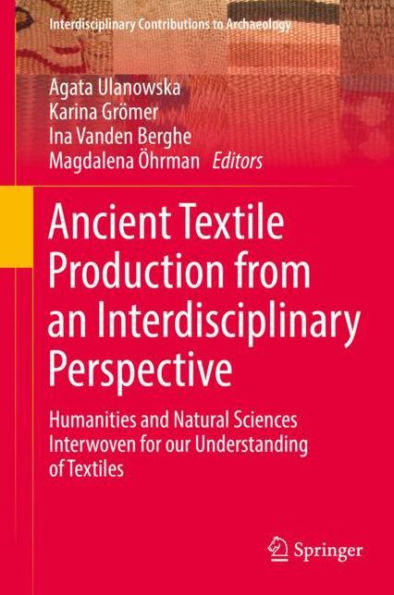
Ancient Textile Production from an Interdisciplinary Perspective: Humanities and Natural Sciences Interwoven for our Understanding of Textiles in Chattanooga, TN
Current price: $179.99
Barnes and Noble
Ancient Textile Production from an Interdisciplinary Perspective: Humanities and Natural Sciences Interwoven for our Understanding of Textiles in Chattanooga, TN
Current price: $179.99
Loading Inventory...
Size: Hardcover
The diverse developments in textile research of the last decade, along with the increased recognition of the importance of textile studies in adjacent fields, now merit a dedicated, full-length publication entitled “Ancient Textile Production from an Interdisciplinary Perspective: Humanities and Natural Sciences Interwoven for our Understanding of Textiles”. With this volume, the authors and the editors wish to illustrate to the current impact of textile archaeology on the scholarly perception of the past (not limited to archaeology alone). The volume presents new insights into the consumption, meaning, use and re-use of textiles and dyes, all of which are topics of growing importance in textile research. As indicated by the title, we demonstrate the continued importance of interdisciplinarity by showcasing several ‘interwoven’ approaches to environmental and archaeological remains, textual and iconographic sources, archaeological experiments and ethnographic data, from a large area covering Europe and the Mediterranean, Near East, Africa and Asia. The chronological span is deliberately wide, including materials dating from c. 6th millennium BCE to c. mid-14th century CE.
The volume is organised in four parts that aim to reflect the main areas of the textile research in 2020. After the two introductory chapters (Part I: About this Volume and Textile Research in 2020), follow two chapters referring to dyes and dyeing technology in which analytical and material-based studies are linked to contextual sources (Part II: Interdisciplinarity of Colour: Dye Analyses and Dyeing Technologies). The six chapters of Part III: Interdisciplinary Approaches to Textile Tools discuss textiles and textile production starting from the analyses of tools, whether functional or as representative of technological developments or user identity. Archaeological and cultural contexts as well as textile traditions are the main topics of the six chapters in Part IV: Traditions and Contexts: Fibres, Fabrics, Techniques, Uses and Meanings. The two final chapters in Part V: Digital Tools refer to the use of digital tools in textile research, presenting two different case studies.
The volume is organised in four parts that aim to reflect the main areas of the textile research in 2020. After the two introductory chapters (Part I: About this Volume and Textile Research in 2020), follow two chapters referring to dyes and dyeing technology in which analytical and material-based studies are linked to contextual sources (Part II: Interdisciplinarity of Colour: Dye Analyses and Dyeing Technologies). The six chapters of Part III: Interdisciplinary Approaches to Textile Tools discuss textiles and textile production starting from the analyses of tools, whether functional or as representative of technological developments or user identity. Archaeological and cultural contexts as well as textile traditions are the main topics of the six chapters in Part IV: Traditions and Contexts: Fibres, Fabrics, Techniques, Uses and Meanings. The two final chapters in Part V: Digital Tools refer to the use of digital tools in textile research, presenting two different case studies.
The diverse developments in textile research of the last decade, along with the increased recognition of the importance of textile studies in adjacent fields, now merit a dedicated, full-length publication entitled “Ancient Textile Production from an Interdisciplinary Perspective: Humanities and Natural Sciences Interwoven for our Understanding of Textiles”. With this volume, the authors and the editors wish to illustrate to the current impact of textile archaeology on the scholarly perception of the past (not limited to archaeology alone). The volume presents new insights into the consumption, meaning, use and re-use of textiles and dyes, all of which are topics of growing importance in textile research. As indicated by the title, we demonstrate the continued importance of interdisciplinarity by showcasing several ‘interwoven’ approaches to environmental and archaeological remains, textual and iconographic sources, archaeological experiments and ethnographic data, from a large area covering Europe and the Mediterranean, Near East, Africa and Asia. The chronological span is deliberately wide, including materials dating from c. 6th millennium BCE to c. mid-14th century CE.
The volume is organised in four parts that aim to reflect the main areas of the textile research in 2020. After the two introductory chapters (Part I: About this Volume and Textile Research in 2020), follow two chapters referring to dyes and dyeing technology in which analytical and material-based studies are linked to contextual sources (Part II: Interdisciplinarity of Colour: Dye Analyses and Dyeing Technologies). The six chapters of Part III: Interdisciplinary Approaches to Textile Tools discuss textiles and textile production starting from the analyses of tools, whether functional or as representative of technological developments or user identity. Archaeological and cultural contexts as well as textile traditions are the main topics of the six chapters in Part IV: Traditions and Contexts: Fibres, Fabrics, Techniques, Uses and Meanings. The two final chapters in Part V: Digital Tools refer to the use of digital tools in textile research, presenting two different case studies.
The volume is organised in four parts that aim to reflect the main areas of the textile research in 2020. After the two introductory chapters (Part I: About this Volume and Textile Research in 2020), follow two chapters referring to dyes and dyeing technology in which analytical and material-based studies are linked to contextual sources (Part II: Interdisciplinarity of Colour: Dye Analyses and Dyeing Technologies). The six chapters of Part III: Interdisciplinary Approaches to Textile Tools discuss textiles and textile production starting from the analyses of tools, whether functional or as representative of technological developments or user identity. Archaeological and cultural contexts as well as textile traditions are the main topics of the six chapters in Part IV: Traditions and Contexts: Fibres, Fabrics, Techniques, Uses and Meanings. The two final chapters in Part V: Digital Tools refer to the use of digital tools in textile research, presenting two different case studies.
You May Also Like















More About Barnes and Noble at Hamilton Place
Barnes & Noble is the world’s largest retail bookseller and a leading retailer of content, digital media and educational products. Our Nook Digital business offers a lineup of NOOK® tablets and e-Readers and an expansive collection of digital reading content through the NOOK Store®. Barnes & Noble’s mission is to operate the best omni-channel specialty retail business in America, helping both our customers and booksellers reach their aspirations, while being a credit to the communities we serve.
2100 Hamilton Pl Blvd, Chattanooga, TN 37421, United States
Find Barnes and Noble at Hamilton Place in Chattanooga, TN
Visit Barnes and Noble at Hamilton Place in Chattanooga, TN
