
Home
An Introduction to Mathematical Cosmology
Barnes and Noble
Loading Inventory...
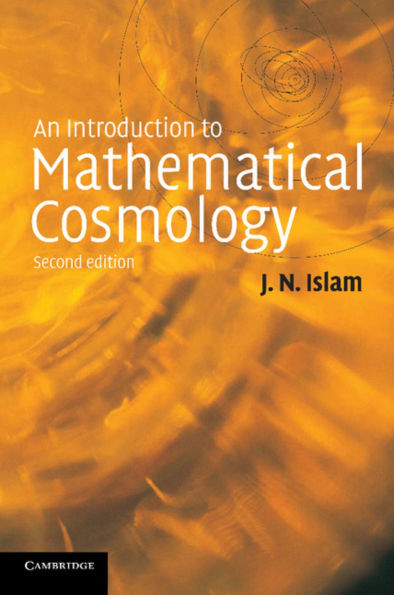
An Introduction to Mathematical Cosmology in Chattanooga, TN
Current price: $158.00
Barnes and Noble
An Introduction to Mathematical Cosmology in Chattanooga, TN
Current price: $158.00
Loading Inventory...
Size: Hardcover
This book provides a concise introduction to the mathematical aspects of the origin, structure and evolution of the universe. The book begins with a brief overview of observational and theoretical cosmology, along with a short introduction of general relativity. It then goes on to discuss Friedmann models, the Hubble constant and deceleration parameter, singularities, the early universe, inflation, quantum cosmology and the distant future of the universe. This new edition contains a rigorous derivation of the Robertson-Walker metric. It also discusses the limits to the parameter space through various theoretical and observational constraints, and presents a new inflationary solution for a sixth degree potential. This book is suitable as a textbook for advanced undergraduates and beginning graduate students. It will also be of interest to cosmologists, astrophysicists, applied mathematicians and mathematical physicists.
This book provides a concise introduction to the mathematical aspects of the origin, structure and evolution of the universe. The book begins with a brief overview of observational and theoretical cosmology, along with a short introduction of general relativity. It then goes on to discuss Friedmann models, the Hubble constant and deceleration parameter, singularities, the early universe, inflation, quantum cosmology and the distant future of the universe. This new edition contains a rigorous derivation of the Robertson-Walker metric. It also discusses the limits to the parameter space through various theoretical and observational constraints, and presents a new inflationary solution for a sixth degree potential. This book is suitable as a textbook for advanced undergraduates and beginning graduate students. It will also be of interest to cosmologists, astrophysicists, applied mathematicians and mathematical physicists.
You May Also Like











More About Barnes and Noble at Hamilton Place
Barnes & Noble is the world’s largest retail bookseller and a leading retailer of content, digital media and educational products. Our Nook Digital business offers a lineup of NOOK® tablets and e-Readers and an expansive collection of digital reading content through the NOOK Store®. Barnes & Noble’s mission is to operate the best omni-channel specialty retail business in America, helping both our customers and booksellers reach their aspirations, while being a credit to the communities we serve.
2100 Hamilton Pl Blvd, Chattanooga, TN 37421, United States
Find Barnes and Noble at Hamilton Place in Chattanooga, TN
Visit Barnes and Noble at Hamilton Place in Chattanooga, TN
