
Home
An Economic History of the Spanish Welfare State: Political Economy Social Policy from Mid-19th Century to Present
Barnes and Noble
Loading Inventory...
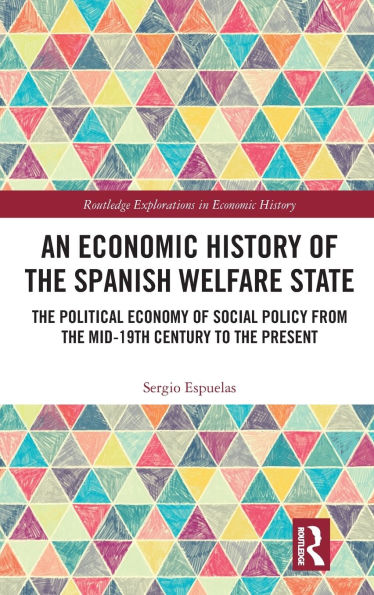
An Economic History of the Spanish Welfare State: Political Economy Social Policy from Mid-19th Century to Present in Chattanooga, TN
Current price: $190.00
Barnes and Noble
An Economic History of the Spanish Welfare State: Political Economy Social Policy from Mid-19th Century to Present in Chattanooga, TN
Current price: $190.00
Loading Inventory...
Size: Hardcover
This monograph analyses the evolution of the welfare state in Spain from qualitative and quantitative perspectives. It basically relies on estimates of public social spending from 1850 to the present and offers comparisons with the rest of Europe.
As a whole, the volume sheds light on the historical, political, and economic conditions at play during the relatively late development of the Spanish welfare state. Three key driving factors are explored: the political regime, social inequality, and Spain’s exposure to international markets. While economic backwardness and demographic factors explain part of the story, Espuelas demonstrates that inequality explains much of the pre-1936 gap; the lack of democracy and the Franco dictatorship were crucial up to the 1970s, and globalization, rather than having a clear positive or negative effect, has mainly influenced the way social policy is financed.
This volume will be of interest to advanced students and researchers of economic history, welfare states, European history, and social policy.
As a whole, the volume sheds light on the historical, political, and economic conditions at play during the relatively late development of the Spanish welfare state. Three key driving factors are explored: the political regime, social inequality, and Spain’s exposure to international markets. While economic backwardness and demographic factors explain part of the story, Espuelas demonstrates that inequality explains much of the pre-1936 gap; the lack of democracy and the Franco dictatorship were crucial up to the 1970s, and globalization, rather than having a clear positive or negative effect, has mainly influenced the way social policy is financed.
This volume will be of interest to advanced students and researchers of economic history, welfare states, European history, and social policy.
This monograph analyses the evolution of the welfare state in Spain from qualitative and quantitative perspectives. It basically relies on estimates of public social spending from 1850 to the present and offers comparisons with the rest of Europe.
As a whole, the volume sheds light on the historical, political, and economic conditions at play during the relatively late development of the Spanish welfare state. Three key driving factors are explored: the political regime, social inequality, and Spain’s exposure to international markets. While economic backwardness and demographic factors explain part of the story, Espuelas demonstrates that inequality explains much of the pre-1936 gap; the lack of democracy and the Franco dictatorship were crucial up to the 1970s, and globalization, rather than having a clear positive or negative effect, has mainly influenced the way social policy is financed.
This volume will be of interest to advanced students and researchers of economic history, welfare states, European history, and social policy.
As a whole, the volume sheds light on the historical, political, and economic conditions at play during the relatively late development of the Spanish welfare state. Three key driving factors are explored: the political regime, social inequality, and Spain’s exposure to international markets. While economic backwardness and demographic factors explain part of the story, Espuelas demonstrates that inequality explains much of the pre-1936 gap; the lack of democracy and the Franco dictatorship were crucial up to the 1970s, and globalization, rather than having a clear positive or negative effect, has mainly influenced the way social policy is financed.
This volume will be of interest to advanced students and researchers of economic history, welfare states, European history, and social policy.
You May Also Like













More About Barnes and Noble at Hamilton Place
Barnes & Noble is the world’s largest retail bookseller and a leading retailer of content, digital media and educational products. Our Nook Digital business offers a lineup of NOOK® tablets and e-Readers and an expansive collection of digital reading content through the NOOK Store®. Barnes & Noble’s mission is to operate the best omni-channel specialty retail business in America, helping both our customers and booksellers reach their aspirations, while being a credit to the communities we serve.
2100 Hamilton Pl Blvd, Chattanooga, TN 37421, United States
Find Barnes and Noble at Hamilton Place in Chattanooga, TN
Visit Barnes and Noble at Hamilton Place in Chattanooga, TN
