
Home
America Under the Hammer: Auctions and Emergence of Market Values
Barnes and Noble
Loading Inventory...
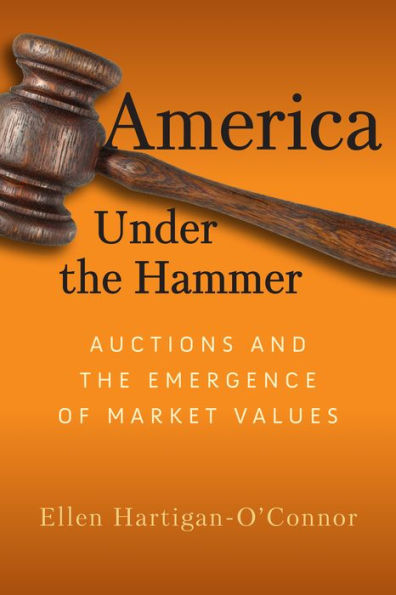
America Under the Hammer: Auctions and Emergence of Market Values in Chattanooga, TN
Current price: $39.95
Barnes and Noble
America Under the Hammer: Auctions and Emergence of Market Values in Chattanooga, TN
Current price: $39.95
Loading Inventory...
Size: Hardcover
Reveals how, through auctions, early Americans learned capitalism
As the first book-length study of auctions in early America,
America Under the Hammer
follows this ubiquitous but largely overlooked institution to reveal how, across the eighteenth and early nineteenth centuries, price became an accepted expression of value. From the earliest days of colonial conquest, auctions put Native land and human beings up for bidding alongside material goods, normalizing new economic practices that turned social relations into economic calculations and eventually became recognizable as nineteenth-century American capitalism.
Starting in the eighteenth century, neighbors collectively turned speculative value into economic “facts” in the form of concrete prices for specific items, thereby establishing ideas about fair exchange in their communities. This consensus soon fractured: during the Revolutionary War, state governments auctioned loyalist property, weaponizing local group participation in pricing and distribution to punish political enemies. By the early nineteenth century, suspicion that auction outcomes were determined by manipulative auctioneers prompted politicians and satirists to police the boundaries of what counted as economic exchange and for whose benefit the economy operated. Women at auctions—as commodities, bidders, or beneficiaries—became a focal point for gendering economic value itself. By the 1830s, as abolitionists attacked the public sale of enslaved men, women, and children, auctions had enshrined a set of economic ideas—that any entity could be coded as property and priced through competition—that have become commonsense understandings all too seldom challenged.
In contrast to histories focused on banks, currencies, or plantations,
highlights an institution that integrated market, community, and household in ways that put gender, race, and social bonds at the center of ideas about economic worth. Women and men, enslaved and free, are active participants in this story rather than bystanders, and their labor, judgments, and bodies define the resulting contours of the American economy.
As the first book-length study of auctions in early America,
America Under the Hammer
follows this ubiquitous but largely overlooked institution to reveal how, across the eighteenth and early nineteenth centuries, price became an accepted expression of value. From the earliest days of colonial conquest, auctions put Native land and human beings up for bidding alongside material goods, normalizing new economic practices that turned social relations into economic calculations and eventually became recognizable as nineteenth-century American capitalism.
Starting in the eighteenth century, neighbors collectively turned speculative value into economic “facts” in the form of concrete prices for specific items, thereby establishing ideas about fair exchange in their communities. This consensus soon fractured: during the Revolutionary War, state governments auctioned loyalist property, weaponizing local group participation in pricing and distribution to punish political enemies. By the early nineteenth century, suspicion that auction outcomes were determined by manipulative auctioneers prompted politicians and satirists to police the boundaries of what counted as economic exchange and for whose benefit the economy operated. Women at auctions—as commodities, bidders, or beneficiaries—became a focal point for gendering economic value itself. By the 1830s, as abolitionists attacked the public sale of enslaved men, women, and children, auctions had enshrined a set of economic ideas—that any entity could be coded as property and priced through competition—that have become commonsense understandings all too seldom challenged.
In contrast to histories focused on banks, currencies, or plantations,
highlights an institution that integrated market, community, and household in ways that put gender, race, and social bonds at the center of ideas about economic worth. Women and men, enslaved and free, are active participants in this story rather than bystanders, and their labor, judgments, and bodies define the resulting contours of the American economy.
Reveals how, through auctions, early Americans learned capitalism
As the first book-length study of auctions in early America,
America Under the Hammer
follows this ubiquitous but largely overlooked institution to reveal how, across the eighteenth and early nineteenth centuries, price became an accepted expression of value. From the earliest days of colonial conquest, auctions put Native land and human beings up for bidding alongside material goods, normalizing new economic practices that turned social relations into economic calculations and eventually became recognizable as nineteenth-century American capitalism.
Starting in the eighteenth century, neighbors collectively turned speculative value into economic “facts” in the form of concrete prices for specific items, thereby establishing ideas about fair exchange in their communities. This consensus soon fractured: during the Revolutionary War, state governments auctioned loyalist property, weaponizing local group participation in pricing and distribution to punish political enemies. By the early nineteenth century, suspicion that auction outcomes were determined by manipulative auctioneers prompted politicians and satirists to police the boundaries of what counted as economic exchange and for whose benefit the economy operated. Women at auctions—as commodities, bidders, or beneficiaries—became a focal point for gendering economic value itself. By the 1830s, as abolitionists attacked the public sale of enslaved men, women, and children, auctions had enshrined a set of economic ideas—that any entity could be coded as property and priced through competition—that have become commonsense understandings all too seldom challenged.
In contrast to histories focused on banks, currencies, or plantations,
highlights an institution that integrated market, community, and household in ways that put gender, race, and social bonds at the center of ideas about economic worth. Women and men, enslaved and free, are active participants in this story rather than bystanders, and their labor, judgments, and bodies define the resulting contours of the American economy.
As the first book-length study of auctions in early America,
America Under the Hammer
follows this ubiquitous but largely overlooked institution to reveal how, across the eighteenth and early nineteenth centuries, price became an accepted expression of value. From the earliest days of colonial conquest, auctions put Native land and human beings up for bidding alongside material goods, normalizing new economic practices that turned social relations into economic calculations and eventually became recognizable as nineteenth-century American capitalism.
Starting in the eighteenth century, neighbors collectively turned speculative value into economic “facts” in the form of concrete prices for specific items, thereby establishing ideas about fair exchange in their communities. This consensus soon fractured: during the Revolutionary War, state governments auctioned loyalist property, weaponizing local group participation in pricing and distribution to punish political enemies. By the early nineteenth century, suspicion that auction outcomes were determined by manipulative auctioneers prompted politicians and satirists to police the boundaries of what counted as economic exchange and for whose benefit the economy operated. Women at auctions—as commodities, bidders, or beneficiaries—became a focal point for gendering economic value itself. By the 1830s, as abolitionists attacked the public sale of enslaved men, women, and children, auctions had enshrined a set of economic ideas—that any entity could be coded as property and priced through competition—that have become commonsense understandings all too seldom challenged.
In contrast to histories focused on banks, currencies, or plantations,
highlights an institution that integrated market, community, and household in ways that put gender, race, and social bonds at the center of ideas about economic worth. Women and men, enslaved and free, are active participants in this story rather than bystanders, and their labor, judgments, and bodies define the resulting contours of the American economy.
You May Also Like















More About Barnes and Noble at Hamilton Place
Barnes & Noble is the world’s largest retail bookseller and a leading retailer of content, digital media and educational products. Our Nook Digital business offers a lineup of NOOK® tablets and e-Readers and an expansive collection of digital reading content through the NOOK Store®. Barnes & Noble’s mission is to operate the best omni-channel specialty retail business in America, helping both our customers and booksellers reach their aspirations, while being a credit to the communities we serve.
2100 Hamilton Pl Blvd, Chattanooga, TN 37421, United States
Find Barnes and Noble at Hamilton Place in Chattanooga, TN
Visit Barnes and Noble at Hamilton Place in Chattanooga, TN
