
Home
Advanced Crop Improvement, Volume 2: Case Studies of Economically Important Crops
Barnes and Noble
Loading Inventory...
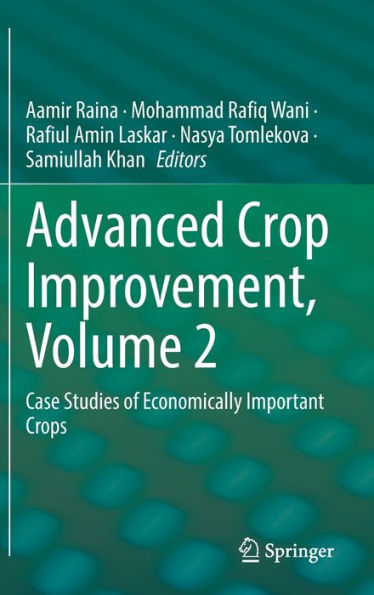
Advanced Crop Improvement, Volume 2: Case Studies of Economically Important Crops in Chattanooga, TN
Current price: $249.99
Barnes and Noble
Advanced Crop Improvement, Volume 2: Case Studies of Economically Important Crops in Chattanooga, TN
Current price: $249.99
Loading Inventory...
Size: Hardcover
As per the reports of FAO, the human population will rise to 9 billion by the end of 2050 and 70% of more food must be produced over the next three decades to feed the additional population. The breeding approaches for crop improvement programs are dependent on the availability and accessibility of genetic variation, either spontaneous or induced by the mutagens. Plant breeders, agronomists, and geneticists are under constant pressure to expand food production by employing innovative breeding strategies to enhance yield, adaptability, nutrition, resistance to biotic and abiotic stresses. In conventional breeding approaches, introgression of genes in crop varieties is laborious and time-consuming. Nowadays, new innovative plant breeding techniques such as molecular breeding and plant biotechnology, supplement the traditional breeding approaches to achieve the desired goals of enhanced food production. With the advent of recent molecular tools like genomics, transgenics, molecular marker-assisted back-crossing, TILLING, Eco-TILLING, gene editing, CRISPR CAS, non-targeted protein abundant comparative proteomics, genome wide association studies have made possible mapping of important QTLs, insertion of transgenes, reduction of linkage drags, and manipulation of genome. In general, conventional and modern plant breeding approaches would be strategically ideal for developing new elite crop varieties to meet the feeding requirement of the increasing world population.
This book highlights the latest progress in the field of plant breeding, and their applicability in crop improvement. The basic concept of this 2-volume work is to assess the use of modern breeding strategies in supplementing the conventional breeding toward the development of elite crop varieties, for obtaining desired goals of food production.
This book highlights the latest progress in the field of plant breeding, and their applicability in crop improvement. The basic concept of this 2-volume work is to assess the use of modern breeding strategies in supplementing the conventional breeding toward the development of elite crop varieties, for obtaining desired goals of food production.
As per the reports of FAO, the human population will rise to 9 billion by the end of 2050 and 70% of more food must be produced over the next three decades to feed the additional population. The breeding approaches for crop improvement programs are dependent on the availability and accessibility of genetic variation, either spontaneous or induced by the mutagens. Plant breeders, agronomists, and geneticists are under constant pressure to expand food production by employing innovative breeding strategies to enhance yield, adaptability, nutrition, resistance to biotic and abiotic stresses. In conventional breeding approaches, introgression of genes in crop varieties is laborious and time-consuming. Nowadays, new innovative plant breeding techniques such as molecular breeding and plant biotechnology, supplement the traditional breeding approaches to achieve the desired goals of enhanced food production. With the advent of recent molecular tools like genomics, transgenics, molecular marker-assisted back-crossing, TILLING, Eco-TILLING, gene editing, CRISPR CAS, non-targeted protein abundant comparative proteomics, genome wide association studies have made possible mapping of important QTLs, insertion of transgenes, reduction of linkage drags, and manipulation of genome. In general, conventional and modern plant breeding approaches would be strategically ideal for developing new elite crop varieties to meet the feeding requirement of the increasing world population.
This book highlights the latest progress in the field of plant breeding, and their applicability in crop improvement. The basic concept of this 2-volume work is to assess the use of modern breeding strategies in supplementing the conventional breeding toward the development of elite crop varieties, for obtaining desired goals of food production.
This book highlights the latest progress in the field of plant breeding, and their applicability in crop improvement. The basic concept of this 2-volume work is to assess the use of modern breeding strategies in supplementing the conventional breeding toward the development of elite crop varieties, for obtaining desired goals of food production.
You May Also Like













More About Barnes and Noble at Hamilton Place
Barnes & Noble is the world’s largest retail bookseller and a leading retailer of content, digital media and educational products. Our Nook Digital business offers a lineup of NOOK® tablets and e-Readers and an expansive collection of digital reading content through the NOOK Store®. Barnes & Noble’s mission is to operate the best omni-channel specialty retail business in America, helping both our customers and booksellers reach their aspirations, while being a credit to the communities we serve.
2100 Hamilton Pl Blvd, Chattanooga, TN 37421, United States
Find Barnes and Noble at Hamilton Place in Chattanooga, TN
Visit Barnes and Noble at Hamilton Place in Chattanooga, TN
