
Home
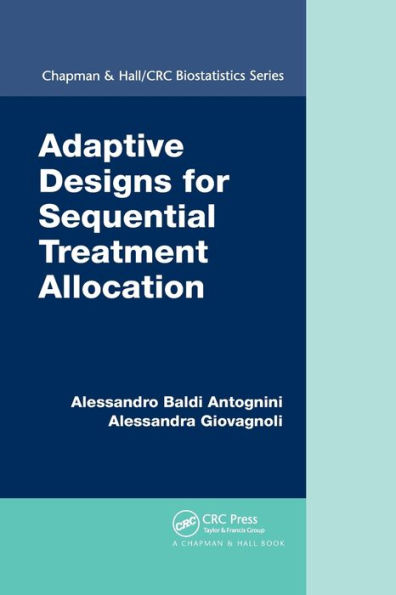
Adaptive Designs for Sequential Treatment Allocation
Barnes and Noble
Loading Inventory...
Adaptive Designs for Sequential Treatment Allocation in Chattanooga, TN
Current price: $84.99
Barnes and Noble
Adaptive Designs for Sequential Treatment Allocation in Chattanooga, TN
Current price: $84.99
Loading Inventory...
Size: Paperback
Adaptive Designs for Sequential Treatment Allocation
presents a rigorous theoretical treatment of the results and mathematical foundation of adaptive design theory. The book focuses on designing sequential randomized experiments to compare two or more treatments incorporating information accrued along the way.
The authors first introduce the terminology and statistical models most commonly used in comparative experiments. They then illustrate biased coin and urn designs that only take into account past treatment allocations as well as designs that use past data, such as sequential maximum likelihood and various types of doubly adaptive designs. The book also covers multipurpose adaptive experiments involving utilitarian choices and ethical issues. It ends with adaptive methods that include covariates in the design. The appendices present basic tools of optimal design theory and address Bayesian adaptive designs.
This book helps readers fully understand the theoretical properties behind various adaptive designs. Readers are then equipped to choose the best design for their experiment.
presents a rigorous theoretical treatment of the results and mathematical foundation of adaptive design theory. The book focuses on designing sequential randomized experiments to compare two or more treatments incorporating information accrued along the way.
The authors first introduce the terminology and statistical models most commonly used in comparative experiments. They then illustrate biased coin and urn designs that only take into account past treatment allocations as well as designs that use past data, such as sequential maximum likelihood and various types of doubly adaptive designs. The book also covers multipurpose adaptive experiments involving utilitarian choices and ethical issues. It ends with adaptive methods that include covariates in the design. The appendices present basic tools of optimal design theory and address Bayesian adaptive designs.
This book helps readers fully understand the theoretical properties behind various adaptive designs. Readers are then equipped to choose the best design for their experiment.
Adaptive Designs for Sequential Treatment Allocation
presents a rigorous theoretical treatment of the results and mathematical foundation of adaptive design theory. The book focuses on designing sequential randomized experiments to compare two or more treatments incorporating information accrued along the way.
The authors first introduce the terminology and statistical models most commonly used in comparative experiments. They then illustrate biased coin and urn designs that only take into account past treatment allocations as well as designs that use past data, such as sequential maximum likelihood and various types of doubly adaptive designs. The book also covers multipurpose adaptive experiments involving utilitarian choices and ethical issues. It ends with adaptive methods that include covariates in the design. The appendices present basic tools of optimal design theory and address Bayesian adaptive designs.
This book helps readers fully understand the theoretical properties behind various adaptive designs. Readers are then equipped to choose the best design for their experiment.
presents a rigorous theoretical treatment of the results and mathematical foundation of adaptive design theory. The book focuses on designing sequential randomized experiments to compare two or more treatments incorporating information accrued along the way.
The authors first introduce the terminology and statistical models most commonly used in comparative experiments. They then illustrate biased coin and urn designs that only take into account past treatment allocations as well as designs that use past data, such as sequential maximum likelihood and various types of doubly adaptive designs. The book also covers multipurpose adaptive experiments involving utilitarian choices and ethical issues. It ends with adaptive methods that include covariates in the design. The appendices present basic tools of optimal design theory and address Bayesian adaptive designs.
This book helps readers fully understand the theoretical properties behind various adaptive designs. Readers are then equipped to choose the best design for their experiment.
You May Also Like














More About Barnes and Noble at Hamilton Place
Barnes & Noble is the world’s largest retail bookseller and a leading retailer of content, digital media and educational products. Our Nook Digital business offers a lineup of NOOK® tablets and e-Readers and an expansive collection of digital reading content through the NOOK Store®. Barnes & Noble’s mission is to operate the best omni-channel specialty retail business in America, helping both our customers and booksellers reach their aspirations, while being a credit to the communities we serve.
2100 Hamilton Pl Blvd, Chattanooga, TN 37421, United States
Find Barnes and Noble at Hamilton Place in Chattanooga, TN
Visit Barnes and Noble at Hamilton Place in Chattanooga, TN