
Home
A Sketch Grammar of Kopar: Language New Guinea
Barnes and Noble
Loading Inventory...
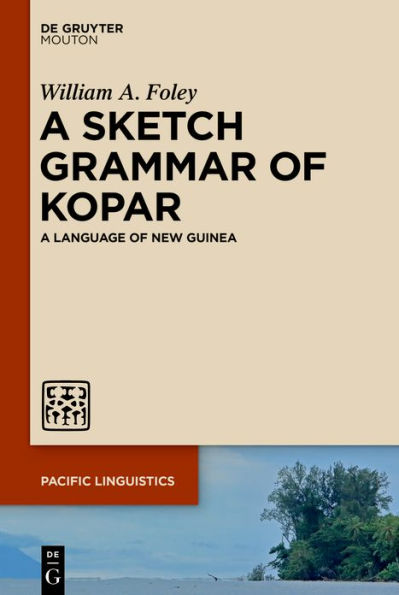
A Sketch Grammar of Kopar: Language New Guinea in Chattanooga, TN
Current price: $140.99
Barnes and Noble
A Sketch Grammar of Kopar: Language New Guinea in Chattanooga, TN
Current price: $140.99
Loading Inventory...
Size: Hardcover
Kopar is a very moribund, close to extinct, language spoken in three villages at the mouth of the Sepik River in Papua New Guinea. This is the only description of the language available. It also discusses areas where rapid language shift is affecting the structure of Kopar.
Although the period of fieldwork was necessarily short, this book provides as comprehensive a description as possible of the grammatical structure of this complex and fascinating language. It is quite thorough and detailed and goes well beyond what is normally considered a sketch grammar. It covers all the phenomena essential to description and comparison and gives clear, typologically sound definitions and explanations. The grammar is written with the research interests of language typologists and comparative grammarians foremost in mind.
Typologically, Kopar can be described as a split ergative, polysynthetic language. The language lacks nominal case marking so ergativity or lack thereof is signaled by verbal agreement affixes. Tenses and moods which describe as yet unrealized events, like future and imperative, pattern accusatively for agreement affixes, while those express realized events, like past and present, pattern ergatively. In addition, the ergative case schema is overlaid by a direct-inverse inflectional schema determined by a person hierarchy, a feature Kopar shares with other languages in its Lower Sepik family. As a polysynthetic language, incorporation of sentential elements like temporals, locationals, adverbials and verbals is extensive, though noun incorporation is not.
Sadly, this work is all the documentation we will likely ever have of Kopar, a language of potentially very high theoretical interest, given its rare typological profile. It will certainly be of interest to language typologists and comparative grammarians, and anyone who wants to explore the range of language variation
Although the period of fieldwork was necessarily short, this book provides as comprehensive a description as possible of the grammatical structure of this complex and fascinating language. It is quite thorough and detailed and goes well beyond what is normally considered a sketch grammar. It covers all the phenomena essential to description and comparison and gives clear, typologically sound definitions and explanations. The grammar is written with the research interests of language typologists and comparative grammarians foremost in mind.
Typologically, Kopar can be described as a split ergative, polysynthetic language. The language lacks nominal case marking so ergativity or lack thereof is signaled by verbal agreement affixes. Tenses and moods which describe as yet unrealized events, like future and imperative, pattern accusatively for agreement affixes, while those express realized events, like past and present, pattern ergatively. In addition, the ergative case schema is overlaid by a direct-inverse inflectional schema determined by a person hierarchy, a feature Kopar shares with other languages in its Lower Sepik family. As a polysynthetic language, incorporation of sentential elements like temporals, locationals, adverbials and verbals is extensive, though noun incorporation is not.
Sadly, this work is all the documentation we will likely ever have of Kopar, a language of potentially very high theoretical interest, given its rare typological profile. It will certainly be of interest to language typologists and comparative grammarians, and anyone who wants to explore the range of language variation
Kopar is a very moribund, close to extinct, language spoken in three villages at the mouth of the Sepik River in Papua New Guinea. This is the only description of the language available. It also discusses areas where rapid language shift is affecting the structure of Kopar.
Although the period of fieldwork was necessarily short, this book provides as comprehensive a description as possible of the grammatical structure of this complex and fascinating language. It is quite thorough and detailed and goes well beyond what is normally considered a sketch grammar. It covers all the phenomena essential to description and comparison and gives clear, typologically sound definitions and explanations. The grammar is written with the research interests of language typologists and comparative grammarians foremost in mind.
Typologically, Kopar can be described as a split ergative, polysynthetic language. The language lacks nominal case marking so ergativity or lack thereof is signaled by verbal agreement affixes. Tenses and moods which describe as yet unrealized events, like future and imperative, pattern accusatively for agreement affixes, while those express realized events, like past and present, pattern ergatively. In addition, the ergative case schema is overlaid by a direct-inverse inflectional schema determined by a person hierarchy, a feature Kopar shares with other languages in its Lower Sepik family. As a polysynthetic language, incorporation of sentential elements like temporals, locationals, adverbials and verbals is extensive, though noun incorporation is not.
Sadly, this work is all the documentation we will likely ever have of Kopar, a language of potentially very high theoretical interest, given its rare typological profile. It will certainly be of interest to language typologists and comparative grammarians, and anyone who wants to explore the range of language variation
Although the period of fieldwork was necessarily short, this book provides as comprehensive a description as possible of the grammatical structure of this complex and fascinating language. It is quite thorough and detailed and goes well beyond what is normally considered a sketch grammar. It covers all the phenomena essential to description and comparison and gives clear, typologically sound definitions and explanations. The grammar is written with the research interests of language typologists and comparative grammarians foremost in mind.
Typologically, Kopar can be described as a split ergative, polysynthetic language. The language lacks nominal case marking so ergativity or lack thereof is signaled by verbal agreement affixes. Tenses and moods which describe as yet unrealized events, like future and imperative, pattern accusatively for agreement affixes, while those express realized events, like past and present, pattern ergatively. In addition, the ergative case schema is overlaid by a direct-inverse inflectional schema determined by a person hierarchy, a feature Kopar shares with other languages in its Lower Sepik family. As a polysynthetic language, incorporation of sentential elements like temporals, locationals, adverbials and verbals is extensive, though noun incorporation is not.
Sadly, this work is all the documentation we will likely ever have of Kopar, a language of potentially very high theoretical interest, given its rare typological profile. It will certainly be of interest to language typologists and comparative grammarians, and anyone who wants to explore the range of language variation
You May Also Like











More About Barnes and Noble at Hamilton Place
Barnes & Noble is the world’s largest retail bookseller and a leading retailer of content, digital media and educational products. Our Nook Digital business offers a lineup of NOOK® tablets and e-Readers and an expansive collection of digital reading content through the NOOK Store®. Barnes & Noble’s mission is to operate the best omni-channel specialty retail business in America, helping both our customers and booksellers reach their aspirations, while being a credit to the communities we serve.
2100 Hamilton Pl Blvd, Chattanooga, TN 37421, United States
Find Barnes and Noble at Hamilton Place in Chattanooga, TN
Visit Barnes and Noble at Hamilton Place in Chattanooga, TN
