
Home
A Bourdieusian Analysis of Chinese Transnational Higher Education Policy Enactment: Habitus
Barnes and Noble
Loading Inventory...
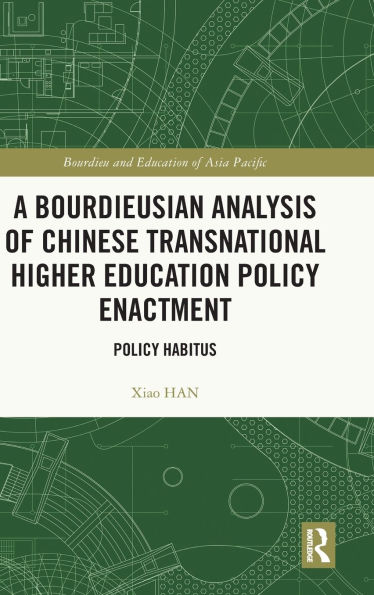
A Bourdieusian Analysis of Chinese Transnational Higher Education Policy Enactment: Habitus in Chattanooga, TN
Current price: $190.00
Barnes and Noble
A Bourdieusian Analysis of Chinese Transnational Higher Education Policy Enactment: Habitus in Chattanooga, TN
Current price: $190.00
Loading Inventory...
Size: Hardcover
This book provides an empirical examination of the meso-level policy enactment of transnational higher education in the context of China.
China’s national policies have not been mechanically implemented at the sub-national level: the strategic enactment is always accompanied by great creativity, innovation, and/or even resistance. From the prism of Bourdieu’s relational sociology, this study moves away from the traditional centralization-decentralization model, or policy experiment hypothesis, to examine how Chinese local officials’ practices are simultaneously full of “invention and improvisation” and confined “within the constraints and limits initially set on its inventions”. By so doing, the book extends the application of Bourdieu’s thinking tools to the arena of critical policy analysis through the establishment of the internal structure to separate habitus and the practice it generated, thereby refuting any determinism or objectivism criticism to Bourdieu’s most contested concept habitus.
This book will be of great interest to Bourdieusian scholars with particular interests in higher education and sociologists of education more broadly.
China’s national policies have not been mechanically implemented at the sub-national level: the strategic enactment is always accompanied by great creativity, innovation, and/or even resistance. From the prism of Bourdieu’s relational sociology, this study moves away from the traditional centralization-decentralization model, or policy experiment hypothesis, to examine how Chinese local officials’ practices are simultaneously full of “invention and improvisation” and confined “within the constraints and limits initially set on its inventions”. By so doing, the book extends the application of Bourdieu’s thinking tools to the arena of critical policy analysis through the establishment of the internal structure to separate habitus and the practice it generated, thereby refuting any determinism or objectivism criticism to Bourdieu’s most contested concept habitus.
This book will be of great interest to Bourdieusian scholars with particular interests in higher education and sociologists of education more broadly.
This book provides an empirical examination of the meso-level policy enactment of transnational higher education in the context of China.
China’s national policies have not been mechanically implemented at the sub-national level: the strategic enactment is always accompanied by great creativity, innovation, and/or even resistance. From the prism of Bourdieu’s relational sociology, this study moves away from the traditional centralization-decentralization model, or policy experiment hypothesis, to examine how Chinese local officials’ practices are simultaneously full of “invention and improvisation” and confined “within the constraints and limits initially set on its inventions”. By so doing, the book extends the application of Bourdieu’s thinking tools to the arena of critical policy analysis through the establishment of the internal structure to separate habitus and the practice it generated, thereby refuting any determinism or objectivism criticism to Bourdieu’s most contested concept habitus.
This book will be of great interest to Bourdieusian scholars with particular interests in higher education and sociologists of education more broadly.
China’s national policies have not been mechanically implemented at the sub-national level: the strategic enactment is always accompanied by great creativity, innovation, and/or even resistance. From the prism of Bourdieu’s relational sociology, this study moves away from the traditional centralization-decentralization model, or policy experiment hypothesis, to examine how Chinese local officials’ practices are simultaneously full of “invention and improvisation” and confined “within the constraints and limits initially set on its inventions”. By so doing, the book extends the application of Bourdieu’s thinking tools to the arena of critical policy analysis through the establishment of the internal structure to separate habitus and the practice it generated, thereby refuting any determinism or objectivism criticism to Bourdieu’s most contested concept habitus.
This book will be of great interest to Bourdieusian scholars with particular interests in higher education and sociologists of education more broadly.
You May Also Like
















More About Barnes and Noble at Hamilton Place
Barnes & Noble is the world’s largest retail bookseller and a leading retailer of content, digital media and educational products. Our Nook Digital business offers a lineup of NOOK® tablets and e-Readers and an expansive collection of digital reading content through the NOOK Store®. Barnes & Noble’s mission is to operate the best omni-channel specialty retail business in America, helping both our customers and booksellers reach their aspirations, while being a credit to the communities we serve.
2100 Hamilton Pl Blvd, Chattanooga, TN 37421, United States
Find Barnes and Noble at Hamilton Place in Chattanooga, TN
Visit Barnes and Noble at Hamilton Place in Chattanooga, TN
